
Blowout Taper Haircut 2026: 20 Styles, Barber Scripts and the Honest Guide to Getting It Right
The blowout taper has 50 million TikTok views. It is the most requested haircut in barbershops across the US since January 2026. Every transformation video on your feed, every before-and-after on Instagram, every “what should I get” thread on Reddit — the blowout taper keeps appearing.
Are you guys tired of blowout tapers or what? Reddit asked this last spring. The thread got hundreds of replies. Half said yes. The other half were in the comments asking which version they should get.
That is the cut in a nutshell. Overexposed enough that people are tired of talking about it. Popular enough that barbershops cannot keep up with requests. And genuinely good enough that even people who roll their eyes at the TikTok version walk in and ask for it.
This guide covers twenty blowout taper styles for 2026. Every style comes with an exact barber script, guard numbers, a face-shape match, and an honest answer to the question nobody else will give you: what does it actually look like if you skip the blow dryer?
At a Glance — Quick Picks
| Need | Best Blowout Taper Version |
|---|---|
| First time getting it | Low blowout taper, softest version |
| Most requested 2026 | Mid blowout taper |
| Wavy hair is the easiest result | Low blowout with natural waves |
| Curly hair, no blow dryer | Afro blowout taper with diffuser |
| Straight hair maximum effort | Mid blowout with thickening spray |
| School-safe | Low or mid blowout, no design |
| Bold weekend look | High blowout taper |
| Long hair on top | Blowout taper long hair version |
What Is a Blowout Taper Haircut?
A blowout taper combines two elements. The taper fades the sides and neckline gradually shorter at the bottom, blending upwards. The blowout creates volume and lift on the crown and top of the sides, producing a rounded, full silhouette that sits higher than a standard fade cut.
The defining characteristic is the weight kept at the top of the sides and back. Unlike a standard fade that removes all volume evenly, the blowout taper leaves bulk in the upper section of the sides and crown, then blow-dries it upward to create the rounded, lifted shape visible in every reference photo.
Blowout Taper vs Blowout Fade The Actual Difference
Is a blowout fade and taper the same thing? Most people use these terms interchangeably. Most barbers hear them differently. The distinction changes the result.
| Blowout Taper | Blowout Fade | |
|---|---|---|
| Side treatment | Gradual blend | Can go to skin |
| Contrast level | Subtle to moderate | Moderate to sharp |
| How long it lasts | 4-6 weeks | 3-4 weeks |
| Grow-out | Gradual, clean | A hard line appears |
| Best for | Most settings | Bold, casual |
A taper blends gradually without necessarily reaching bare skin. A fade cuts shorter and can go all the way to skin, creating sharper contrast. On a blowout, the taper version is more conservative and suits more environments. The fade version is bolder and needs more frequent maintenance.
What You Get With a Blow Dryer vs Without One
This is the honest section no competitor publishes. Every guide tells you to use a blow dryer. Nobody tells you what happens if you do not.
Without a blow dryer:
In straight hair, the top lies relatively flat. You get a clean taper with some natural texture but minimal volume. Looks like a good haircut. Does not look like the TikTok video.
Wavy hair’s natural wave creates some lift. Decent result without heat. Recognizable as the style but less dramatic.
Curly hair curls retain their own volume. A diffuser is recommended but not mandatory. This version actually works without a blow dryer because the curl pattern does the structural work.
With a blow dryer:
Every hair type gets the full blowout shape. Crown lifts. Sides round outward. The silhouette from the reference photos becomes achievable. Five to eight minutes of active styling. This is the version with 50 million views.
The honest summary: the blow dryer is not optional for straight or fine hair if you want the actual blowout result. For wavy and curly hair, it amplifies what is already there rather than creating it from scratch.
The Three Elements That Define It
Every blowout taper has three consistent elements regardless of which variation you choose. First, a taper on the sides, low, mid, or high depending on how bold you want the contrast. Second, weight was kept at the upper section of the sides and back rather than cutting it all even. Third, the crown and upper sides are blown upward and outward to create the rounded volume silhouette.
Remove any of these three and you have a different haircut.
20 Blowout Taper Styles for 2026
Classic Mid-Blowout Taper
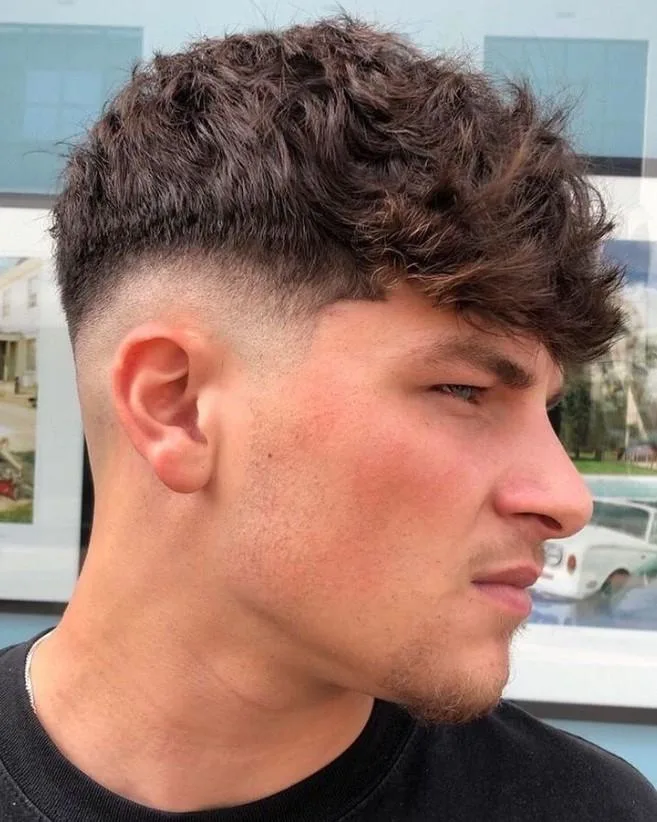
The most requested version. Mid taper on the sides starting at ear level, volume built throughout the crown and upper sides, and a rounded shape that looks intentional from every angle. This is the standard when someone says “blowout taper” without specifying further.
A mid-blowout taper is the balanced version, not as subtle as a low, and not as aggressive as a high. It suits every face shape and works in most settings from school to office to weekend without changing anything.
Tell your barber: “Mid-blowout taper. Keep weight at the top of the sides and back. I want the blowout shape when styled. Mid taper starting at the ear. Keep [X] inches on top. Standard version.”
Face shape: All — genuinely universal.
Hair type: All best results on wavy and thick.
School safe: Yes, in most settings.
Guard numbers: 1.5-2 at the tightest, blending to 3-4 at the top of the fade zone.
Maintenance: Every 4-5 weeks.
Blow dryer: Essential for straight hair. Optional for wavy hair. Diffuser for curls.
Style time: 5-8 minutes with a dryer. 2 minutes without.
Low Taper Blowout
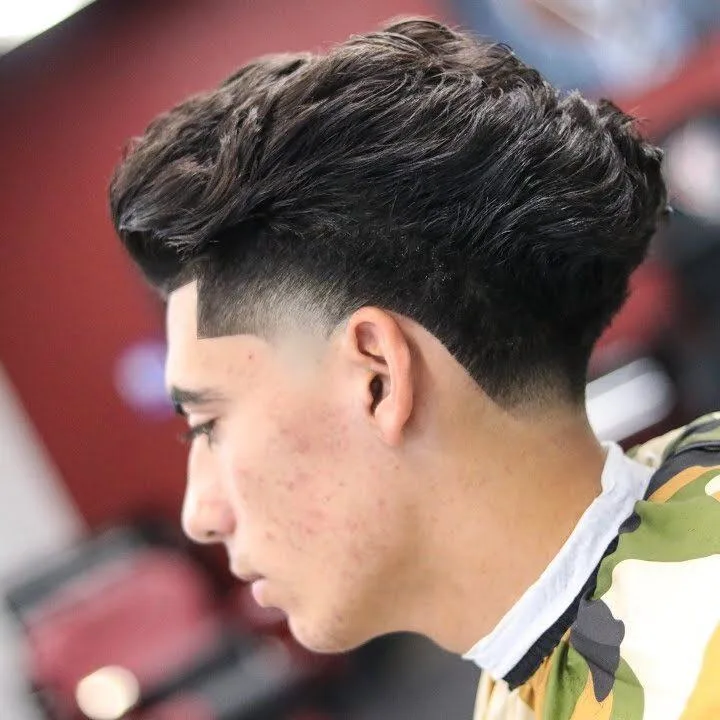
This version is 90 percent “I just woke up like this” and 10 percent “I just left the barbershop.” The low taper keeps everything subtle — the fade starts just above the ear and blends very gradually. The blowout volume on top is the only thing that signals this is a deliberate style choice.
A low blowout taper is the correct starting point for first-timers. The conservative fade means any small imperfection in the blend is invisible. It also lasts longer between trims than mid- or high versions because the contrast is gentle from the start; no hard line appears suddenly at week three.
Tell your barber: “Low taper blowout. Start the taper just above the ear; keep it subtle. Leave weight at the top of the sides for the blowout shape. Number 2 at the lowest, blending to 4. Keep it conservative.”
Face shape: All.
School safe: Yes, universally.
Guard numbers: 2 at tightest, blending to 4.
Maintenance: Every 5-6 weeks.
Blow dryer: Recommended but optional for wavy hair.
Blowout Taper Straight Hair
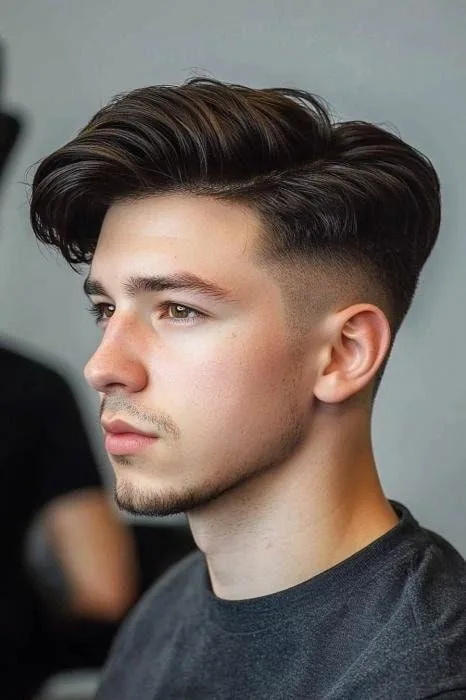
Straight hair is the most searched variation of the blowout taper and the most effort-intensive. Straight strands have no natural volume and no curl pattern to retain shape. Every bit of lift in the blowout shape comes from the blow dryer and the thickening product applied before it.
The result, when done correctly, is worth the effort. Straight hair produces the cleanest, sharpest blowout silhouette because the strands align uniformly rather than forming a textured mass. The shape is precise and looks intentional even from a distance.
Tell your barber: “Blowout taper fade, straight hair. Keep at least three inches on top — I need length for the blowout shape. Mid-taper. Point-cut the top for texture. Cut the top dry so we can see where it sits.”
Face shape: Oval and oblong; the vertical shape of the blowout balances both.
Hair type: Straight, specific version.
School safe: Yes.
Guard numbers: 1.5-2 at tightest, blending to 3.
Maintenance: Every 4-5 weeks.
Blow dryer: Essential; without it the top lies flat.
Products needed: thickening spray before blow-drying and matte clay after.
Style time: 7-10 minutes.
For twenty cuts specifically designed for straight hair, our boys’ haircuts for straight hair guide covers the full range.
Blowout Taper Wavy Hair
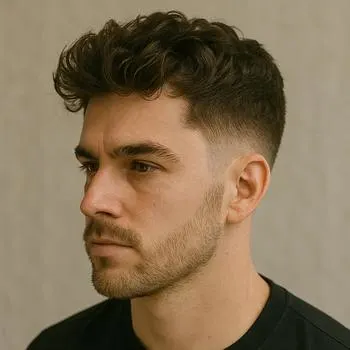
Wavy hair is the easiest canvas for a blowout taper. The natural wave creates lift and texture without requiring the full blow-dry effort that straight hair needs. The blowout shape happens more organically; the diffuser amplifies what is already there rather than creating volume from nothing.
Tell your barber: “Blowout taper for wavy hair. Keep three inches on top. Low to mid taper on the sides. Leave weight at the upper sides for the blowout shape. I want the natural wave to add volume.”
Face shape: Round and oval.
Maintenance: Every 4-5 weeks.
Blow dryer: Optional — diffuser on damp hair produces an excellent natural result.
Style time: 3-5 minutes with diffuser. Under 2 minutes air dry.
Blowout Taper Curly Hair
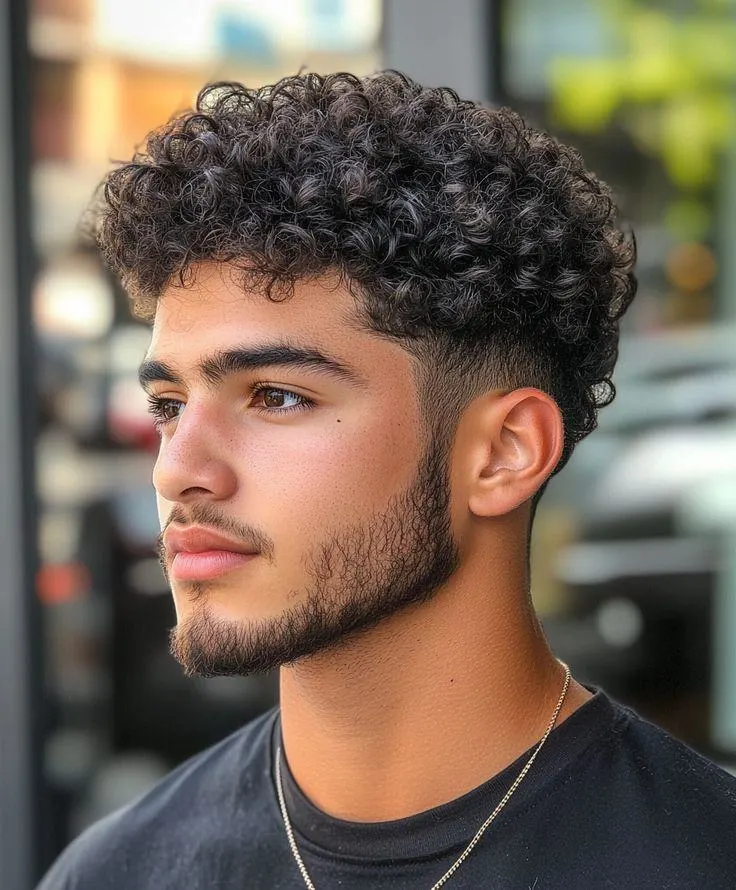
Curly hair produces the most effortless version of the blowout taper. Tight curls and waves retain their own volume without any heat styling. The taper cleans up the sides, the curls on top create the rounded blowout shape naturally, and the result maintains itself longer than any straight or wavy version.
The critical rule for curly blowout tapers: always ask the barber to cut the top section dry. Curly hair shrinks between thirty and fifty percent when dry. A barber who cuts it wet is cutting at least one inch shorter than requested.
Tell your barber: “Blowout taper for curly hair. Mid-taper on the sides. Keep at least two and a half to three inches on top; please cut the top dry so we can see the curl pattern before taking more off. Shape the outline clean.”
Face shape: Oval and round.
Blow dryer: Not required — diffuser optional for definition.
Style time: Apply curl cream to damp hair, scrunch, and air dry.
Maintenance: Every 3-4 weeks.
For the complete curly hair guide, our curly hairstyles for men page covers type 2A through 4C.
Blowout Afro Taper Fade
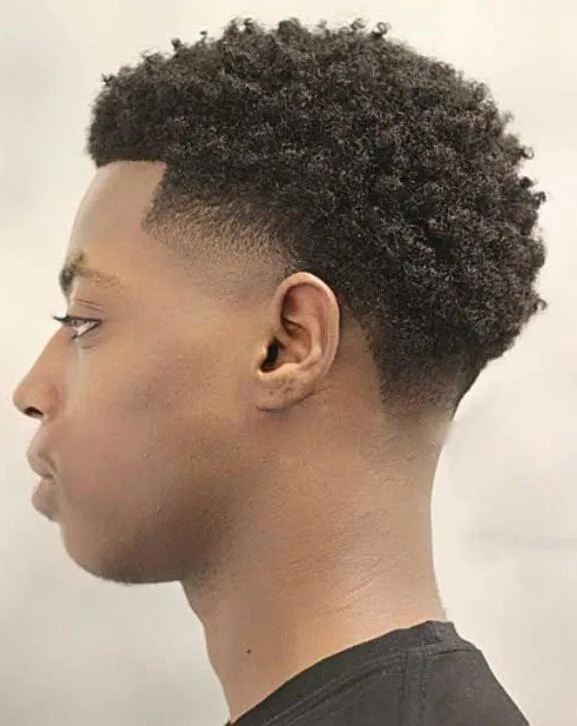
The afro blowout taper with a taper fade is one of the most popular versions on this list. Tightly curled type 4 hair retains volume so well that the blowout shape forms with minimal product and no heat styling. The taper and clean lineup at the hairline sharpen the shape and turn a natural afro into a structured style.
Tell your barber: “Blowout afro taper fade. Mid-taper on the sides. Leave two to three inches on top; I want the afro shape and height. Clean shape-up at the forehead and temples. Number 1 at the lowest.”
Face shape: All — the vertical height suits most proportions.
Blow dryer: No pick is used to lift the afro shape.
Style time: 2-3 minutes with an afro pick and curl sponge.
Maintenance: Every 3-4 weeks.
For the curved fade that suits afro textures particularly well, our burst fade guide covers the rounded fade technique.
Asian Blowout Taper
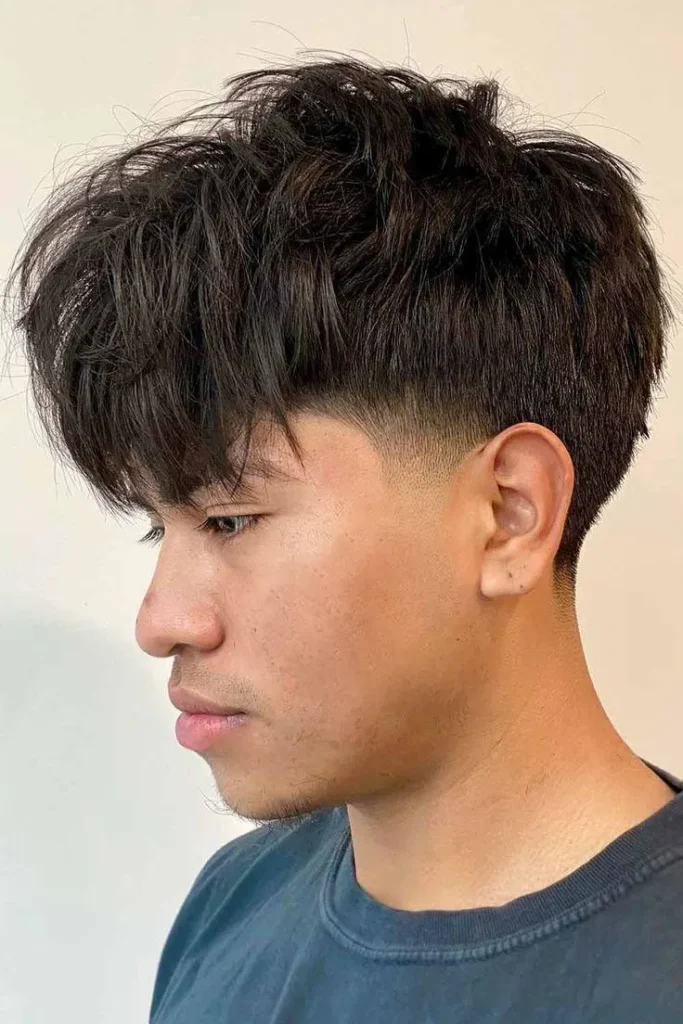
Thick, straight Asian hair produces a specific version of the blowout taper: heavy crown volume with naturally strong shape retention once the blow dryer has done its work. The weight of the hair holds the blowout shape longer than fine or thin hair.
Tell your barber: “Blowout taper for thick, straight hair. Mid-taper. Keep three inches on top. I want maximum volume at the crown when blow-dried. Point-cut the top for texture; do not leave it blunt.”
Hair type: Thick and straight works with the natural weight.
Style time: 5-7 minutes blow dry. Round brush recommended.
Maintenance: Every 4-5 weeks.
High Blowout Taper
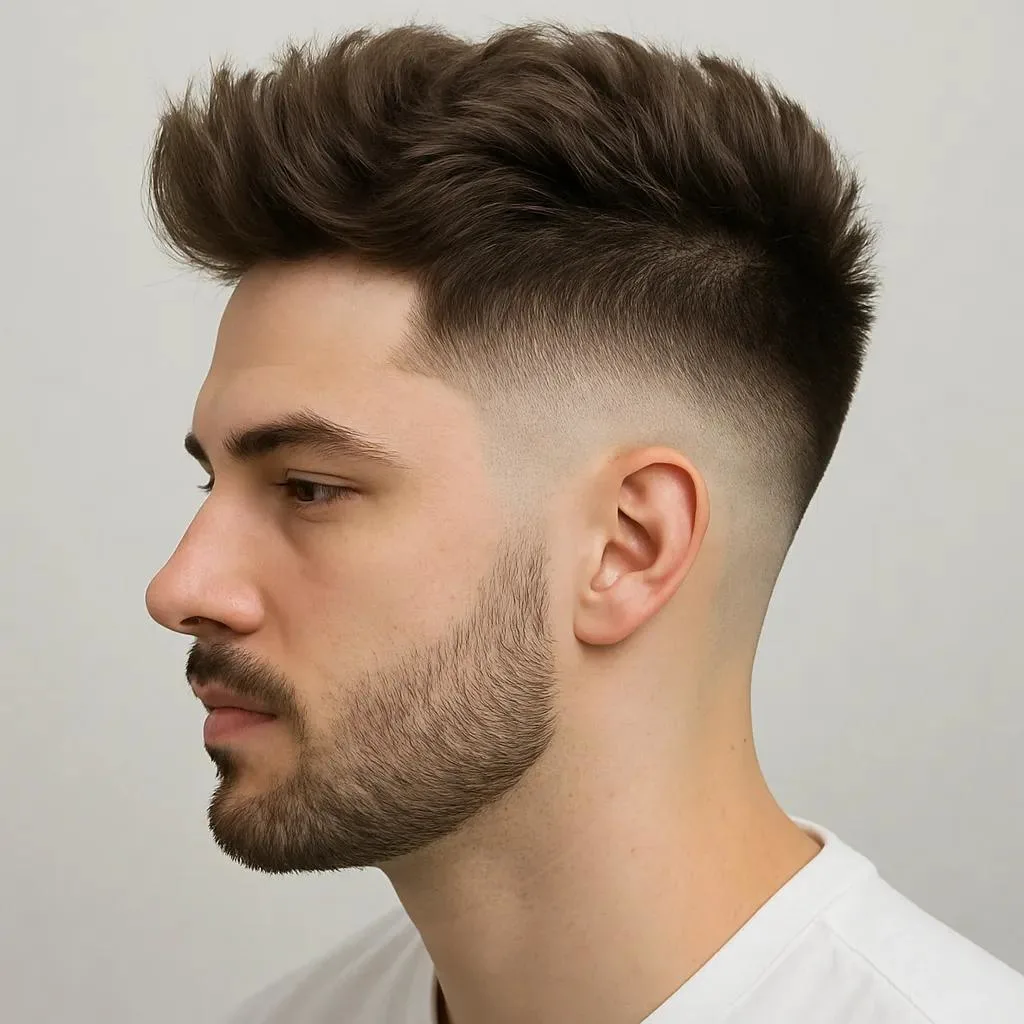
The most dramatic version. The taper starts well above the ear and creates sharp contrast between the very short sides and the full volume on top. This is the bold version — the one that reads as a style statement rather than a subtle upgrade.
High blowout tapers need more frequent maintenance than low or mid versions because the hard contrast line at the top of the fade becomes visible quickly as the sides grow. Every two to three weeks rather than four to five.
Tell your barber: “High blowout taper. Start the taper well above the ear; I want aggressive contrast. Number 1 at the tightest, blend to 3. Keep full weight at the crown.”
School safe: Check some schools’ flags, high skin tapers.
Maintenance: Every 2-3 weeks.
Setting: Casual and weekend primarily.
Blowout Taper with Textured Fringe
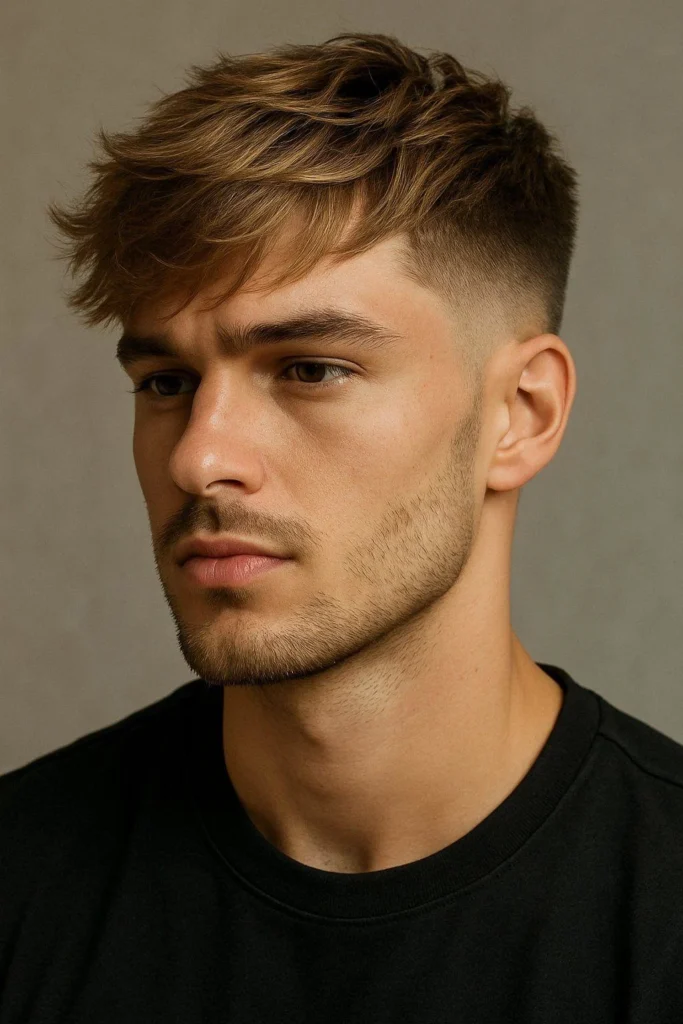
Mid-high taper burst fade fringe blowout: the Reddit title that tried to describe this combination in one phrase. The textured fringe falling forward combined with the blowout volume behind it creates a style that covers two 2026 trends simultaneously.
Tell your barber: “Blowout taper with a textured fringe. Keep the fringe long enough to fall across the forehead about two and a half inches. Point-cut the fringe choppily. Mid taper on the sides with blowout weight on top.”
Face shape: Oblong, heart, and large foreheads.
Maintenance: Every 5 weeks.
For the full textured fringe guide, our textured fringe haircut page covers every variation with barber scripts.
Messy Blowout Taper
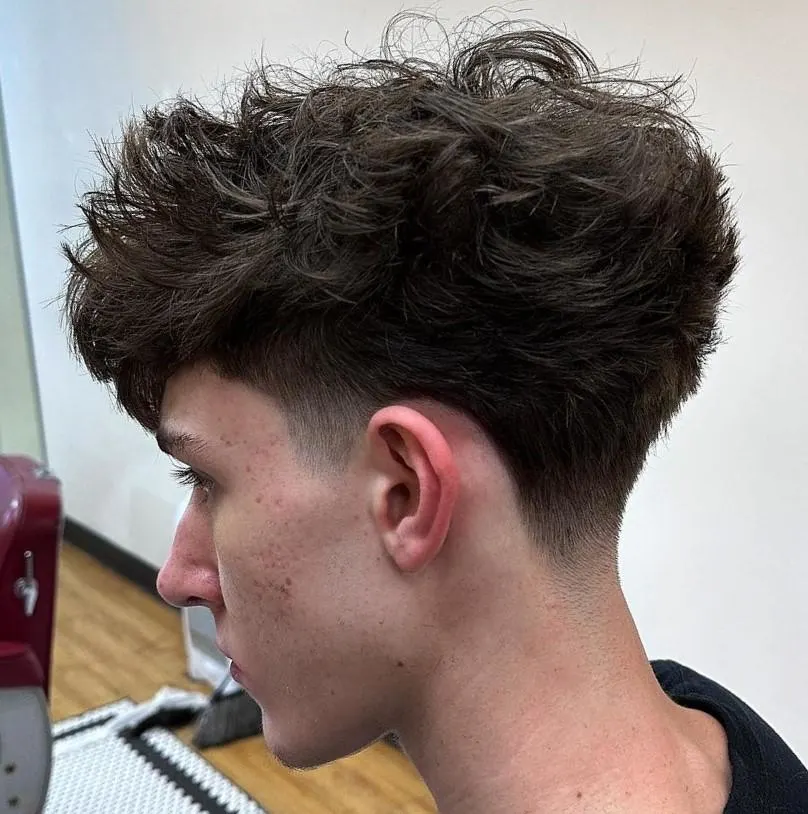
The undone version. Volume is there, but the top is not styled back or smoothed; it is pushed forward and left intentionally imperfect. The contrast between the clean taper and the deliberately messy top creates the “effortless” effect that takes longer to achieve than it looks.
Tell your barber: “Blowout taper. Keep the top at three inches. I want a messy finish rather than a slicked-back look, point-cut heavily for texture. Mid taper.”
Style time: Under 2 minutes damp fingers pushed forward through the top.
School safe: Yes.
Blowout Taper Long Hair
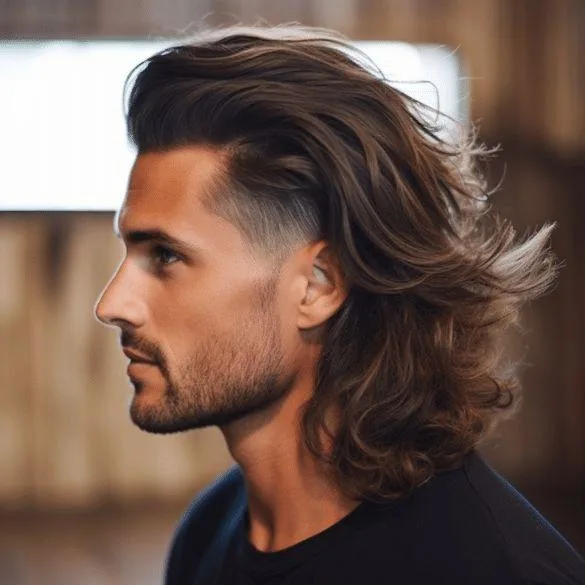
Longer top length combined with a blowout taper creates a hybrid that sits between a standard blowout taper and a bro flow. The sides are tapered cleanly while the top has enough length to move and flow naturally, with the blow-dried volume adding lift at the crown.
Tell your barber: “Blowout taper, longer top. Keep four to five inches on top — enough for movement and flow. Low taper on the sides. Do not cut the top shorter.”
Maintenance: Sides every 4-5 weeks. Top every 8-10 weeks.
For the full long-on-top guide, our boys’ haircuts long-on-top page covers the grow-out phase and split appointment strategy.
Blowout Taper with Design
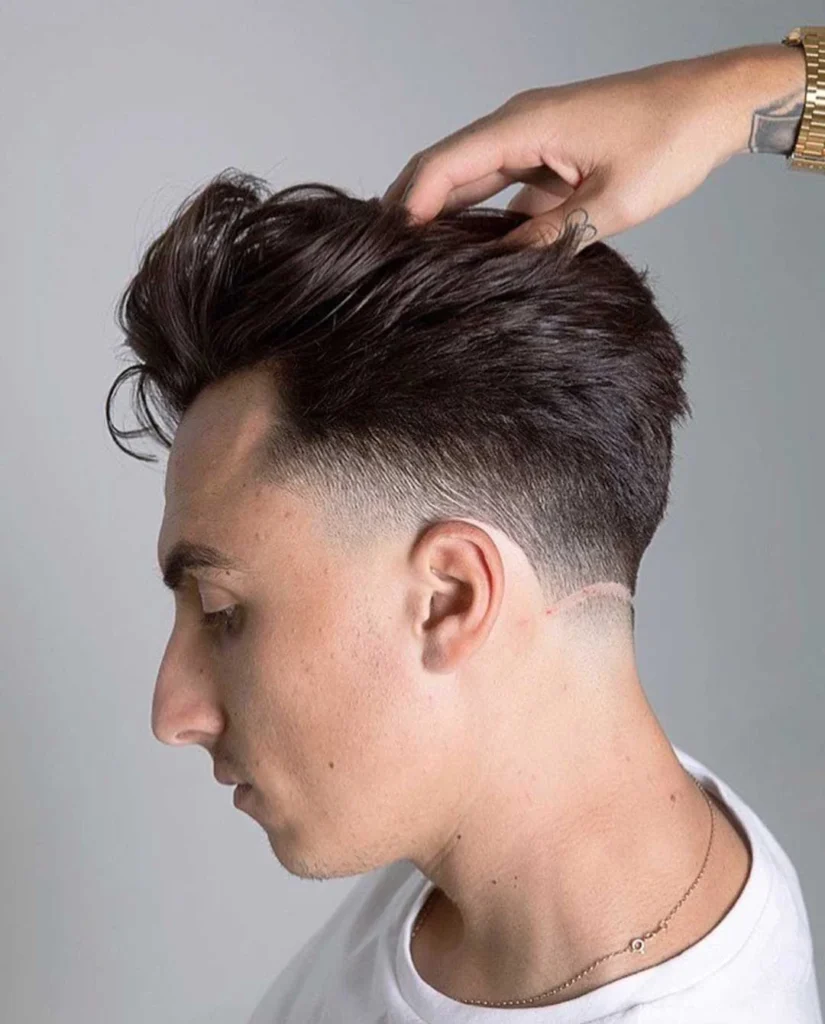
Shaved designs or graphics added into the taper section. The blowout provides the volume above while the design adds a personalized element below. The most common versions are a shaved line at the temple or a geometric pattern near the neckline.
School safe rating: Caution — shaved designs are the specific element that school dress codes flag most often. The blowout itself is fine. The design added to it may not be.
Tell your barber: “Blowout taper with a line design at the temple. I want [describe the specific design], a mid taper with a clean line added.”
Blowout Taper Edgar Cut
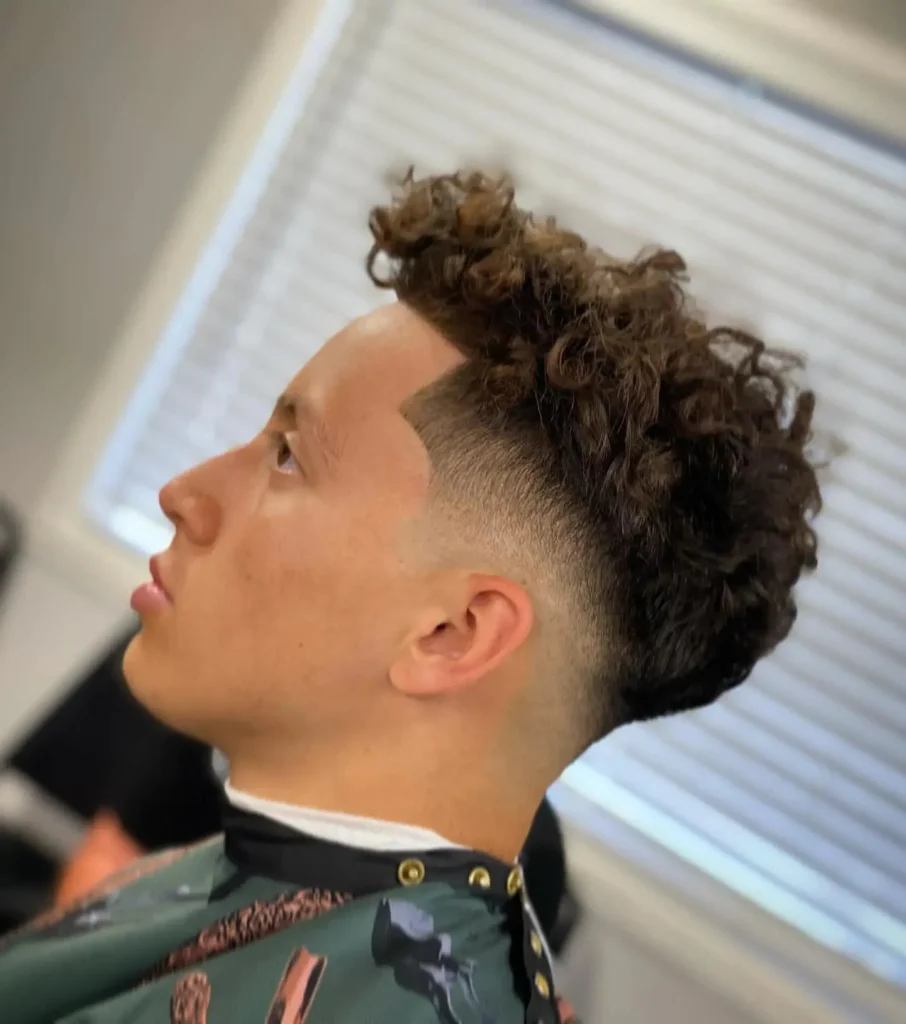
The Edgar cut blunt straight fringe combined with a high skin fade updated with a blowout taper. The blunt fringe sits across the forehead while the blowout volume pushes upward behind it.
Tell your barber: “Edgar, blowout taper.” Straight blunt fringe. High skin fade. Blowout volume behind the fringe.”
Face shape: Square and oval — the straight fringe suits angular features.
Hair type: Thick straight hair holds the blunt line best.
School safe: Check high skin fade may conflict with conservative policies.
For the full Edgar guide, our Edgar haircut page covers every variation.
Blowout Taper Perm
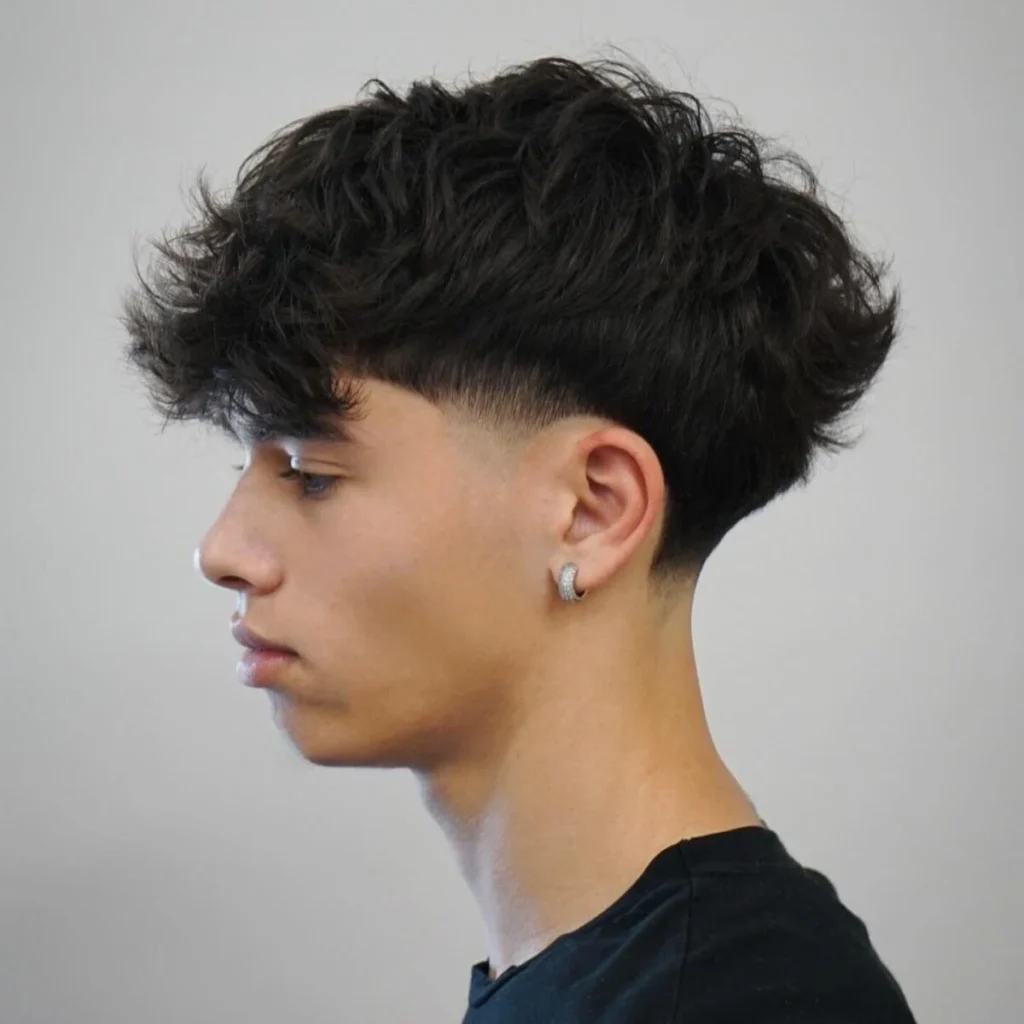
A perm on top creates artificial curl structure that holds the blowout shape without daily blow-drying. The permanent wave gives straight or fine hair the natural volume that curly hair has by default. Combined with a taper, the result is one of the most low-maintenance versions of the blowout taper after the initial perm settles.
Tell your barber: “Blowout taper for permed hair. Please cut the top dry and shorter than you think permed hair springs back significantly when dry. Mid-taper. Leave two and a half inches dry.”
The critical instruction: Tell the barber about the perm before he starts. Permed hair behaves like curly hair and shrinks substantially when dry.
Blowout Taper Mullet
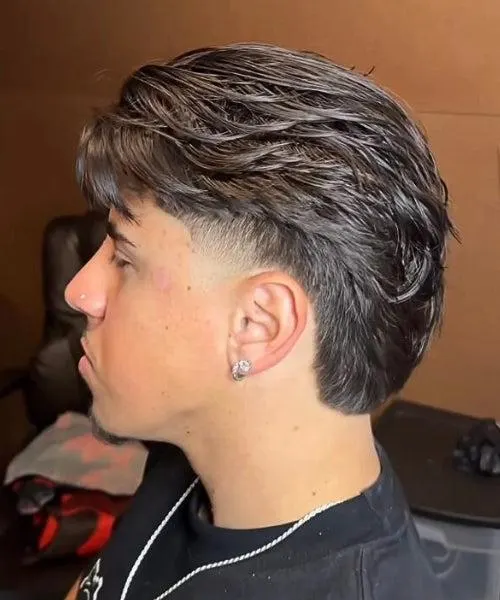
The modern mullet with a blowout taper on the sides. Volume at the front and crown from the blowout, longer sections at the back from the mullet structure. The two trends combine into one cut that covers multiple style directions simultaneously.
Tell your barber: “Modern mullet, blowout, taper. Mid-taper on the sides. Blowout volume at the crown. Keep the back at collar length clean mullet lines.”
School safety: Check the back length occasionally gets flagged.
Blowout Drop Fade
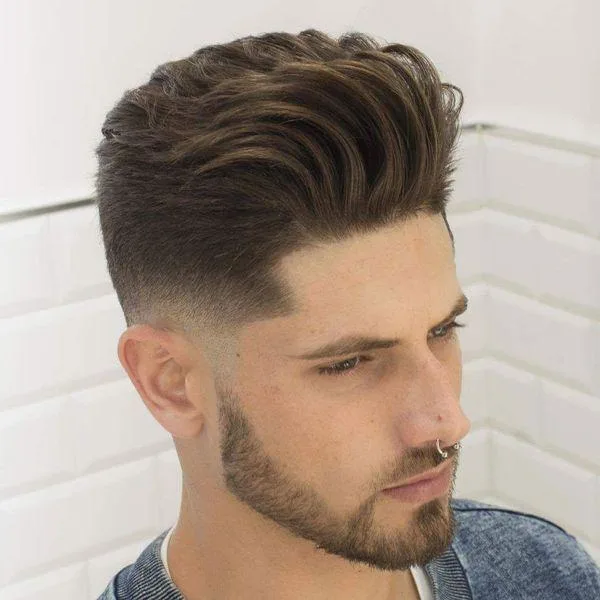
The drop fade follows a curved line behind the ear rather than a straight horizontal line. Combined with a blowout, the curved fade line creates a more relaxed, organic silhouette than the standard straight taper.
Tell your barber: “Blowout taper with a drop. The fade line should curve down behind the ear. Blowout volume on top. Mid-level overall.”
For the full drop fade guide, our drop fade haircut page covers the curved technique in detail.
Blowout Taper for Boys and Teens
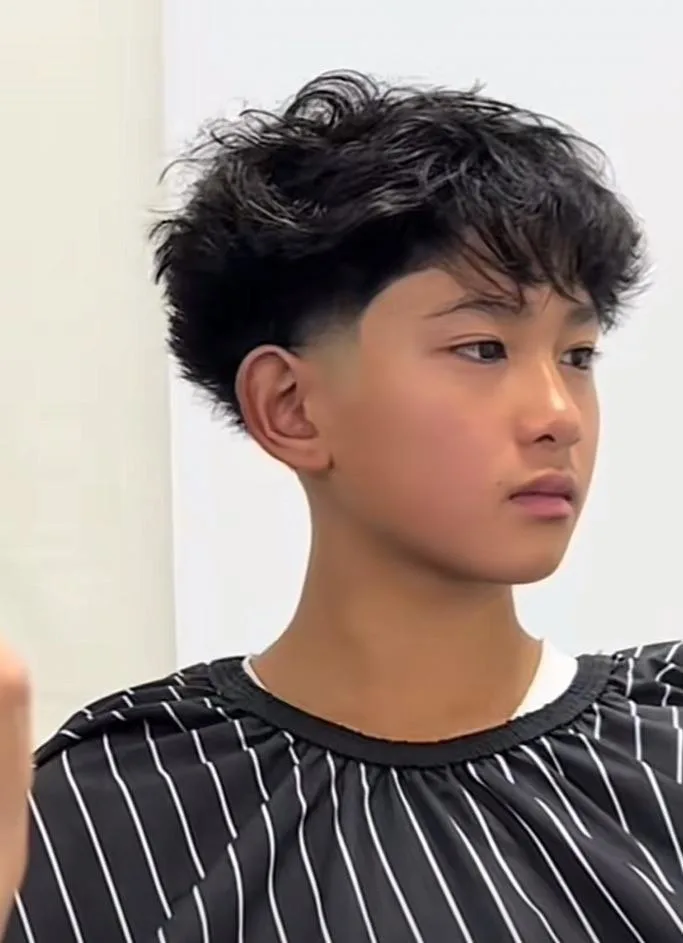
The blowout taper is the most requested cut for boys aged thirteen to eighteen in 2026. The TikTok exposure means most teens have a specific reference already; they walk in with the phone, they know the name, and they know what they want.
For younger boys the main considerations are school safety and maintenance reality. The mid or low blowout taper is the correct version for school environments. The high version with aggressive contrast occasionally gets flagged by conservative dress codes.
For boys who will not use a blow dryer every morning, and most thirteen-year-olds will not, the wavy hair version or the messy blowout taper are the honest recommendations. Both work without daily heat styling.
Tell your barber (for teens): “Blowout taper for a [age]-year-old. Mid-taper. Keep three inches on top for the blowout shape. School-appropriate: no skin at the sides.”
For the full teen guide, our teen boy haircuts page covers twenty-five styles with school safety ratings. For younger boys, our boys’ haircuts hub covers every age from seven to twelve.
Low Blowout Taper Fade
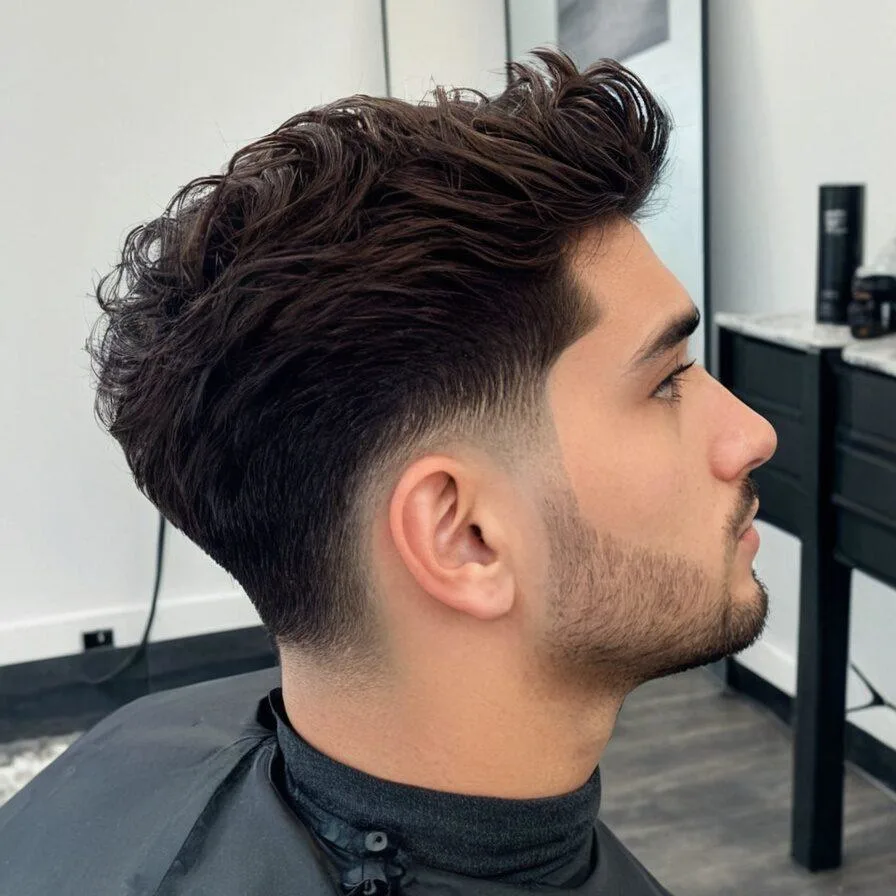
The conservative version has a low fade starting above the ear, blowout volume on top, and no skin visible at any point. This is the version for office environments, conservative dress codes, and anyone who wants the blowout shape without aggressive contrast.
Tell your barber: “Low blowout taper fade. Number 2 at the lowest, no skin. Gradual blend. Blowout weight on top. Conservative and office appropriate.”
Maintenance: Every 5-6 weeks is the longest-lasting version.
Setting: Office, school, and formal events are universally safe.
Blowout Taper Slickback
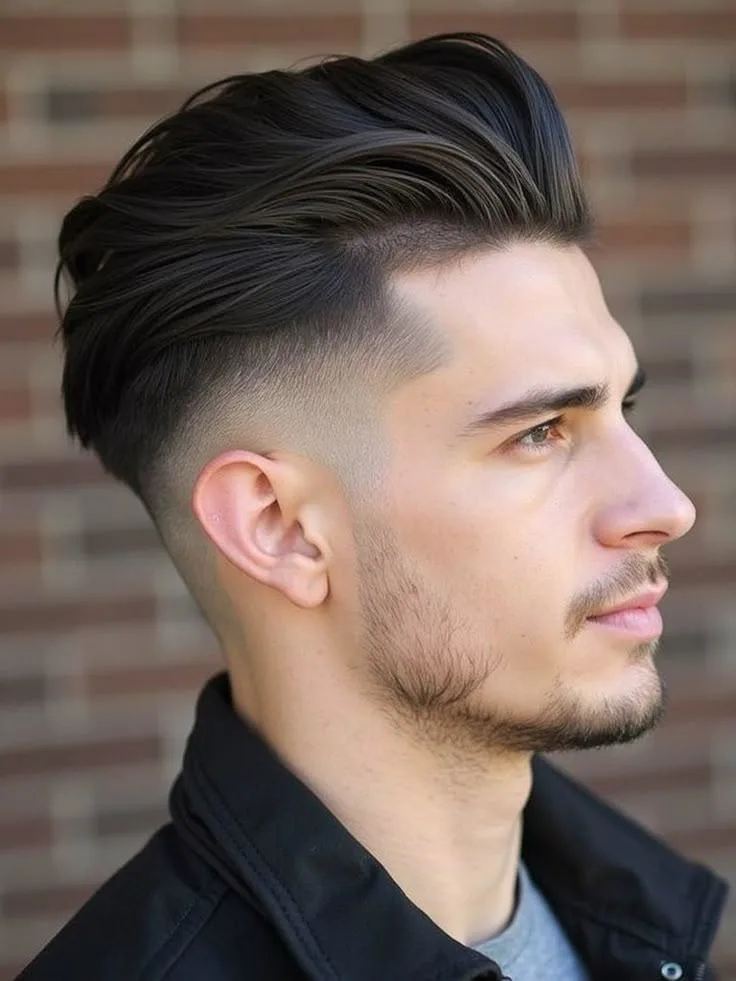
Longer top blown upward at the crown then swept straight back is the slick-back variant of the blowout taper. The volume is there but directed backward rather than rounded outward.
Tell your barber: “Blowout taper, slicked back. Keep four inches on top. Mid-taper. I want to style it back rather than rounded forward.”
Products: Pomade for hold in the slick-back direction. Medium shine.
Style time: 5-7 minutes — round brush plus blow dryer.
Blowout Taper French Crop
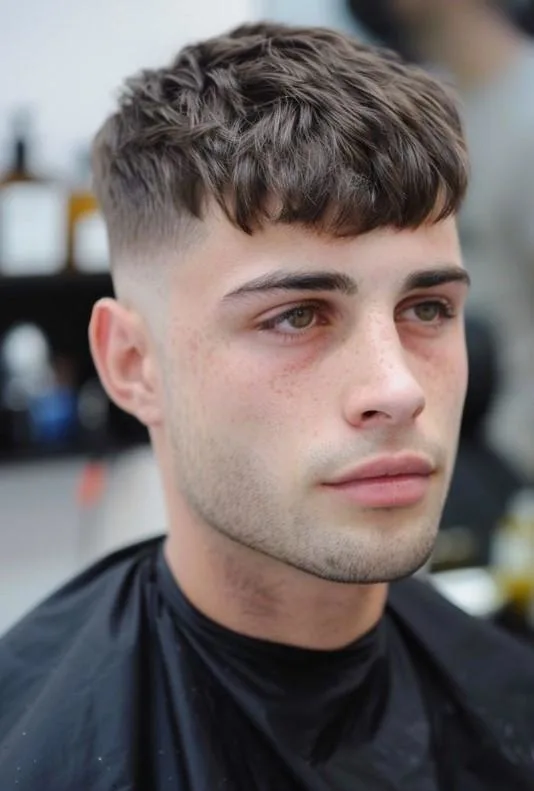
French crop fringe combined with blowout volume behind it. The blunt fringe falls forward while the crown area is lifted and rounded from the blowout. A style that suits wide foreheads because the fringe covers while the volume adds height rather than width.
Tell your barber: “French crop, blowout, taper. A blunt, choppy fringe at the mid-forehead. Mid-taper. Blowout volume at the crown behind the fringe.”
Face shape: Oblong, heart, and large foreheads.
Products: Texture clay for fringe definition and mousse before blow drying for crown volume.
Blowout Taper by Hair Type: Which Version Suits You
| Hair Type | Best Version | Blow Dryer | Natural Volume | Style Time |
|---|---|---|---|---|
| Straight | Mid blowout | Essential | Very low | 7-10 min |
| Wavy | Low blowout | Optional | Medium | 3-5 min |
| Curly | Afro blowout | No diffuser | High | 2-3 min |
| Thick | Mid/high blowout | Yes | High | 5-7 min |
| Fine/Thin | Low blowout | Essential | Very low | 7-10 min |
Straight Hair Blowout Taper
Straight hair is the most effort-intensive version. No natural volume means every bit of lift comes from the blow dryer and the thickening product applied before it. The result is worth the effort — straight hair produces the cleanest blowout silhouette because the strands align uniformly.
If you get a buzz cut, will it come out like a blowout? No. A buzz cut removes the length that creates the blowout shape. You need at least three inches on top for the volume to form. The buzz cut is the opposite direction entirely: minimum length, zero volume on top.
For twenty cuts specifically designed for straight-haired boys, our boys’ haircuts for straight hair guide covers every variation.
Wavy Hair Blowout Taper
Wavy hair is the natural sweet spot for a blowout taper. The wave adds dimension and movement to the volume on top without requiring the full blow-dry effort. A diffuser on damp hair produces a result that looks like significant effort was applied without any.
Curly Hair Blowout Taper
The easiest blowout taper to maintain. Curly hair retains its own volume without heat styling. The curl pattern creates the rounded, full shape that straight hair needs a blow dryer to achieve. Ask for the top to be cut dry. Curls shrink significantly when dry, and a barber cutting wet will take off more than intended.
Thick Hair Blowout Taper
Thick hair holds the blowout shape the longest of any type. The natural weight at the crown creates the rounded silhouette even without maximum blow-dry effort. A diffuser on damp thick hair often produces the full blowout shape without additional product.
Fine Hair Blowout Taper
Fine hair needs thickening spray applied to damp roots before blow-drying. The spray adds temporary texture and grip that helps the fine strands hold their lifted position after the dryer is off. Without it, fine hair settles flat within an hour regardless of how well it was blow-dried.
Blowout Taper by Face Shape
What face shape suits a taper fade? For the blowout taper specifically, the vertical volume at the crown changes the face shape equation differently than a standard taper.
Round face: The blowout taper is ideal; the crown volume adds vertical height that slims round proportions. A mid or high blowout taper with volume concentrated at the top works best. Avoid spreading the volume wide at the sides, which adds width.
Oval face: The most flexible face shape. All blowout levels work. The mid blowout is the strongest match for oval proportions.
Square face: A low or mid blowout with softer volume is the correct choice. The blowout adds height without emphasizing the angular jaw. Avoid the high blow-out with aggressive contrast that can make a square jaw look harsher.
Oblong face: The blowout taper needs width rather than height here. A low blowout that spreads the volume outward rather than upward suits oblong faces better than a tall, high blowout.
Diamond face: A mid blowout that adds some vertical height while keeping volume controlled suits diamond proportions. The blowout volume draws attention upward, which balances a strong cheekbone.
Low vs. Mid vs. High Blowout Taper: Which Is Right for You?
Which taper is better? The honest answer is the one that matches your lifestyle, hair type, and how often you want to visit the barbershop.
| Low Blowout | Mid-blowout | High Blowout | |
|---|---|---|---|
| Boldness | Subtle | Balanced | Aggressive |
| School safe | Always | Usually | Check |
| Office safe | Yes | Yes | Check |
| Blow dryer needed | Yes (straight) | Yes | Yes |
| Maintenance | Every 5-6 weeks | Every 4-5 weeks | Every 2-3 weeks |
| Grow-out | Very gradual | Gradual | A hard line appears fast |
| Annual cost | $200-225 | $250-300 | $375-475 |
| Best for | First-timers, office | Most men | Bold, casual |
The grow-out difference matters more than most guides acknowledge. A high blowout taper grows out visibly within two weeks; the contrast line between the faded sides and the longer upper section becomes obvious, and the style looks intentional for a much shorter window. A low blowout taper grows out gradually over five to six weeks because the contrast is gentle from the start.
How to Ask Your Barber for a Blowout Taper
Can any barber do a taper? Technically yes. Should you sit in any barber’s chair for a blowout taper without checking first? No.
The blowout taper requires two skills in combination — a clean taper blend and the ability to cut for volume at the upper sides and crown. Not every barber has seen enough of these to nail it on a first attempt. Ask before sitting: “Have you done blowout tapers before? Can you show me some you have done on Instagram?” A barber confident in this cut will say yes immediately.
The Universal Blowout Taper Script
“Blowout taper. Keep [X] inches on top I want enough length for the blowout volume. Leave weight at the top of the sides and back, do not take it all even. [Low/mid/high] taper on the sides. I want the rounded blowout shape when styled.”
Scripts Per Level
Low blowout: “Low taper blowout. Number 2 at the tightest, blend to 4. Conservative and office appropriate. Keep full weight on the top of the sides.”
Mid blowout: “Mid blowout taper. Standard version. Number 1.5 at the tightest, blend to 3. Keep three inches on top. Leave weight at the upper sides for the blowout shape.”
High blowout: “High blowout taper. Aggressive contrast. Number 1 at the tightest, blend to 2. Keep the sides tight and short. Full blowout volume on top.”
Can Any Barber Do a Taper?
Yes, every barber is trained in tapering. The question is whether they have specific experience with the blowout taper shape, which requires leaving weight intentionally at the upper sides rather than cutting everything even. This distinction is where poorly executed blowout tapers happen. The result looks like a standard taper because the barber removed the upper volume that creates the blowout shape.
Two Photos, Always Two
The front photo shows the top volume and fringe direction. The side photo shows the taper level and where the fade starts. A single front photo leaves the entire side and back interpretation to the barber. Two photos remove ninety percent of the ambiguity.
How to Style a Blowout Taper at Home
Step-by-Step Blow-Dry Guide
Start with clean, towel-dried hair at roughly eighty percent dry. Apply a thickening spray or volumizing mousse to the roots while the hair is still damp; this is the step that creates the structural base for the blowout.
Point the dryer at the roots first and work upward. The goal is to lift the roots away from the scalp before the hair sets in its natural position. A round brush helps redirect straight hair away from the scalp. Work from the front to the back of the crown.
Once the roots are lifted and the shape is set, direct the dryer backward from the crown toward the nape to build the rounded blowout silhouette. Finish with a cool shot — cold air closes the hair cuticle and locks the shape in place significantly longer than if you leave the heat on until the end.
Apply a small amount of matte clay or paste through the top after styling. Distribute evenly with fingers for a natural finish rather than a heavy product-loaded appearance.
Without a Blow Dryer What Actually Happens
In straight hair, the top lies relatively flat. You have a clean taper with some texture from the point cut but very little of the rounded volume that defines the blowout. Decent haircut. Not the blowout.
Wavy hair’s natural wave creates moderate volume. The blowout shape is partially there. Better result than straight hair without the dryer. Still not the full effect.
Curly hair — the diffuser creates the equivalent effect of the blow dryer for straight hair. Even without the diffuser, curl patterns retain enough volume for the blowout shape to read correctly. This is the one version where skipping heat styling is a legitimate option.
Best Products for Blowout Taper By Hair Type
Budget ($5-12):
Any volumizing mousse applied to damp roots before blow-drying is available at every drugstore. Sea salt spray for wavy and curly versions. TRESemmé Thick and Full mousse ($6) is a reliable starting point for fine or straight hair.
Mid-range ($12-20):
American Crew Volumizing Spray ($14) applied before blow-drying. Bumble and Bumble Thickening Spray ($18) for fine hair needing maximum lift.
Premium ($20+):
Moroccanoil Volumizing Mousse ($26) — one of the most effective pre-stylers for the blowout taper shape on all hair types. Living Proof Full Dry Volume Blast ($30) as a finishing product that adds lift after styling.
Matte finish products for after blow-drying:
Gatsby Wax Fiber ($6) — budget. American Crew Fiber ($14) is mid-range. Moroccanoil Texture Clay ($24) — premium. All three provide hold without shine that makes the blowout look product-heavy.
Are Blowouts Bad for Hair?
Daily heat styling does cause damage over time. The blow dryer works by evaporating water from the hair shaft using heat. Repeated exposure breaks down the protein bonds that keep hair strong and elastic. The result over months and years is dryness, brittleness, and reduced elasticity.
The practical answer: use heat protectant spray before every blow-dry session. Apply argan oil or a light serum to damp hair before the protectant for additional moisture protection. Give the hair at least one or two air-dry days per week. Deep condition weekly with a hydrating mask rather than standard conditioner.
These four steps significantly reduce the damage from regular blow drying without requiring you to change the haircut or give up the style.
Is fade haram in Islam?
Is fade haram in Islam? This question appears directly in Google’s People Also Ask for blowout taper searches and deserves an honest, respectful response.
The Islamic concept most relevant to haircuts is qaza, the prohibition against cutting some parts of the head short while leaving others long in a way that creates irregular, patchy unevenness. Most classical scholars identify “qaza” as the prohibited practice, not “fades” or “tapers” as a category.
The majority position among contemporary Islamic scholars who engage with this question is that a gradual fade, one that creates a smooth, blended transition rather than abrupt patchiness, is not qaza and is therefore permissible. The blowout taper, with its smooth blend between the taper section and the longer top, falls into this permissible category in most scholarly opinions.
The version most likely to be considered problematic is a skin fade that leaves the scalp bare next to full-length hair without any blending. The gradual low blowout taper, which uses a number 2 or higher as the shortest guard, avoids this entirely.
For the most conservative interpretation, request a low blowout taper with a number 2 at the shortest point and an exceptionally gradual blend. No skin visible at any point. This version aligns with the most cautious scholarly position while still producing a clean, structured result.
How Long Does a Blowout Taper Last?
Maintenance by Level
| Level | Looks Sharp | Grows Out Visibly | Trim Needed |
|---|---|---|---|
| Low blowout | Weeks 1-4 | Week 5 gradually | Every 5-6 weeks |
| Mid blowout | Weeks 1-3 | Week 4 gradually | Every 4-5 weeks |
| High blowout | Days 1-10 | Day 12 obviously | Every 2-3 weeks |
The Grow-Out Reality
The grow-out is where the level decision matters most. A high blowout taper creates dramatic contrast between tight sides and a full top as the sides grow, the line where the short section meets the weight above it becomes visible quickly. By week two or three, the shape has degraded enough to look unintentional.
A low blowout taper grows out slowly and cleanly. The gentle contrast means growth happens across a wider zone rather than at a single obvious line. The style looks intentional for five to six weeks rather than two to three.
For men who want the blowout look without returning to the barbershop every two weeks, the low blowout taper is the correct choice on grow-out alone.
Annual Cost by Level
| Level | Trims Per Year | Annual Cost (US, $30/cut) |
|---|---|---|
| Low blowout | 8-9 | $240-270 |
| Mid blowout | 10-12 | $300-360 |
| High blowout | 17-25 | $510-750 |
The high blowout taper costs more than double the annual investment of a low blowout taper. That financial difference alone makes the level decision worth considering carefully before sitting in the chair.
Browse More Guides
For the conservative version of the taper without the blowout volume, our low taper fade guide covers every variation with guard numbers and exact barber scripts.
One level up in contrast, our mid taper fade page covers the standard mid fade in full depth.
For the full comparison between every fade and taper level, our taper vs. fade guide explains the difference with exact terminology.
Style combinations worth exploring: the textured fringe haircut as a fringe addition and the modern mullet as the back-length combination.
For boys and teens specifically: our boys’ haircuts hub covers ages seven to eighteen, and the teen boy haircuts guide covers the full teen range with school safety ratings.
For curly hair specifically, our curly hairstyles for men guide covers type 2A through 4C with dedicated styling instructions.
Not sure which version suits your face shape and hair type? Our teen haircut finder quiz takes sixty seconds.
Frequently Asked Questions
What is a blowout taper haircut?
A blowout taper combines a gradual taper fade on the sides and neckline with volume-lifted styling on the crown and upper sides. The taper blends the sides shorter at the bottom and transitions upward, while the blowout creates a rounded, full silhouette on top by blow-drying the hair upward and outward. The result is a haircut that looks structured and voluminous rather than flat.
What is the difference between a blowout taper and blowout fade?
A blowout taper uses a gradual blend that does not necessarily reach bare skin. A blowout fade cuts shorter and can go to skin, creating sharper contrast. The taper version is more conservative, lasts longer between trims, and grows out more gradually. The fade version is bolder and needs maintenance every two to three weeks rather than four to five.
How do I ask my barber for a blowout taper?
Say: “Blowout taper. Keep [X] inches on top, leaving enough length for the volume. Keep weight at the top of the sides and back. [Low/mid/high] taper on the sides. I want the rounded blowout shape when styled.” Bring a front photo and a side photo. Ask the barber specifically whether they have done blowout tapers before sitting down.
Are blowouts bad for hair?
Daily heat styling does cause incremental damage over time. Use heat protectant spray before every blow-dry session. Apply argan oil or a moisture serum to damp hair before the heat protectant. Take at least one to two air-dry days per week. Deep condition weekly. These steps significantly reduce heat damage without requiring you to change the haircut.
Which taper is better?
Depends on your priorities. Low taper is most subtle, lasts five to six weeks, and suits every setting. Mid taper balanced, lasts four to five weeks, and suits most settings. High taper — most dramatic, lasts two to three weeks, best for casual environments. For first-timers: low. For most people: mid. For bold looks: high.
Can any barber do a taper?
Every barber is trained in tapering. The question is whether they have specific experience with the blowout taper shape, which requires intentionally leaving weight at the upper sides rather than cutting everything even. Ask before sitting: “Have you done blowout tapers before? Can you show me some on Instagram?”
How to style a blowout taper at home?
Apply thickening spray to damp roots. Blow dry upward at the roots first to create lift at the base. Work backward from front to crown. Finish with cool air to lock the shape. Apply a small amount of matte clay through the top. Total time: five to eight minutes. Without a blow dryer, wavy and curly hair can air dry with a diffuser for a similar result. Straight hair needs the blow dryer.
What face shape suits a taper fade?
Every face shape suits a taper fade — the version changes based on face shape. Round faces benefit from high or mid blowouts for vertical height. Oval faces suit all versions. Square faces suit low or mid blowouts to avoid emphasizing the jaw. Oblong faces suit a low blowout with width rather than height. Diamond faces suit a mid-blowout for balanced proportions.
Is fade haram in Islam?
Most contemporary Islamic scholars consider gradual fades permissible because they create a smooth blend rather than the patchy unevenness described in the prohibition against qaza. The low blowout taper using a number 2 guard at the shortest point with no bare skin is the version most consistently considered permissible. Skin fades that leave scalp bare next to full-length hair are more debated among scholars.
If I get a buzz cut, will it come out like a blowout?
No. A buzz cut removes the length that creates the blowout shape. You need at least three inches on top for the volume to form. A buzz cut is the opposite direction entirely, with minimum length and zero volume on top. To get a blowout taper, the top must be left long enough to blow-dry upward and create the rounded silhouette.
How long does a blowout taper last?
A low blowout taper lasts five to six weeks before the grow-out becomes visible. A mid-blowout lasts four to five weeks. A high blowout needs a touch-up every two to three weeks because the contrast line between tight sides and a full top becomes obvious quickly. The annual cost ranges from $240 for a low blowout to $510-750 for a high blowout.
Is the blowout, taper, and school appropriate?
Yes, in most settings when using a low or mid taper without skin at the sides and no shaved designs. The low blowout taper with a number 2 guard at the shortest point passes every school dress code. High blowout tapers with aggressive contrast occasionally get flagged by more conservative schools. Shaved designs added to the taper are the most common specific conflict.
What products work best for a blowout taper?
Thickening spray or volumizing mousse applied to damp roots before blow-drying creates the volume base. Matte clay or paste applied after blow drying adds hold and definition. For curly hair, curl cream and a diffuser replace the blow dryer. Budget pick: any volumizing mousse from a drugstore. Mid-range: American Crew Volumizing Spray. Premium: Moroccanoil Volumizing Mousse.
Does a blowout taper work on straight hair without a blow dryer?
Partially. Without a blow dryer, straight hair lies relatively flat, and the rounded volume that defines the blowout shape does not form. You get a clean taper with some texture from the point cut on top but not the full blowout result. The blow dryer is essential for straight hair to achieve the look seen in reference photos. For wavy hair, the result without heat is decent. For curly hair, it works without heat styling.
The blowout taper is overexposed enough to be tiresome to talk about and popular enough that every barbershop cannot keep up with requests. Both things are true simultaneously.
The reason it has stayed at the top of request lists since January is straightforward. It works on every hair type. It suits every face shape. It photographs well. And when it is executed correctly — with the right barber, the right level, and the honest five minutes of morning effort — it looks better in person than in any TikTok transformation video.
Pick the level that matches your maintenance tolerance. Choose the hair type version that suits what you actually have. Save the barber script. Bring two photos.
That is the formula. The rest is just a blow dryer and five minutes.
For the full guide to related styles, our taper vs. fade guide covers every fade level with exact terminology. For boys and teens, our teen boy haircuts page covers the full age range with school safety ratings.