Drop Fade Haircut 2026: 20 Styles, the Curved Line Explained, and Exactly What to Tell Your Barber
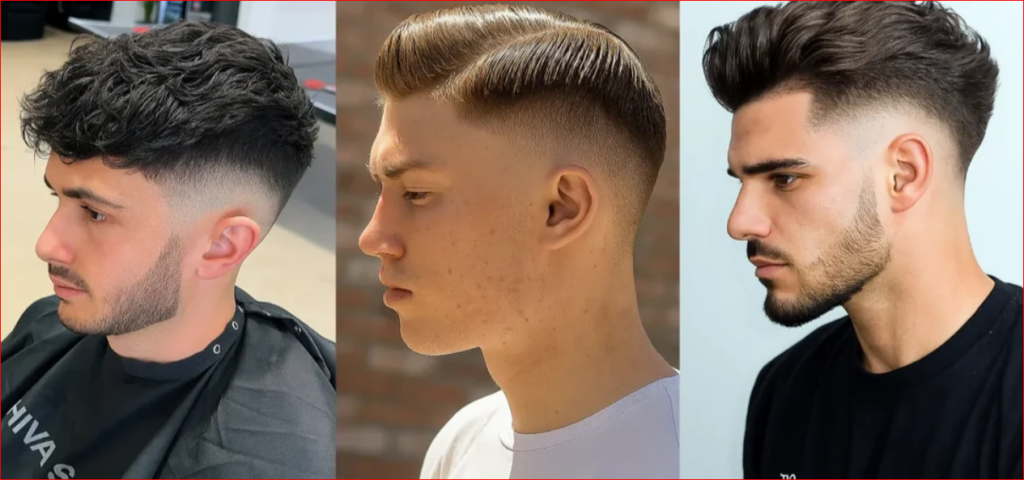
Every fade haircut has a line. Most lines go straight across the same height from the temple, through the sides, all the way to the neckline. That line is clean and reliable.
The drop fade’s line does something different.
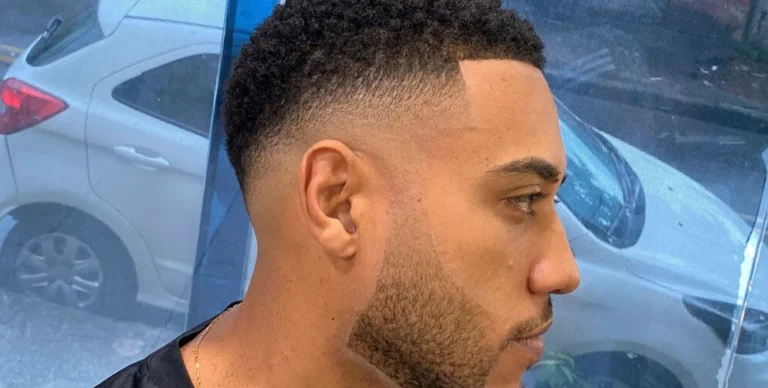
It starts at the temple like a regular fade. It maintains consistent height through the sides. Then, as it approaches the ear, it curves downward, following the natural contour of the skull, dipping behind the ear, and tapering toward the nape of the neck. That one curved line changes everything. The shape from the front looks cleaner. The shape from the side looks more dimensional. The grow-out is gentler than any straight-line fade at the same height.
And it is one of the most technically demanding cuts a barber can execute.
A Reddit thread asking barbers their least favorite cut to do produced one answer more than any other: drop fades. Not because the result is bad. Because the curved line is genuinely difficult to execute correctly symmetrically from both sides, following an arc that is different on every skull. A bad drop fade has an uneven curve. A good one looks like the haircut was designed specifically for your head.
This guide covers twenty drop fade styles for 2026, the occipital bone explanation nobody else gives you, the complete barber script, and exactly what to do if you want to change your drop fade into a low taper.
At a Glance — Quick Picks
| Need | Best Drop Fade Version |
|---|---|
| First time, most wearable | Low drop fade |
| Most requested 2026 | Mid-drop fade |
| Curly hair is the best contrast. | Low-dropped fade curls |
| Straight hair, the cleanest line | Mid-drop fade skin |
| Short hair | Short drop fade school safe |
| Office professional | Low-drop conservative |
| With a design | Mid-drop with design |
| Boys ages 10-18 | Low drop school rated |
| Bold weekend | High skin drop fade |
What Is a Drop Fade Haircut?
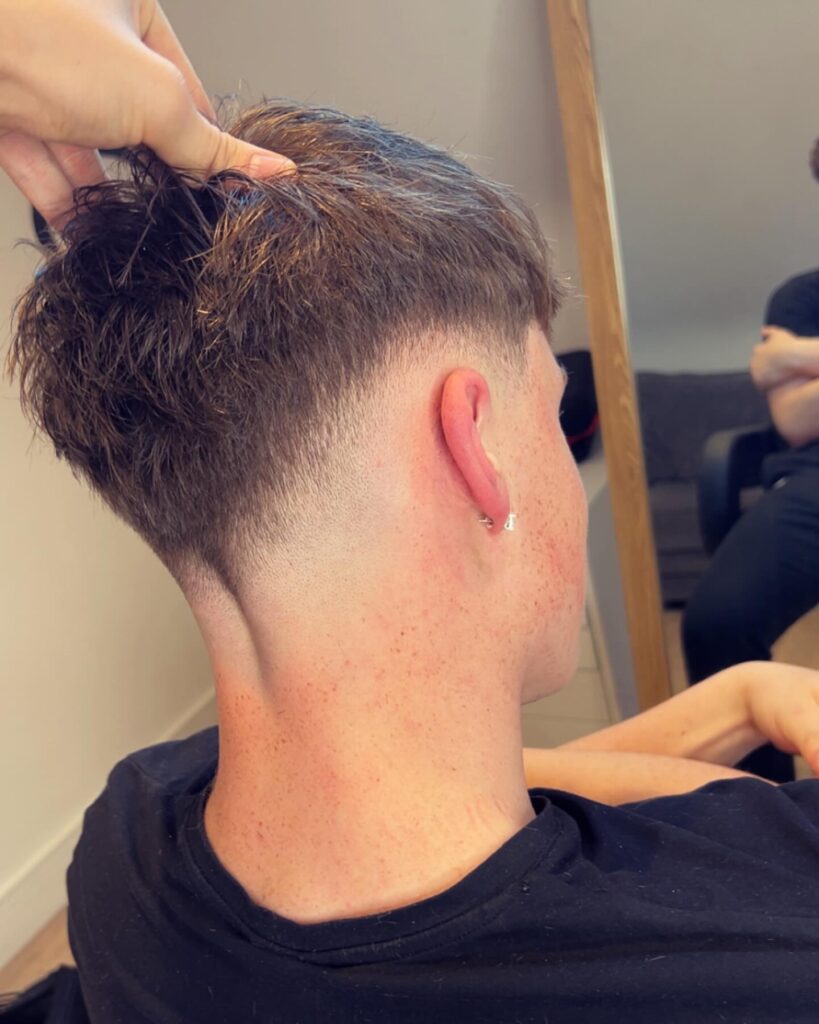
A drop fade is a men’s haircut where the fade line curves downward behind the ears rather than maintaining a straight horizontal line around the head. Starting at the temple, the fade stays consistent through the sides, then drops as it reaches the back of the ear and continues lower toward the nape of the neck.
The defining characteristic is the curve. A regular fade keeps the same gradation in length all the way around the head at the same height. A drop fade lowers around the back of the head, giving the impression of the hairline dropping behind the ears. This creates a dimensional look that follows the natural contour of the skull rather than imposing an artificial horizontal line.
The Occipital Bone: Why It Matters
The occipital bone is the rounded bone at the base of the skull, the part of the back of your head that curves outward before descending to the neckline. If you place your hand at the back of your head and feel for the point where the skull curves most prominently before dropping toward the neck, that is the occipital bone.
The drop fade follows this contour. The fade line drops downward as it approaches this bone, then continues to taper toward the nape. This is why the drop fade looks different from every angle because the curve is following a three-dimensional shape rather than running in a flat horizontal line.
Every person’s occipital bone sits at a slightly different position. This is one of the reasons drop fades are technically difficult; the barber needs to identify each client’s individual skull shape and adjust the curve accordingly. The same “mid drop fade” looks slightly different on everyone because the skull it is following is different.
Drop Fade vs. Regular Fade: The Actual Difference
| Drop Fade | Regular Fade | |
|---|---|---|
| Fade line direction | Curves down behind the ear | Straight horizontal |
| Follows skull shape | Yes, contour-based | No fixed height |
| Visual effect | Dimensional from every angle | Clean from the front only. |
| Technical difficulty | High | Moderate |
| Grow-out | Gradual, natural | Can appear as a hard line |
| Best for | Visual interest, face framing | Clean, uniform look |
If you want something with more character and visual interest, the drop fade wins. For a timeless, no-fuss look, a regular fade works well.
Is Drop Fade a Mid-Fade?
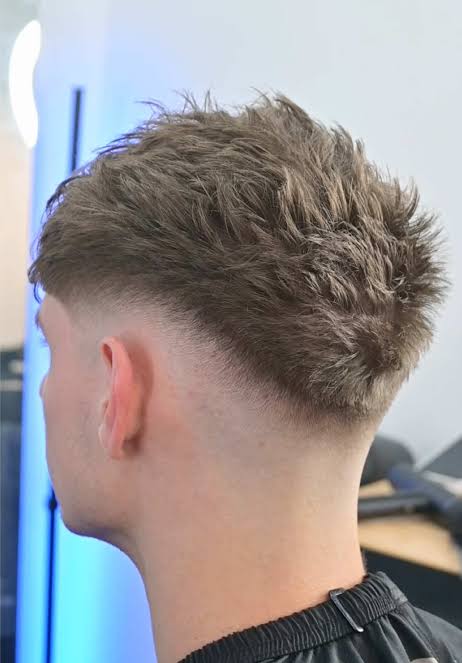
No, and this is one of the most common confusions about this cut. The terms describe two completely different things.
Drop describes the shape of the fade line. Mid describes the height of the fade on the head.
A mid fade starts at the temple that is the mid description. A drop fade has a curved line behind the ear that is the drop description. These can exist independently or together. A low drop fade is a low-height fade with a curved line. A mid-drop fade is a temple-height fade with a curved line. A high drop fade is a crown-height fade with a curved line.
What Is the V Burst Fade?
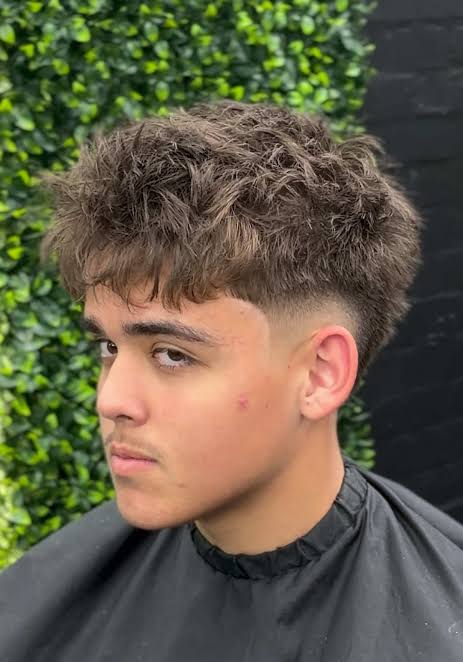
The V burst fade is a specific variation of the drop fade where the neckline is shaped into a V formation rather than a natural or squared neckline. The fade drops behind the ear as in a standard drop fade, but at the nape of the neck the barber creates a V-shaped point that descends downward rather than a flat or rounded neckline. This creates a visual extension of the neckline that emphasizes neck length and adds a distinctive detail to the back of the cut.
20 Drop Fade Haircut Styles for 2026
Classic Low Drop Fade
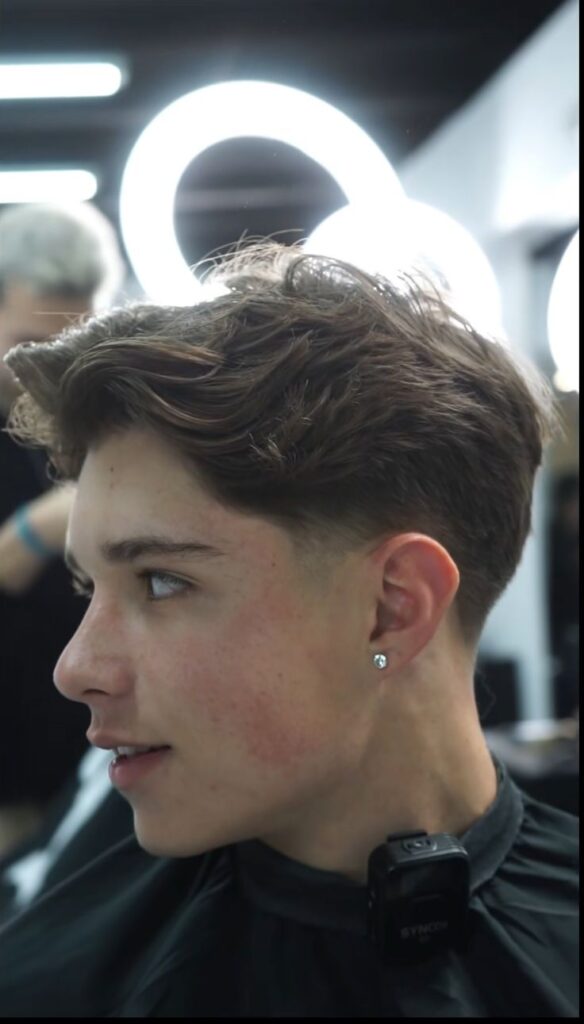
The starting point. The fade begins low just above the ear and curves gently behind the ear before tapering toward the nape. The contrast is subtle. The curve is visible from the side but not aggressive from the front. School-safe in every setting. Grows out gradually without a hard visible line.
Tell your barber, “Low drop fade. The fade line should curve downward behind the ear, not straight across. Number 1.5 at the lowest, blending to 3. The curve should start just behind the ear and drop toward the nape. Keep it subtle.”
Face shape: All the low positions and gentle curves suit every face.
Hair type: All.
School safe: Yes, universally.
Guard numbers: 1.5 at lowest, blend to 3.
Maintenance: Every 4-5 weeks.
Style time: Depends on top zero to 3 minutes.
Mid Drop Fade
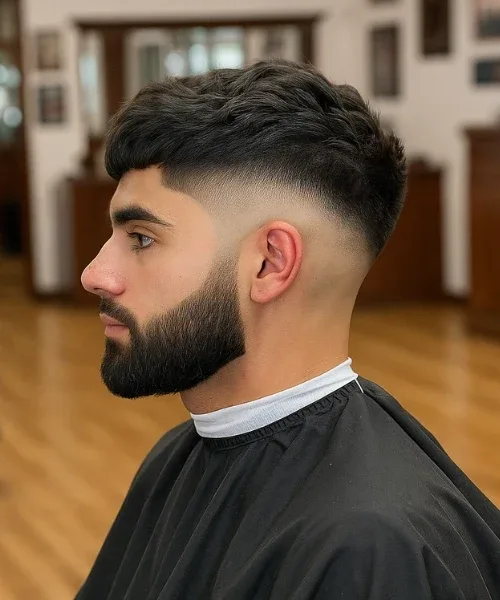
The most requested version in barbershops. The fade starts at the temple, maintains consistent height through the sides, then curves downward behind the ear with more visible depth than the low version. The curve creates a clearly visible arc from the side view.
Tell your barber, “Mid drop fade. Temple start. Curve clearly downward behind the ear. Number 1 at the lowest, blending to 3 at the top of the fade zone. Check from behind before blending to ensure the curve is symmetric.”
Face shape: Oval and round; the curve adds dimension that suits both.
School safe: Yes, in most settings.
Guard numbers: 1 at tightest, blend to 3.
Maintenance: Every 3-4 weeks.
High Drop Fade
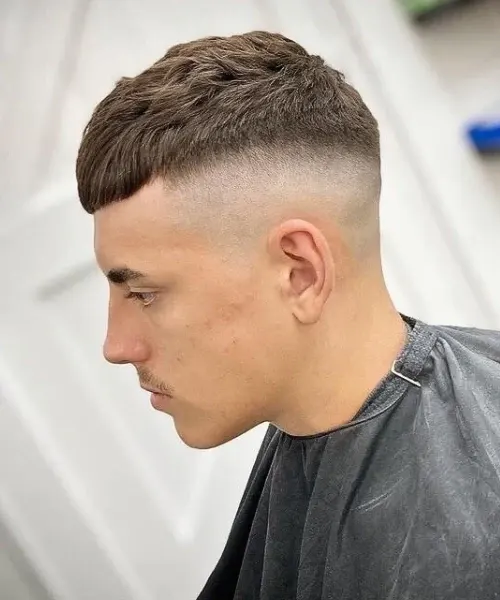
The most dramatic version. The fade starts high, well above the ear, and creates an aggressive curved arc dropping behind the ear all the way to the nape. High contrast between the skin-level lowest section and the full top above.
Tell your barber, “High drop fade. Start the fade well above the ear. Aggressive curve downward behind the ear—I want the drop to be clearly visible from every angle. Number 0.5 at the lowest.”
School safe: Check high skin fades occasionally conflict with conservative school policies.
Maintenance: Every 2-3 weeks.
Drop Fade with Textured Top
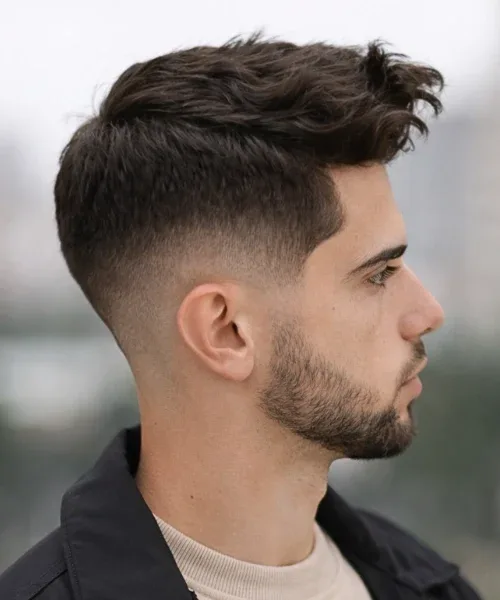
The most versatile combination. Mid drop fade on the sides with a textured, choppy top point-cut for natural movement and separation. The curved fade provides a dimensional base for any textured top style.
Tell your barber, “Mid drop fade with textured top. Curve clearly behind the ear. Two and a half inches on top point-cut for texture. Number 1 at the lowest. Cut the top dry.”
Face shape: Oval and round.
Hair type: All best on wavy and straight.
School safe: Yes.
Maintenance: Every 3-4 weeks.
Style time: 90 seconds light clay.
For the full textured fringe guide, our textured fringe haircut page covers the point-cutting technique.
Drop Fade Curly Hair
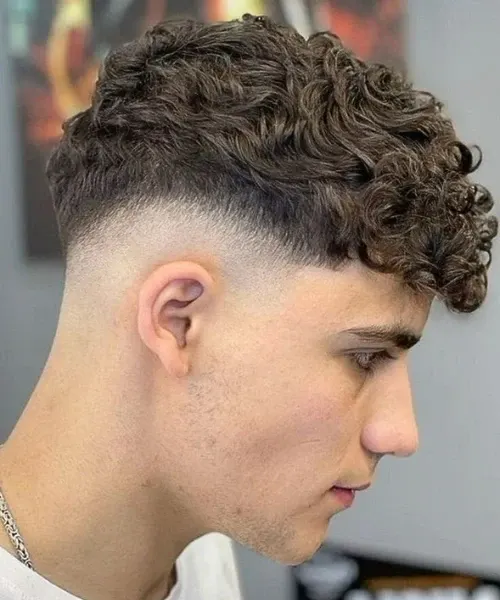
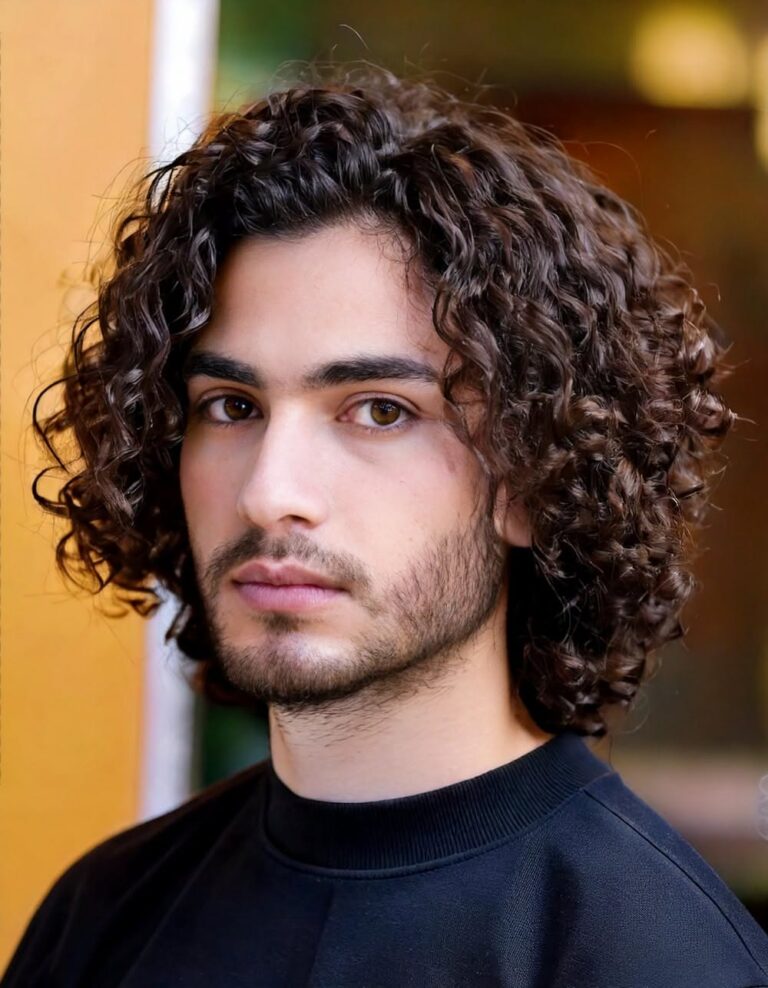
Curly hair paired with a drop fade creates one of the most visually striking combinations available. The natural curl volume on top contrasts dramatically with the faded curved sides, and the curve of the drop fade mirrors the natural arc of the curl silhouette above it.
The critical rule: always ask the barber to cut the top section dry. Curly hair shrinks between thirty and fifty percent when wet. A barber cutting wet produces significantly shorter results than intended.
Tell your barber, “Drop fade for curly hair. Mid- or low drop. Please cut the top section dry; my curls shrink significantly when wet. Keep at least two and a half inches on top for the curls to form. Number 1 at the lowest.”
Face shape: Oval and round.
Maintenance: Every 3-4 weeks curly hair at the drop grows out faster.
Style time: Curl cream on damp hair, scrunch, and air dry.
For the complete curly guide, our curly hairstyles for men page covers every curl type from 2A through 4C.
Drop Fade Straight Hair
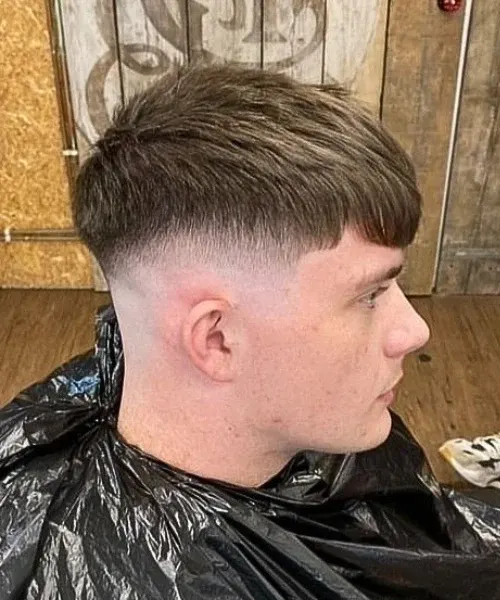
Straight hair makes the curved line of the drop fade more visible and precise than any other hair type. Because straight strands lie flat and consistently, every detail of the barber’s blending shows, which makes a well-executed drop fade on straight hair particularly sharp, and a poorly executed one immediately obvious.
Tell your barber, “Drop fade for straight hair. Mid-drop precise curve behind the ear. Number 1.5 at the lowest. Cut the top dry. The straight hair will show every detail of the blend; please take extra care with the curve symmetry.”
Face shape: All straight hair suits every drop fade level.
Maintenance: Every 4 weeks straight hair shows grow-out clearly.
For the straight hair style guide, our boys’ haircuts for straight hair page covers twenty cuts.
Drop Fade Short Hair
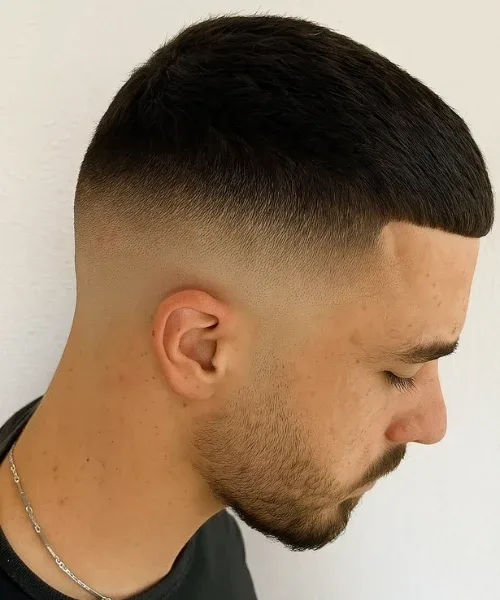
Short top combined with a drop fade. The overall cut stays close to the head. The drop fade adds dimensional character to what would otherwise be a uniform shortcut. Works particularly well for men who want something more distinctive than a standard crop without committing to significant length.
Tell your barber, “Drop fade with short hair on top. Low to mid drop. Keep the top to an inch and a half. Curve clearly behind the ear. School and work appropriate.”
School safe: Yes, universally.
Maintenance: Every 3-4 weeks.
Style time: Zero.
Drop Fade with Fringe
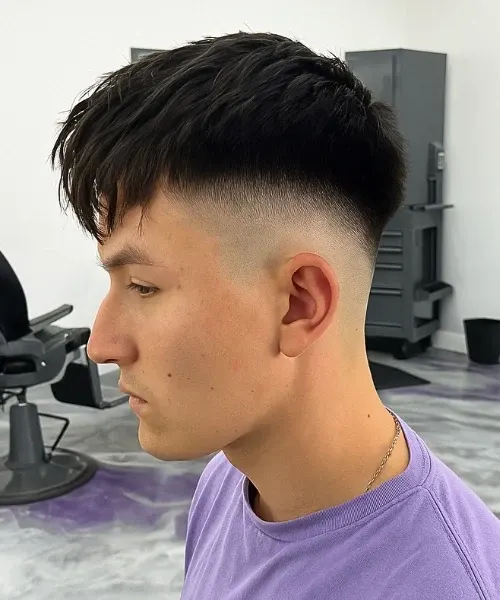
A forward-falling textured fringe on top combined with a drop fade on the sides. The fringe adds definition at the forehead, while the curved drop fade provides a more interesting side silhouette than a standard taper.
Tell your barber, “Drop fade with fringe. Mid drop. Curve behind the ear. Keep the fringe at the eyebrow length point-cut for texture. Number 1 at the lowest.”
Face shape: Oblong, heart, and large foreheads; the fringe adds a horizontal element.
For the full textured fringe guide, our textured fringe haircut page covers the technique.
Drop Fade Long Hair
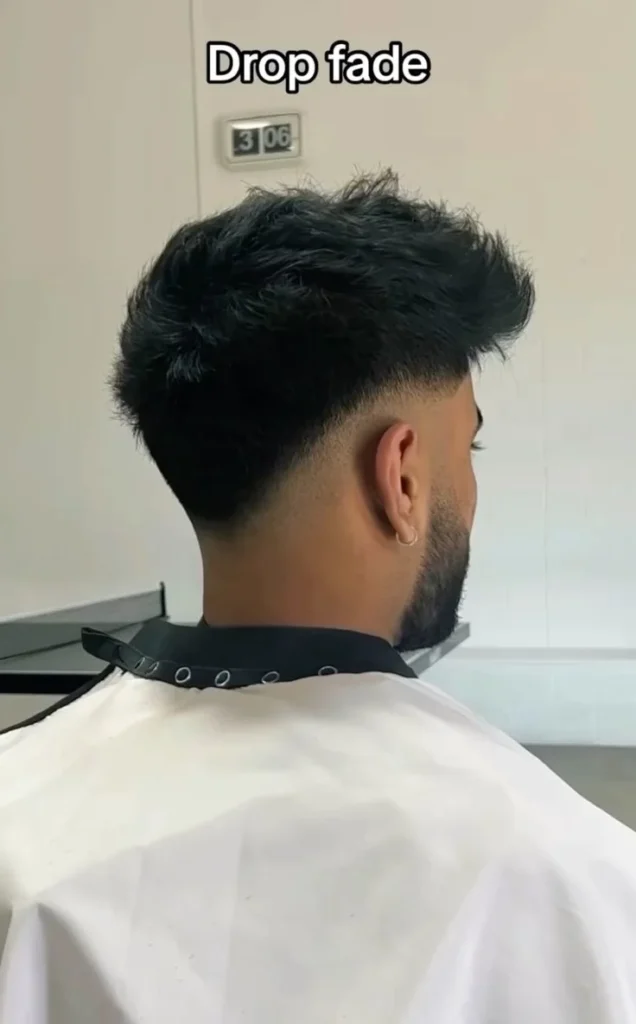
Longer, top three to five inches with a drop fade on the sides. The curved drop fade is the correct fade choice for longer hair because it follows the skull contour rather than creating a dramatic straight-line contrast that can look disconnected with significant length above.
Tell your barber, “Drop fade with longer top. Low to mid drop. Number 1.5 at the lowest. Keep [X] inches on top; do not touch the top length.”
For the full long-on-top strategy, our boys’ haircuts long on top guide covers the grow-out phase.
Drop Fade with Design
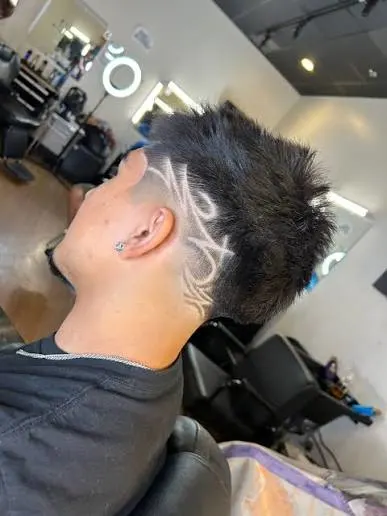
Shaved designs or razor art added into the drop fade zone. The curved section behind the ear provides a natural canvas for geometric or curved designs that complement the arc of the drop.
Tell your barber, “Drop fade with design. Mid-drop. I want [describe specific design] in the fade zone near the temple or behind the ear. The design should work with the curve of the drop rather than against it.”
School safe: Usually no shaved designs are the most commonly flagged element in school dress codes.
Maintenance: Every 2-3 weeks designs grow out fast.
Skin Drop Fade
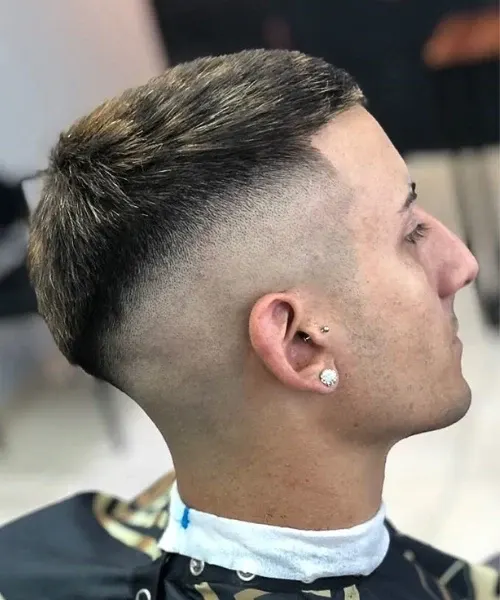
The drop fade is taken to bare skin at the lowest point. The curve drops behind the ear to skin level, creating maximum contrast between the bare sides and the full top. The grow-out is the fastest of any version; the skin section regrows visibly within two weeks.
Tell your barber, “Skin drop fade. Take the lowest section to skin number 0.5, or 0. The curve drops clearly behind the ear to the nape. Blend the gradient from skin upward.”
School safe: Check bare skin fades occasionally conflict with school dress codes.
Maintenance: Every 2-3 weeks.
Drop Fade Comb Over
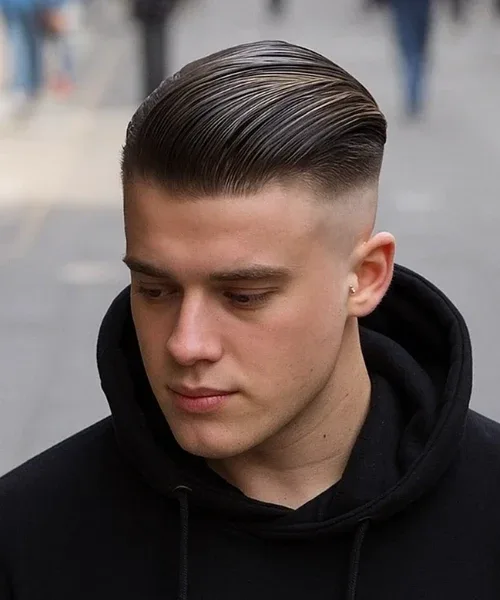
A side-parted, combed-over top combined with a low or mid drop fade. The comb over provides clean, professional direction to the top, while the drop fade adds modern dimensional character to the sides. One of the most office-appropriate drop fade combinations.
Tell your barber, “Drop fade with comb over. Low to mid drop. Side part on the left or whichever side the hair falls naturally. Two and a half inches on top. Curve behind the ear.”
Office safe: Yes, most professional-looking drop fade combinations.
Maintenance: Every 4 weeks.
Style time: 2 minutes of damp comb and light pomade.
Drop Fade Crew Cut
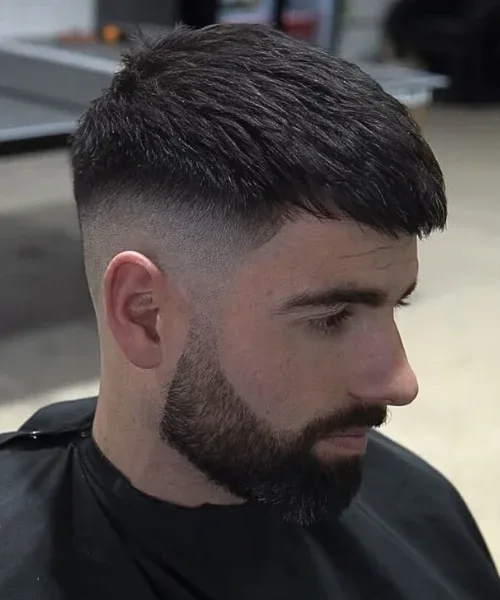
The classic crew cut updated with a drop fade. A traditional military style with a short even top, given a more contemporary character by replacing the standard taper with a curved drop fade. Simply ask for a crew cut with a drop fade, and most barbers will know exactly what you mean.
Tell your barber, “Crew cut with drop fade. Short, even at an inch and a half. Drop fade on the sides with the curve clearly behind the ear.”
For the full buzz cut guide, our buzz cut page covers every variation.
Drop Fade Wavy Hair
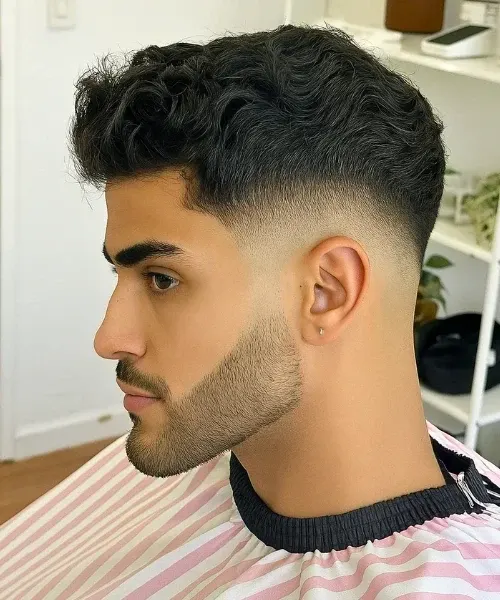
Wavy hair adds natural movement to the top that pairs well with the dimensional curved fade below. The wave adds texture and volume that straight hair needs product to achieve, making the wavy drop fade one of the lower-maintenance versions.
Tell your barber, “Drop fade for wavy hair. Mid-drop. Let the natural wave do the texture work on top. Number 1.5 at the lowest.”
Style time: Sea salt spray on damp hair, scrunch, air dry.
Maintenance: Every 3-4 weeks.
Drop Fade Faux Hawk
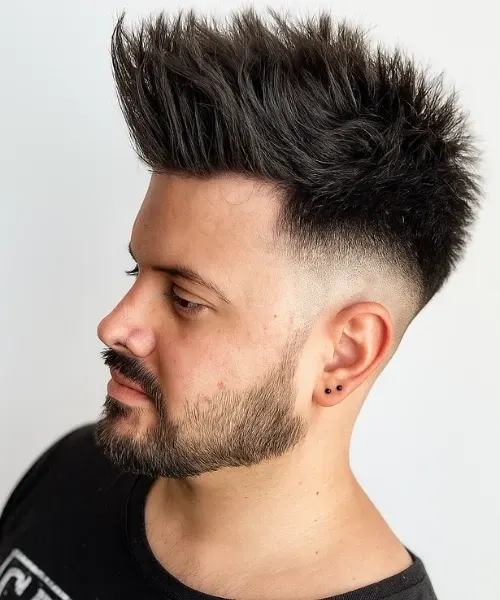
The faux hawk’s central ridge of volume combined with a drop fade on the sides. The curved arc of the drop fade echoes the shape of the faux hawk ridge above it, creating a cohesive silhouette from every angle.
Tell your barber, “Faux hawk with drop fade. High drop aggressive curve behind the ear. Keep enough length on top to push into a central ridge. Number 0.5 to 1 at the lowest.”
Drop Fade Long on Top
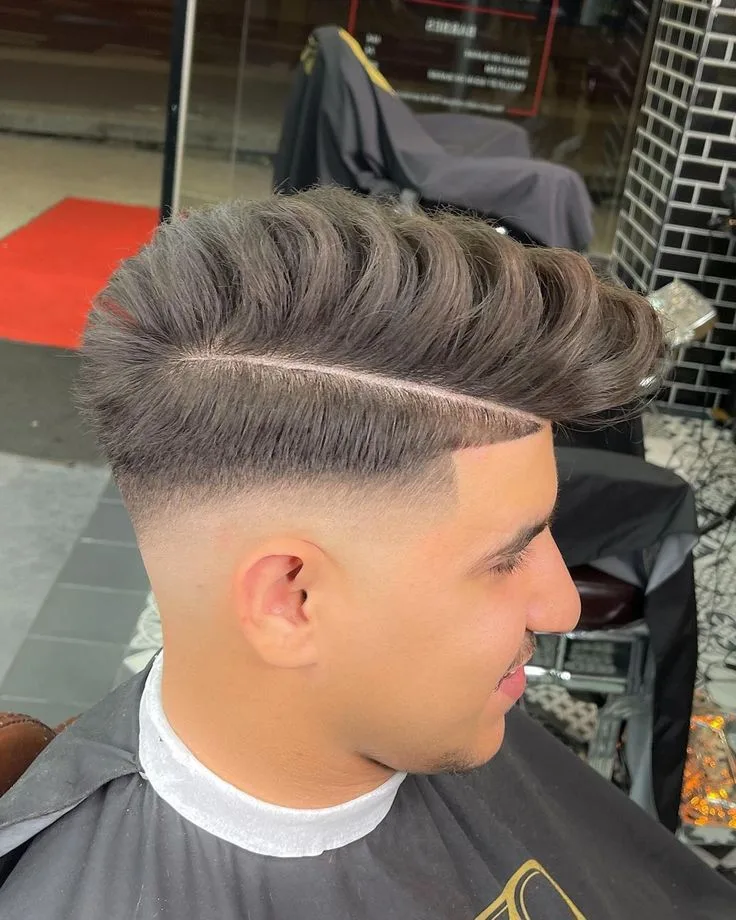
Wolf cut, blowout taper, or any significant top length combined with a drop fade base. The curved fade adds dimensional interest to the sides that a standard taper cannot provide when paired with significant top volume.
Tell your barber, “Drop fade with longer top. Keep [X] inches on top of the wolf cut or blowout structure above the drop fade. Low to mid drop. Do not touch the top length.”
For the blowout combination, our blowout taper guide covers the technique.
Drop Fade High Top
A flat top or box fade structure combined with a drop fade underneath. The angular flat top above and the curved drop fade below create an interesting contrast between the geometric top and the organic curved sides.
Tell your barber, “High top with drop fade. Keep the top flat and even box fade style. Drop fade on the sides with a clear curve behind the ear. High drop to create maximum contrast.”
Medium Drop Fade
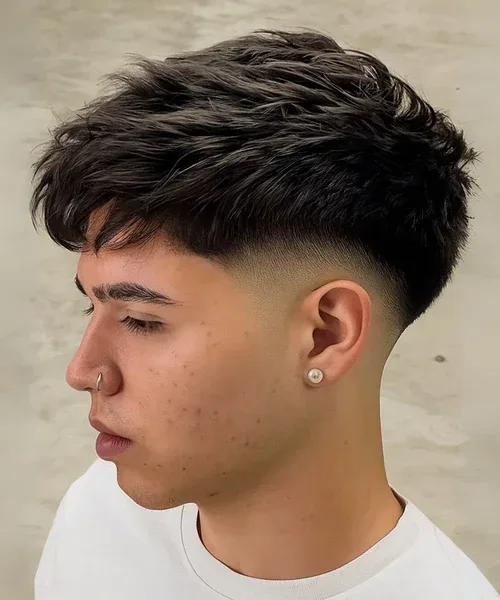
The transitional version between low and high. Starts between the ear and the temple, creating moderate contrast with a clearly visible curve. More presence than a low drop, less aggressive than a high drop.
Tell your barber, “Medium drop fade. Start between the ear and temple. Curve clearly downward behind the ear. Number 1 to 1.5 at the lowest.”
Maintenance: Every 3-4 weeks.
Drop Fade for Boys and Teens
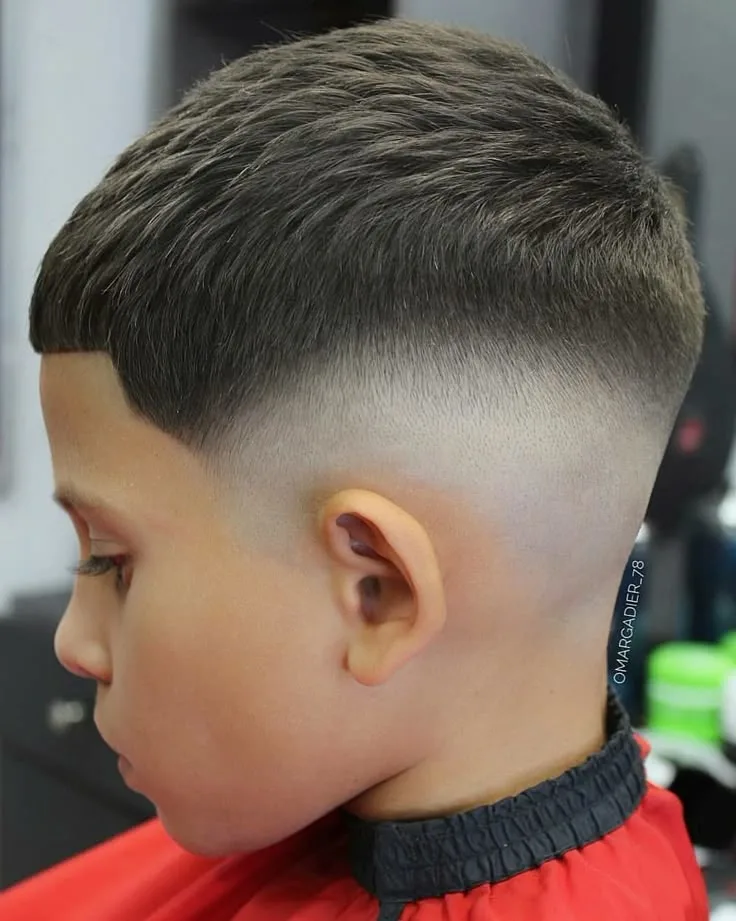
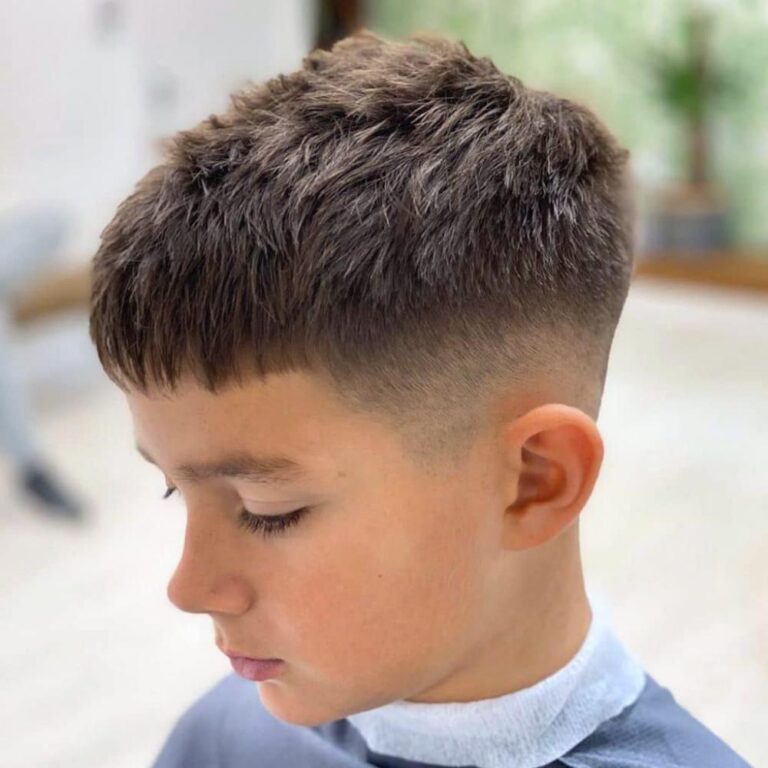
The drop fade is one of the most requested cuts for boys aged ten to eighteen. The curved arc is distinctive enough to stand out from a standard fade while remaining school-appropriate in its conservative versions. The low drop fade is school-safe in virtually every environment.
For boys ten to thirteen, low drop fade with a number 1.5 at the lowest. School-safe everywhere.
For teens fourteen to eighteen, mid-drop fade. School-safe in most settings. Check policy if considering skin at the lowest.
Tell your barber (for boys): “Drop fade for a [age]-year-old. The low-to-mid drop curve is clearly behind the ear. Number 1.5 at the lowest not to skin. School-appropriate.”
For full teen guides: our teen boy haircuts page and boys’ haircuts hub.
Conservative Drop Fade
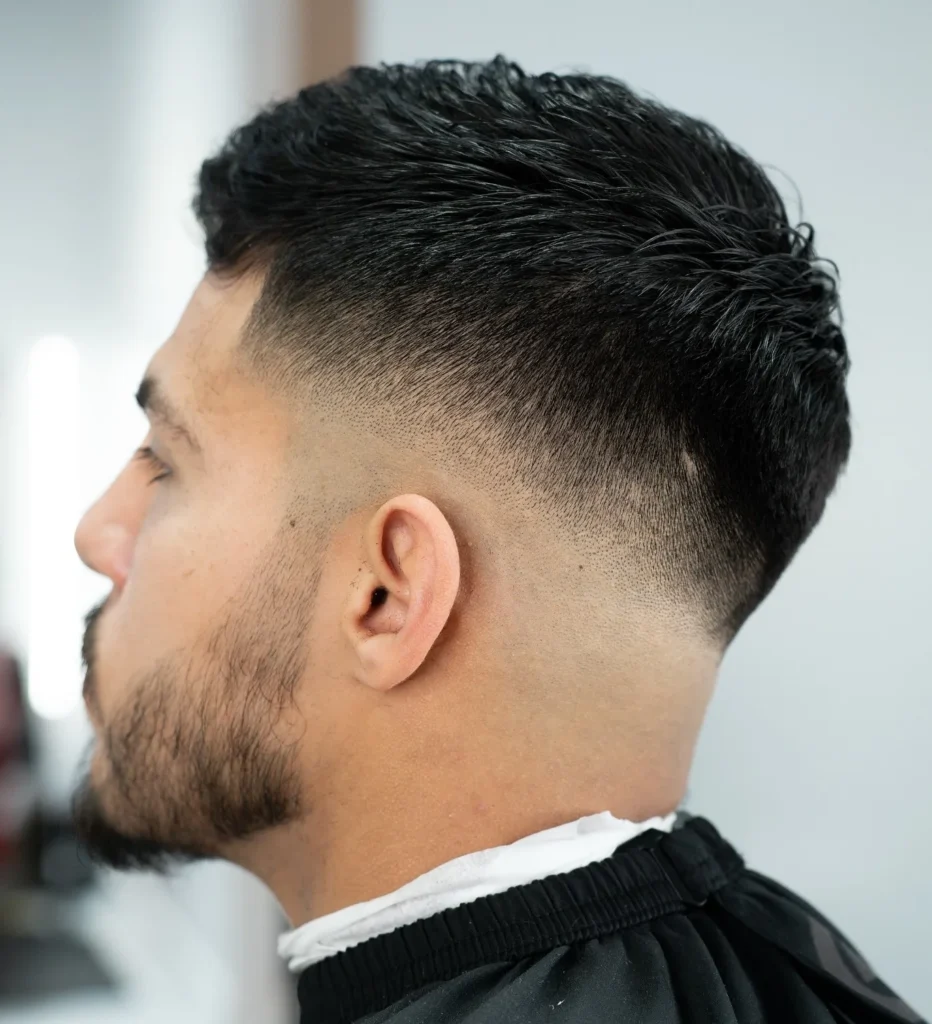
The most restrained version. Number 2 or higher at the lowest point with no skin visible. The curve is subtle but present and visible from the side but not dramatic from the front. This version passes every professional and school environment without discussion.
Tell your barber, “Conservative drop fade. Number 2 at the lowest is no skin. Subtle curve behind the ear—I want the drop present but not aggressive. Office-appropriate.”
Office safe: Yes, universally.
School safe: Yes, universally.
Maintenance: Every 5-6 weeks.
Drop Fade vs. Burst Fade: The Complete Comparison
These two fade types are regularly confused. They are related but structurally different, and the difference matters for which top styles each suits.
Drop Fade the Curved Line
The drop fade’s line curves downward behind the ear, following the skull’s natural contour. The arc runs from the side of the head downward toward the nape. When viewed from the back, the curve creates a horseshoe shape that follows the neck.
Burst Fade the Semicircle Around the Ear
The burst fade creates a semicircle or sunburst pattern radiating outward from around the ear. Rather than dropping downward like the drop fade, the burst fade’s line curves around the ear in a 180-degree arc. It is most commonly paired with mohawks, mullets, and faux hawks because the outward radiation of the burst complements the central-ridge top styles.
Clear Comparison Table
| Drop Fade | Burst Fade | |
|---|---|---|
| Fade line location | Behind the ear, curves downward | Around the ear, radiates outward |
| Skull following | Yes, drops with occipital contour. | Partially arcs around the ear |
| Best top styles | Any versatile | Mohawk, mullet, faux hawk |
| Visual effect | Dimensional, contoured | Dramatic, radiating |
| Technical demand | High | Very high |
| School suitability | Depends on height | Depends on height |
Which Should You Choose?
Choose a drop fade if you want a versatile curved fade that works with any top style. The drop adds dimension and character without requiring a specific top style to make visual sense.
Choose a burst fade if you are wearing a mohawk, mullet, or faux hawk; specifically, the outward radiation of the burst fade complements these central-ridge or long-back top styles in a way the drop fade cannot.
For the full burst fade guide, our burst fade page covers every variation.
Drop Fade by Hair Type Complete Matching Guide
| Hair Type | Best Version | Guard at Lowest | Key Barber Instruction |
|---|---|---|---|
| Straight | Mid-drop skin | 1.5 | “Curve must be precise; straight hair shows everything.” |
| Wavy | Mid-drop | 1.5 | “Let the natural wave texture the top.” |
| Curly | Low drop | 1 | “Cut top section dry curls shrink.” |
| Thick | Mid-drop skin | 1 | “Extra leverage around the curve for coarse hair” |
| Fine | Low conservative | 2 | “No skin, keep coverage at sides.” |
Drop Fade on Straight Hair
Straight hair is simultaneously the best and most demanding canvas for a drop fade. Best because the clean, consistent strands make the curved line exceptionally sharp when executed correctly. Most demanding because the same consistency means every imperfection in the arc is immediately visible.
A barber who executes a drop fade on straight hair confidently is demonstrating real technical skill. A barber who rushes it will leave an uneven arc that is impossible to miss.
Drop Fade on Curly Hair
The drop fade on curly hair produces the most visually dramatic result because the natural curl volume above creates strong contrast with the faded curved sides below. The curve of the drop fade also mirrors the natural silhouette of the curl cluster, creating a cohesive shape from every angle.
Always cut curly hair top sections dry. This is non-negotiable for accurate length assessment on curly texture.
For dedicated curly guidance, our curly hairstyles for men guide covers type 2A through 4C.
Drop Fade on Thick Hair
Thick, coarse hair presents a specific challenge around the curved section of the drop fade. The hair density requires tighter clipper work; as the barber moves around the curve, the lever settings and technique need adjustment to blend cleanly through the arc on thick hair.
As one experienced hairstylist notes, “If your hair is curly or coarse, you are going to need tighter clipper work and possibly a different lever setting as you go around the curve.”
Tell the barber specifically, “My hair is thick and coarse; please adjust the clipper technique around the curved section. “I want the blend to be as smooth on the curve as it is on the straight sections.”
Drop Fade on Wavy Hair
Wavy hair is one of the most forgiving types for a drop fade. The natural wave adds texture and dimension to the top without product, and the wavy texture also helps disguise the early grow-out phase of the curved fade section; the waves hide the grow-out more gracefully than straight strands do.
Drop Fade for Fine Hair
Fine hair benefits from keeping a number 2 or higher as the lowest guard, avoiding skin exposure that would emphasize the lack of density at the sides. The conservative drop fade creates the curved line characteristic without going to skin, maintaining the drop fade’s visual interest while avoiding the scalp visibility issue.
Drop Fade by Face Shape
Do drop fades look good? They suit most face shapes particularly well and for the same reason in most cases. The curved arc behind the ear creates a more gradual transition from the fade to the nape, which frames the face without imposing an artificial straight-line contrast.
Round face: The drop fade combined with crown volume on top is one of the strongest looks for round faces. The height adds vertical length, while the curved fade avoids the severity of a high straight fade that can make a round face look shorter.
Oval face: The most flexible face shape. Every drop fade level works. Mid drop is the strongest match for balanced oval proportions.
Square face: The mid-drop fade softens the strong jaw more than a high straight fade because the curve follows the skull rather than creating a hard horizontal line at mid-head. Avoid high skin drop fades that can emphasize jaw angularity.
Oblong face: Low or conservative mid drop. The curved arc adds interest without adding the vertical height that a high fade creates. Avoid high drops on oblong faces.
Heart face: Low drop with a fringe combination. The fringe covers forehead width, while the low drop keeps the sides from adding additional width or height.
Why Barbers Struggle with Drop Fades and What This Means for You
Reddit’s most upvoted answer to “What’s your least favorite cut to do?” is drop fades. Understanding why helps you find the right barber and communicate more clearly before sitting down.
Why Drop Fades Are Technically Hard
The curved line requires the barber to blend along an arc rather than a straight horizontal line. A straight fade can be executed with the clipper held consistently flat against the skin. A drop fade requires constant adjustment of the clipper angle as it follows the curve behind the ear.
The arc must be symmetric from both sides; the drop on the left must match the drop on the right when viewed from behind. Because every person’s skull has a slightly different occipital bone position and curve, the barber cannot use a fixed reference point. They must read the skull shape and adjust.
The blend along the curved section requires the same smoothness as the straight sections. Inconsistency in technique shows more obviously on a curve than on a straight line.
Three Questions to Ask Before Sitting Down
“Have you done drop fades before?” A barber confident in the technique says yes immediately and offers to show examples.
“Can I see some photos of drop fades you have done?” Look for the curve behind the ear in the side-view photos. If the photos show a straight line, that barber is not executing true drop fades.
“Can you make the curve symmetric from both sides and check before blending?” This question tells the barber you know what you are looking for. Most good barbers will nod and appreciate the specificity.
Signs of a Bad Drop Fade
An uneven arc where one side drops lower than the other. A straight line where the curve should be; the barber followed a straight line behind the ear rather than curving with the skull. Visible steps in the blend along the curved section where the gradient should be smooth.
Is There Such a Thing as a Low Drop Fade?
Reddit asks this directly; some barbers dispute whether a “low drop fade” is technically accurate. The answer is yes. “Low” describes the height where the fade begins on the head. Drop describes the shape of the fade line behind the ear. Both can coexist. A low drop fade begins close to the ear level and curves gently behind the ear toward the nape. A high drop fade begins well above the ear and curves dramatically.
How to Ask for a Drop Fade Complete Barber Scripts
The Universal Drop Fade Script
“Drop fade. The fade line should curve downward behind the ear, not go straight across. [Low/mid/high] drop. Number [X] at the lowest. The curve should follow the natural shape of my skull behind the ear and toward the nape.”
Scripts Per Height
Low drop fade: “Low drop fade. Number 1.5 at the lowest. The curve starts just behind the ear and drops gently toward the nape. Keep it subtle.”
Mid drop fade: “Mid drop fade. Temple starts. Number 1 is the tightest. Curve clearly downward behind the ear; I want it visible from the side.”
High drop fade: “High drop fade. Skin at the lowest number, 0.5. Aggressive curve behind the ear all the way to the neckline. Clear arc from side view.”
Skin drop fade: “Skin drop fade. Zero at the lowest bare skin. Mid start. The curve should be dramatic behind the ear.”
Conservative office version: “Conservative drop fade. Number 2 at the lowest is no skin. Subtle curve just present enough to see from the side. Office appropriate.”
The Critical Instruction
“Please check the curve is symmetric from both sides before blending the look from directly behind to confirm the arc matches on the left and right.”
This one sentence prevents the most common drop fade problem. A barber who hears this will check before committing to the blend. A barber who ignores it should be reconsidered for this specific cut.
Two Photos: Front AND Back
The drop fade is unique among fade types in requiring a back photo as well as a front photo. The front photo shows the top style and fade height. The back photo shows the actual drop arc and how it looks at the neckline. Without a back photo reference, the barber must interpret the curve entirely.
Can You Change a Drop Fade into a Low Taper?
This Quora question appears twice, and the answer requires understanding what each cut does.
The Honest Answer
Yes, but you cannot do it immediately. A drop fade takes hair to skin or near-skin along the curved section. A low taper keeps visible hair throughout the gradient. You cannot add hair back. The only direction is shorter.
The transition requires growing out the faded section first, then reshaping as a low taper once the curved section has enough length to taper rather than fade.
The Transition Method
In the first two weeks after a skin drop fades, the sides are growing back but still very short. Nothing can be done yet.
Around weeks three to four, the curved section has grown to the point where a number 2 or 3 guard can reach it. Book an appointment and ask, “I want to soften the drop and fade into a gradual low taper. I am growing it out.” Please taper the sides rather than fade them this visit.”
By weeks six to eight, the drop curve has grown enough that a clean low taper can be cut across the entire side section, and the drop fade is effectively converted.
When to Just Start Fresh
If the original drop fade was a high skin fade with significant contrast, the grow-out process takes longer and the in-between stage is more visible. In this case, continuing with the drop fade and gradually reducing the height each visit from high to mid to low drop is often cleaner than attempting a direct conversion.
Is Drop Fade Haram in Islam?
The Islamic prohibition most relevant to haircuts is qaza, cutting some sections very short while leaving others long in a patchy, irregular way. The drop fade creates a smooth curved gradient rather than a patchy contrast. Most contemporary Islamic scholars who engage with men’s grooming questions consider gradual fades permissible because they blend smoothly rather than creating qaza-style irregularity.
The conservative drop fade number 2 at the lowest, with no skin visible, is the version most clearly within the majority permissible position. It creates the curved character of the drop fade without the bare skin contrast that some scholars flag in skin fades.
How Long Will a Drop Fade Last?
Maintenance Table by Version
| Version | Looks Sharp | Grows Out Visibly | Trim Frequency |
|---|---|---|---|
| Low conservative drop | Weeks 1-4 | Week 5 gradually | Every 4-5 weeks |
| Standard low drop | Weeks 1-3 | Week 4 gradually | Every 4-5 weeks |
| Mid-drop | Weeks 1-3 | Weeks 3-4 | Every 3-4 weeks |
| High skin drop | Days 1-10 | Day 12-14 | Every 2-3 weeks |
Will a Fade Last 3 Days?
Yes, three days after a drop fade is still the fresh stage. Most fades look their sharpest in the first five to seven days. The curve of the drop fade actually holds its visual impact slightly longer than a straight-line fade because the graduated arc grows out more gradually than a hard horizontal line.
Do Fades Look Professional?
Yes, with level-appropriate selection. A low drop fade looks professional in every environment, including the most conservative corporate settings. A mid-drop fade suits most professional environments. A high skin drop fade is worth checking against specific workplace policies.
For the full comparison of professional suitability across every fade type, our taper vs. fade guide covers every level.
Annual Cost by Level
| Level | Trims Per Year | Annual Cost (US, $30/cut) |
|---|---|---|
| Low conservative drop | 8-9 | $240-270 |
| Standard low drop | 9-10 | $270-300 |
| Mid-drop | 12-15 | $360-450 |
| High skin drop | 17-25 | $510-750 |
Browse More Fade Guides
For the semicircle version that radiates around the ear rather than dropping behind it, our burst fade guide covers every variation.
For the full comparison between every fade type, our taper vs. fade guide covers the difference with exact terminology.
For the straight-line alternative at the same height, our low taper fade guide and mid taper fade page cover the non-curved versions.
For the textured fringe combination, our textured fringe haircut guide covers the fringe technique.
For boys and teens: our boys’ haircut hub covers every age. The teen boy haircuts guide covers the full teen range.
For curly hair: our curly hairstyles for men guide covers types 2A through 4C.
Not sure which fade suits your face shape? Our teen haircut finder quiz takes sixty seconds.
Frequently Asked Questions
What is a drop fade haircut?
A drop fade is a men’s haircut where the fade line curves downward behind the ears rather than maintaining a straight horizontal line around the head. The fade starts at the temple, stays consistent through the sides, then drops behind the ear following the natural contour of the skull, specifically the occipital bone, and tapers toward the nape. The result is a curved fade that looks dimensional from every angle.
Is a taper or drop fade better?
They serve different purposes. A taper creates a gradual blend along a straight horizontal line—conservative, professional, and grows out slowly. A drop fade creates a curved arc behind the ear following the skull, making it more dimensional, more visually interesting, and technically more demanding. For a conservative professional look, taper. For distinctive character and better face framing from every angle, drop fade.
Which fade is best for boys?
The low drop fade with a number 1.5 at the lowest is the best starting point for boys ten to eighteen. It is school-safe in every setting, grows out gradually without a hard visible line, and provides the distinctive curved character of the drop fade without aggressive contrast. For teens wanting more presence, the mid-drop fade with a number 1 suit most school environments.
What is a 1-2 fade haircut?
A 1-2 fade uses a number one guard at the lowest section and a number two guard slightly higher, blended between the two. On a drop fade this would mean a number one at the very bottom of the curved arc and a number two at the top of the fade zone, a moderate contrast that looks deliberate without going to skin.
Do drop fades look good?
Yes, when executed correctly. The curved line that follows the skull’s natural contour creates a more organic, dimensional appearance than a straight fade. It frames the face from every angle rather than just the front. The critical condition is execution of a poorly done drop fade with an uneven arc or straight line where there should be a curve, which looks worse than a standard fade. Find a barber who has done them before.
What is the V Burst fade?
The V burst fade is a drop fade variation where the neckline is shaped into a V formation rather than a flat or rounded neckline. The drop fade curves behind the ear as usual, but at the nape the barber creates a V-shaped point that descends downward, creating a visual extension of the neck length and a distinctive detail visible from behind.
What is the most attractive fade?
The most attractive fade is the one matched to face shape. For round faces, a drop fade with crown volume adds vertical proportion. For oval faces, any fade level works. For square faces, a mid-drop softens the jaw better than a high straight fade. For oblong faces, a low drop avoids adding height. The drop fade specifically is considered highly attractive because it frames the face from multiple angles rather than creating a single-view clean line.
Is drop fade a mid fade?
No. These terms describe different things. Drop describes the shape of the fade line curved downward behind the ear. Mid describes the height where the fade starts on the head at the temple. A mid-drop fade is a fade that starts at mid-height and has a curved drop line. They can be combined, but they are not the same thing.
What is a no. 1 haircut?
A number one guard cuts hair to three millimeters, the tightest fade level before bare skin. On a drop fade it is used at the lowest section of the curved arc, near the natural hairline. Higher guards mean longer hair; number two is six millimeters, and number three is nine millimeters.
Do girls find fades attractive?
Survey data consistently shows that clean, well-maintained haircuts, regardless of specific style, are highly rated. The drop fade specifically rates well because the curved arc creates a more polished, dimensional appearance than a standard cut. The low and mid drop fade versions are considered more universally attractive than high skin fades, which rate well in some demographics but not all professional or social contexts.
Will a fade last 3 days?
Yes, three days after a drop fade is still in the fresh stage. Most fades look sharpest in the first five to seven days. The drop fade’s curved arc actually holds its visual impact slightly longer than a straight-line fade because the graduated curve grows out more gradually than a hard horizontal line. The skin-fade version shows regrowth faster; usually by day ten the skin section has visible stubble.
How long will a drop fade last?
A conservative low drop fade lasts four to five weeks before the grow-out becomes visible. A standard mid-drop fade needs a touch-up every three to four weeks. A high skin drop fade needs attention every two to three weeks because the skin section grows back visibly fast. The curved arc of any version grows out more gradually than a straight fade at the same height.
Do fades look professional?
Yes, level-dependent. A low drop fade with a number 2 at the lowest looks professional in every environment, including the most conservative corporate settings. A mid-drop fade suits most professional environments. A high skin drop fade is worth checking against specific workplace dress codes. No fade curved or straight has ever been officially prohibited in mainstream professional environments at the low or mid level.
Can you change a drop fade into a low taper?
Yes, but not immediately. The transition requires growing out the faded section first, approximately four to six weeks. Once the curved section has grown to number 2 or 3 guard length, ask your barber to taper the sides gradually rather than fade them. By week six to eight the drop fade is effectively converted to a low taper. If the original fade was a high skin drop, reducing the height gradually across successive cuts is cleaner than attempting a direct conversion.
The drop fade has a line. That line curves. Everything about the cut—the dimensional appearance, the face-framing effect, the grow-out behavior, and the technical difficulty—comes from that curve.
Pick the version that matches your hair type and lifestyle from this guide. Save the barber script. Ask the three verification questions before sitting down. Bring a front photo and a back photo.
And say the one instruction that protects the result before the clippers start: “Please check the curve is symmetric from both sides before blending.”
For the complete comparison between every fade type, our taper vs. fade guide covers every level with exact terminology. For boys and teens, our boys’ haircuts hub covers ages seven to eighteen with school safety ratings.