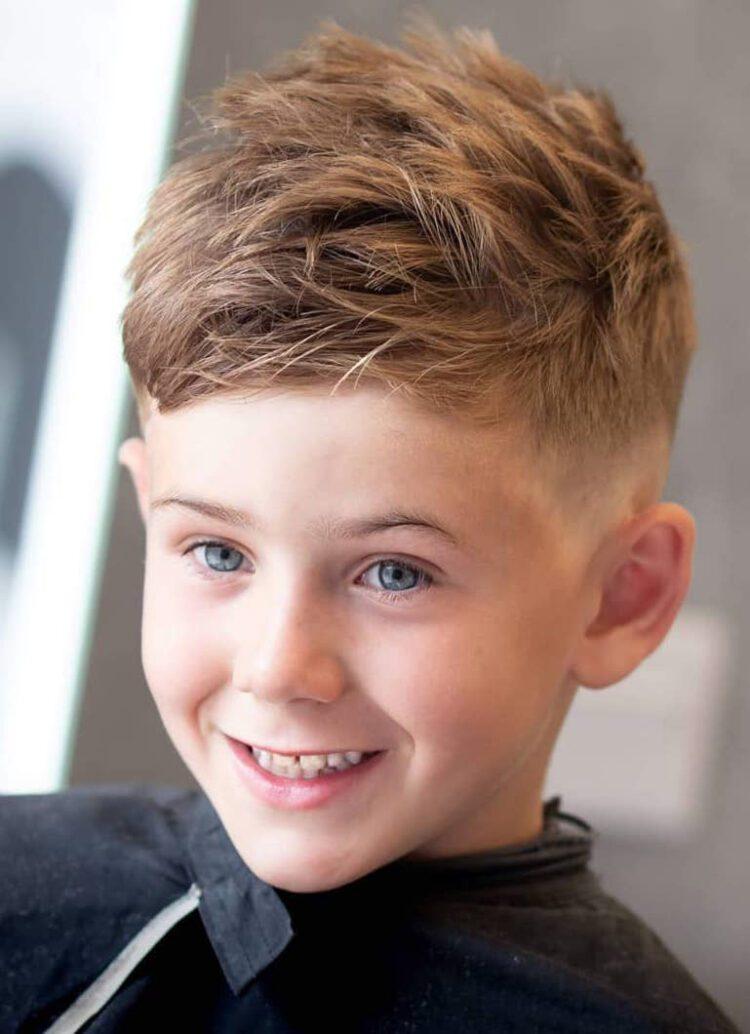
Crew Cut Haircut 2026: 20 Styles, the Yale Origin Story, and Everything Your Barber Needs to Know
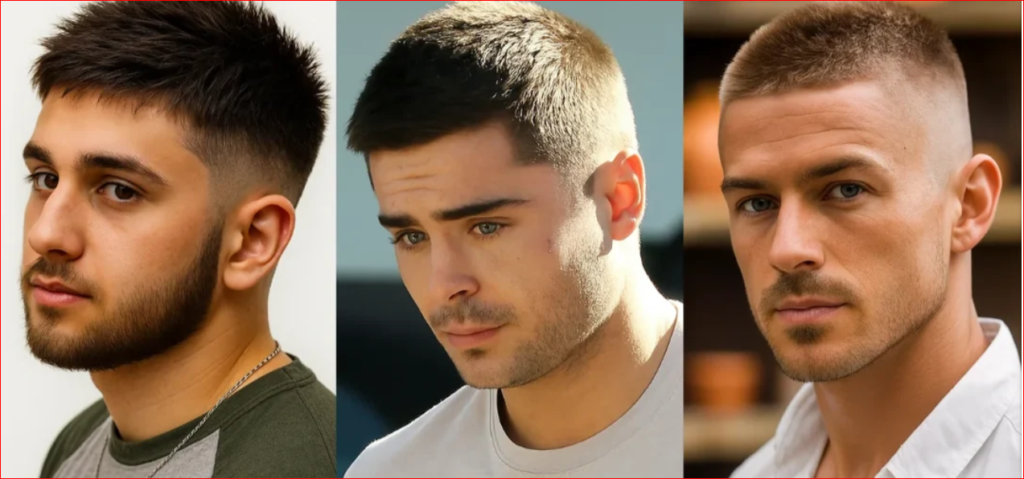
The crew cut never went out of style.
The comeback narrative gets applied to it every few years, and it is wrong every single time. The crew cut was being requested at barbershops every day of every year between 1945 and now. What changed in 2026 is that the modern version became visible again. Timothée Chalamet wore one on a red carpet. Drake has paired them with precise beards for years. The look shifted from rigid military precision to textured, matte-finished, personality-forward, and suddenly everyone noticed the cut that had been there all along.
The crew cut is the most universally flattering men’s haircut in existence. It suits every face shape. It works in every professional environment. It requires zero daily styling in its classic version and under three minutes in its modern textured update. It is the cheapest well-maintained haircut annually because the grow-out is gradual and the trim schedule is forgiving.
This guide covers twenty crew cut styles for 2026, the Yale rowing origin that explains the name, what separates a crew cut from a buzz cut and an Ivy League, and exactly what to tell your barber, including whether you can do it at home.
At a Glance
| Need | Best Crew Cut Version |
|---|---|
| Zero daily effort | Classic crew cut taper |
| Office professional | Classic or side-part version |
| Most modern 2026 | Textured crew with skin fade |
| School appropriate | Any version always passes. |
| Curly hair | Curly crew cut dry |
| Thick Asian hair | Mid fade with point-cut top |
| Bold weekend | Skin fade crew cut |
| Boys ages 10 to 18 | Classic school rated everywhere |
What Is a Crew-Cut Haircut for Men?
A crew cut is a short men’s haircut with tapered or faded sides and a slightly longer top section that graduates from longer at the front to shorter at the crown. The defining characteristic is that the graduation of the hair is not the same length all over the top. The front is fractionally longer, the crown is slightly shorter, and the whole top section follows the natural curve of the head.
The sides and back are cut shorter than the top using clippers, with a taper or fade creating a smooth transition. The standard top length is between half an inch and one inch, though modern versions go slightly longer for styling flexibility.
Crew Cut vs. Buzz Cut vs. Ivy League: The Three-Way Comparison
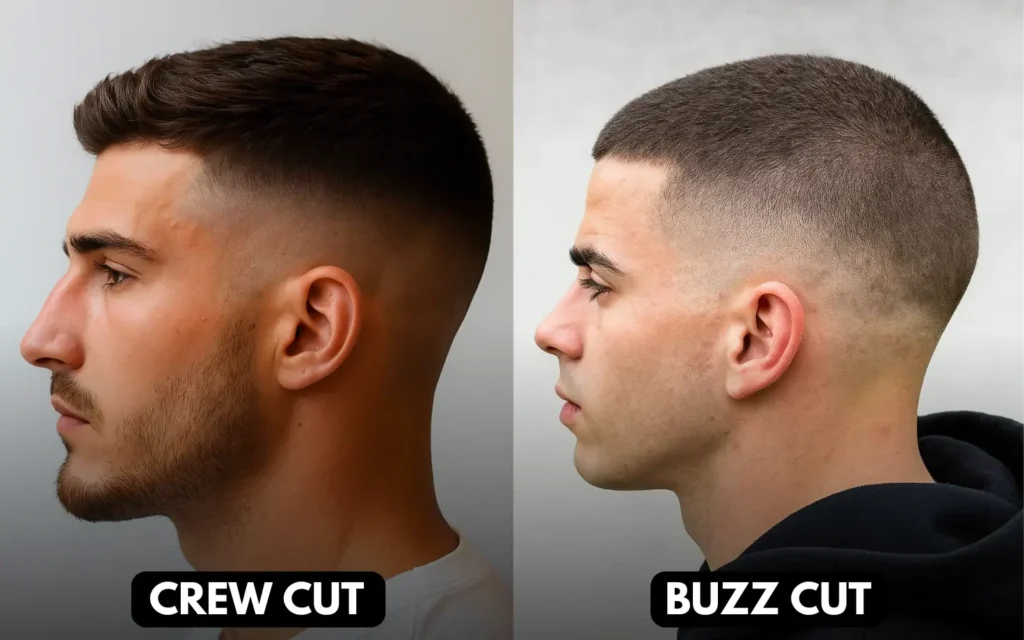
These three haircuts are confused constantly. They are related but technically distinct.
| Buzz Cut | Crew Cut | Ivy League | |
|---|---|---|---|
| Top length | Same all over | Graduated front to back | Longer, side-part capable |
| Guard used | Same guard throughout | Different guards on top and sides | Scissors on top primarily |
| Daily styling | Zero | None to light product | Pomade or comb needed |
| Origin | Military induction | Yale rowing 1920s | Ivy League prep schools |
| Office suitability | Yes. | Yes. | Yes. |
| School suitability | Always | Always | Always |
The buzz cut uses the same clipper guard from front to back with no graduation. The crew cut keeps the sides shorter and graduates the top from front to crown. The Ivy League is a longer version of the crew cut where the top has enough length to part and comb to the side. The Ivy League is sometimes called a Princeton or a Harvard clip.
Is a Crew Cut a Military Hairstyle?
The crew cut is associated with military grooming but did not originate in the military. It originated at Yale University in the 1920s. The US military adopted the short, functional style during World War II because it was practical, hygienic, and required no maintenance during active service.
In 2026 the crew cut is simultaneously the most popular haircut in military service and a red carpet choice for men with no military connection. The military association is part of its heritage, not a limitation on who wears it.
Why Is a Crew Cut Called a Crew Cut?
The name comes from Yale University’s rowing team in the 1920s. Rowing teams are called crews. The Yale crew kept their hair very short to prevent it from being blown across their faces during competition on the water. Other Yale students adopted the short functional style, and the association with the rowing crew gave it the name.
By the 1930s and 1940s the crew cut had spread beyond Yale to other universities, then to the military, then to mainstream civilian life. The name stuck because the Yale rowing crew origin was well-documented and the athletic, functional character of the cut reflected its rowing origins.
What Is the Army Number 1 Haircut?
The Army number 1 haircut refers to a cut where the sides are clipped with a number 1 guard, which cuts hair to three millimeters, combined with a graduated short top. US Army Regulation AR 670-1 requires a tapered appearance on the sides and back with hair that does not touch the collar, ears, or eyebrows.
In practice, most Army regulation haircuts use a number 1 or 1.5 on the sides with scissor-over-comb on the top, producing a tight, clean crew cut that meets grooming standards. The number 1 guard at the sides is the tightest level before bare skin. Number 2 is six millimeters, and number 3 is nine millimeters.
Is a Crew Cut High Maintenance?
No. The crew cut is one of the lowest-maintenance haircuts available. In its classic taper version, it needs a trim every four to five weeks. Daily styling ranges from zero wash, towel dry, and walk-out to two minutes of light matte clay for the textured modern version. No blow dryer needed. No pomade required unless you specifically want a slicked finish.
20 Crew-Cut Hairstyles for Men in 2026
Classic Crew Cut
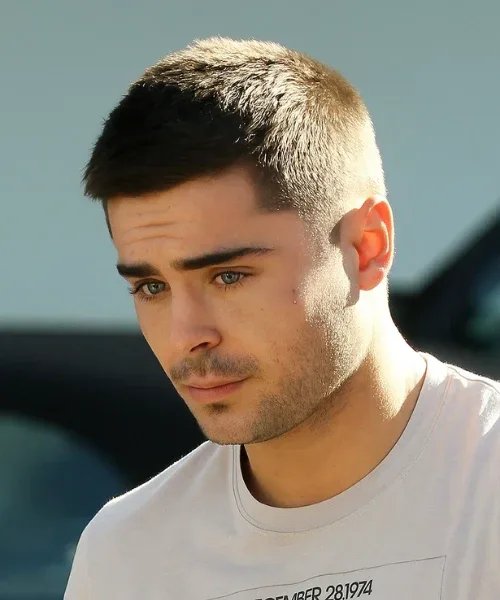
The original and still the most requested version. Half an inch to one inch on top, graduated so the front is fractionally longer than the crown, and soft taper on the sides. The barber uses scissor-over-comb on the top section to ensure the hair rounds naturally with the shape of the head rather than sitting flat.
Tell your barber, “Classic crew cut. Half inch to one inch on top graduated so the front is slightly longer than the crown. Low to mid taper on the sides. Scissor-over-comb on the top so it rounds with my head shape.”
Face shape: All universally flattering.
Hair type: All.
School safe: Yes, universally.
Guard numbers: 1.5 to 2 on sides, scissors on top.
Maintenance: Every 4-5 weeks.
Style time: Zero to 2 minutes.
Textured Crew Cut
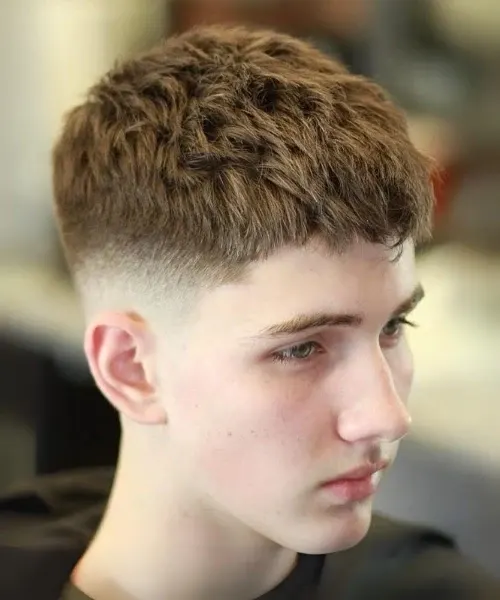
The 2026 update to the classic. Same structure, graduated top, short sides, but with point-cutting on the top section for natural separation and movement. Finished with light matte clay rather than pomade. The Reddit question “Is this just a crew cut?” I kind of like how the top has some texture to it” describes this version exactly.
Tell your barber, “Textured crew cut. One inch on top point-cut for texture and separation, not blunt. Mid fade on the sides. I want a matte, natural finish, not slick or smooth.”
Face shape: All the texture adds personality to any face shape.
Style time: 2 minutes with fingertip matte clay; work through dry hair.
Crew Cut with Fade
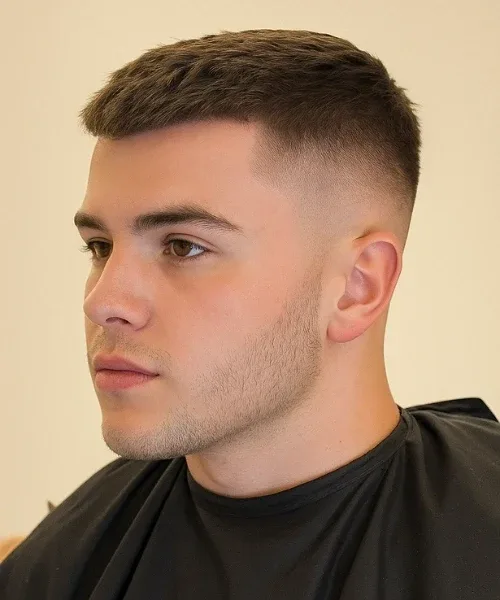
Mid fade on the sides combined with the crew-cut top structure. The fade provides sharper contrast than a taper and gives the classic crew cut a more modern, barbershop-current feel. The most popular crew cut combination in 2026.
Tell your barber, “Crew cut with a mid fade. The temple starts on the fade. Number 1.5 at the lowest, blending to 3. Half inch to one inch on top graduated.”
Maintenance: Every 3-4 weeks.
For the full mid-fade guide, our mid-fade haircut page covers every fade variation.
Crew Cut Low Taper
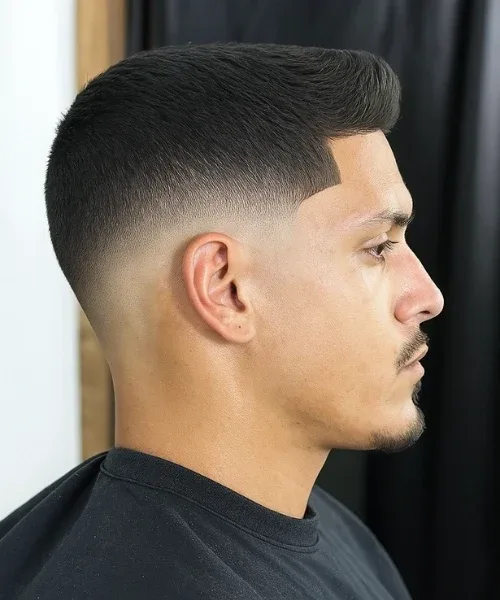
The most professional and conservative version. Low taper starting just above the ear, no skin visible anywhere, very gradual blend. The top graduates naturally go from front to crown. This version passes every professional dress code globally.
Tell your barber, “Crew cut with a low taper. Low taper on the sides, number 2 at the lowest, no skin. Half inch on top, graduated. Office appropriate.”
Office safe: Yes, in every environment.
School safe: Yes, universally.
Maintenance: Every 4-5 weeks.
For the full low taper guide, our low taper fade page covers every conservative variation.
Crew Cut Mid Taper
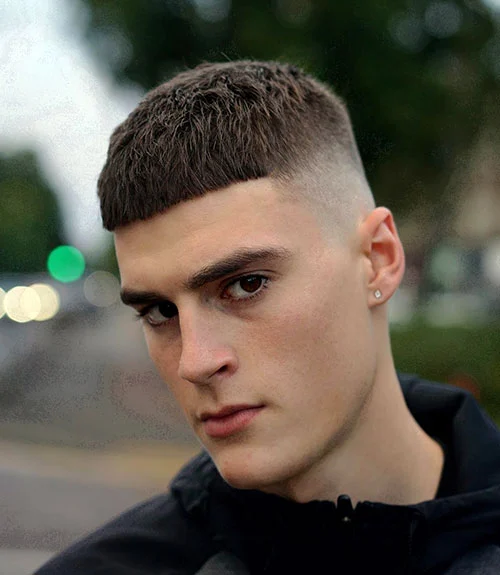
The balanced middle option. The mid taper starts at the temple level, producing moderate contrast between the short sides and the graduated top. More presence than the low taper, less aggressive than a skin fade.
Tell your barber, “Crew cut with a mid taper. Temple start. Number 1.5 at the lowest. Half inch to one inch on top, graduated front to crown.”
For the full mid-taper guide, our mid-taper fade page covers every variation.
Crew Cut Skin Fade
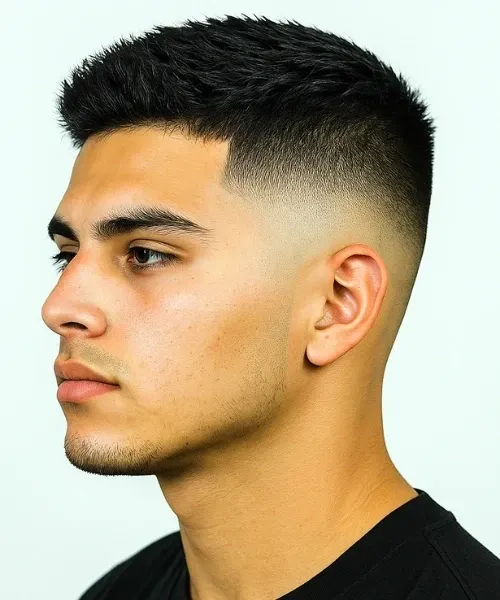
The sharpest version. Sides go to bare skin at the lowest section, zero guard, with a smooth blend upward to the crew cut top. Maximum contrast between the skin sides and the graduated top. The 2026 modern edge version that Queens NYC barbershop described as the crew cut getting its sharpest upgrade.
Tell your barber, “Crew cut with a skin fade. Zero guard at the lowest to skin. Mid-start. Blend smooth. Half inch to one inch on top, graduated.”
School safe: Check skin fades occasionally to conflict with school dress codes.
Maintenance: Every 2-3 weeks.
For the full skin fade guide, our skin fade haircut page covers every skin fade variation.
Long Crew Cut
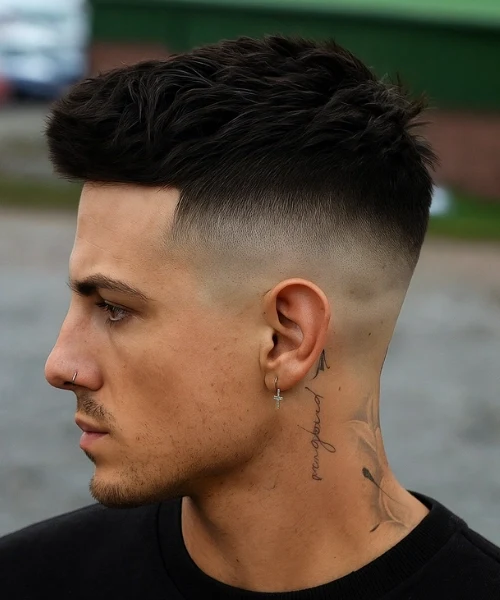
The top section is left at one and a half to two inches rather than the standard half inch to one inch. The gradient from front to crown is more pronounced. The extra length allows for side-parting, forward brushing, or a natural messy finish. This version sits between the classic crew cut and the Ivy League.
Tell your barber, “Long crew cut. Keep one and a half to two inches on top graduated so the front is longer than the crown. Low to mid taper on the sides. I want enough length to style the top.”
Maintenance: Every 4-5 weeks.
Style time: 3 minutes of matte clay or light cream.
Short Crew Cut
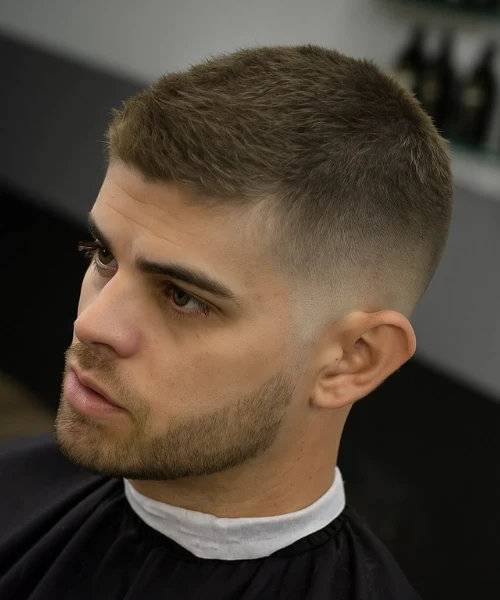
The top is kept at a quarter inch to half an inch very close to a buzz cut but with the defining crew cut graduation from front to crown still present. Zero daily styling. Military precision without the zero-length commitment of a full buzz.
Tell your barber, “Short crew cut. Quarter to half an inch on top to keep the graduation from the front to the crown. Number 1 at the lowest on the sides. Very clean and tight.”
School safe: Yes, universally.
Style time: Zero.
Maintenance: Every 3-4 weeks.
Crew Cut Side Part
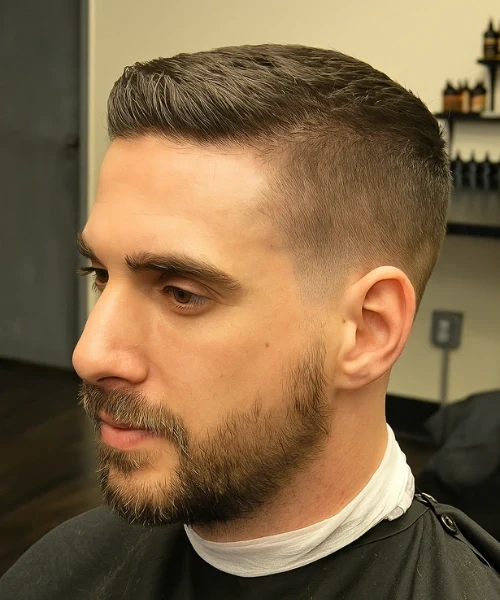
A defined side part is added to the graduated crew top, creating a polished, structured look that bridges the crew cut and the Ivy League. The hair on top is long enough to comb cleanly to one side. The sides stay short with a taper or fade.
Tell your barber, “Crew cut with a side part. Keep enough length on top to comb over cleanly to the left. The natural side part is not razor-shaved. Low taper on the sides.”
Office safe: Yes, one of the most formal crew cut versions.
Style time: 2 minutes of comb and light pomade.
Crew Cut Hard Part
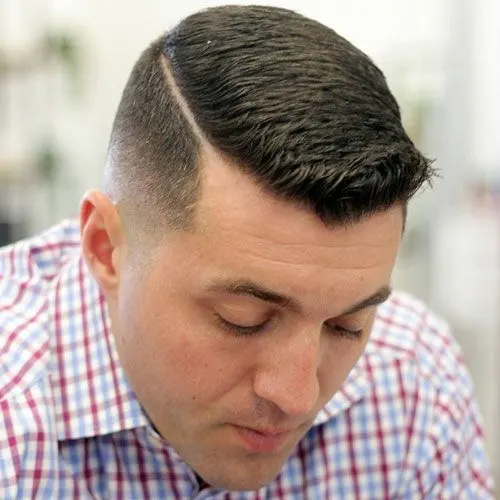
A razor-shaved line creates a precise boundary at the natural parting. Queens, NYC expert tip: the hard part should be approximately one millimeter wide, no wider, or it starts looking gimmicky rather than sharp. The hard part turns a standard crew cut into a deliberately architectural look.
Tell your barber, “Crew cut with a hard part. Razor-shaved lines at my natural parting keep it about one millimeter wide. Low to mid fade on the sides.”
Maintenance: Every 2-3 weeks the razor line grows out quickly and needs refreshing.
Crew Cut Comb Over
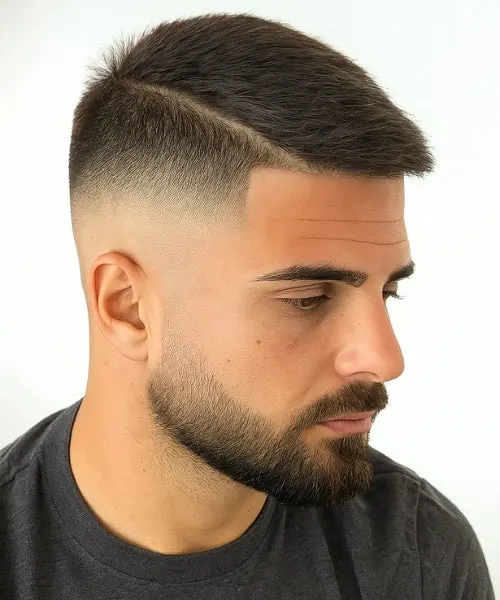
The top is left long enough to comb fully to one side, creating a sweep rather than a part. The movement is deliberate and directional. This version bridges the crew cut, the comb over, and the Ivy League into a single versatile style.
Tell your barber, “Crew cut comb over. Keep the top long enough to sweep completely to one side, with no visible part underneath, just a smooth sweep. Mid taper on the sides.”
Style time: 2 minutes. Comb and lightly hold pomade on damp hair.
Crew Cut Quiff
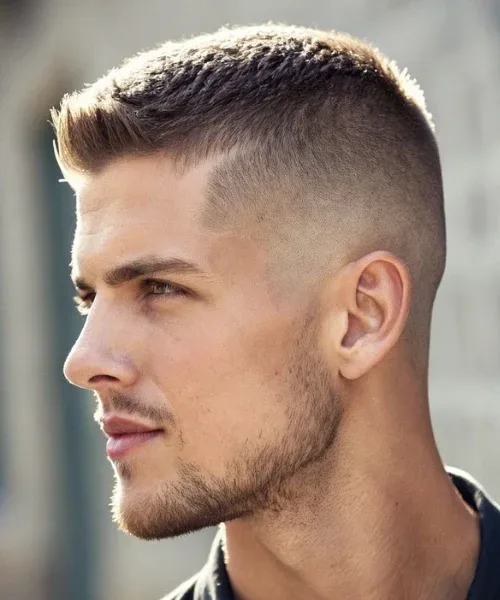
Volume pushed upward and forward at the front of the crew top. The quiff adds height that suits round face shapes particularly well. The crew-cut structure keeps the sides clean, while the quiff creates vertical proportion above.
Tell your barber, “Crew cut with a quiff front. Keep one and a half to two inches at the front; I want enough length to push the front upward. Crew cut graduation to the crown. Mid fade on the sides.”
Face shape: Round and heart-shaped; the height adds vertical proportion.
Style time: 4 minutes blow-dry upward at roots, light clay.
Crew Cut Flat Top
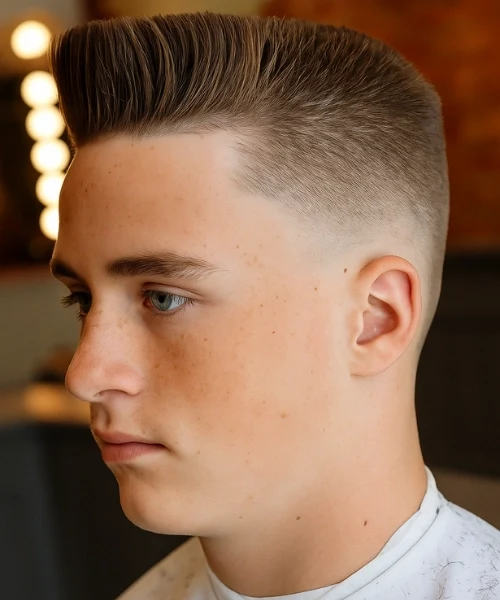
The top section is clipped level and flat rather than following the natural curve of the head, the classic military flat top silhouette. The sides and back are closely tapered or faded. The flat top requires precision clipper work to achieve a genuinely horizontal surface on top.
Tell your barber, “Flat top crew cut. I want the top section levelled and flat, genuinely horizontal, not rounded. Close taper or fade on the sides. This is a technical cut; please check from the front before finishing.”
Hair type: Works best on thick, straight hair that holds the flat surface.
Maintenance: Every 2-3 weeks, flat tops grow out visibly as the top rounds with new growth.
Curly Crew Cut
Type 2 to 3 curls on top with a crew-cut structure on the sides. The natural curl creates texture and volume on the short graduated top without any product. The crew-cut sides provide clean contrast.
The dry-cut rule applies: curly hair shrinks significantly when wet. Ask the barber to cut the top section dry.
Tell your barber, “Crew cut for curly hair. Please cut the top section dry; my curls shrink when wet. Keep half an inch to one inch on top dry. Mid fade or low taper on the sides.”
Style time: Curl cream on damp hair, scrunch, and air dry.
For dedicated curly guidance, our curly hairstyles for men page covers types 2A through 4C.
Crew Cut for Straight Hair
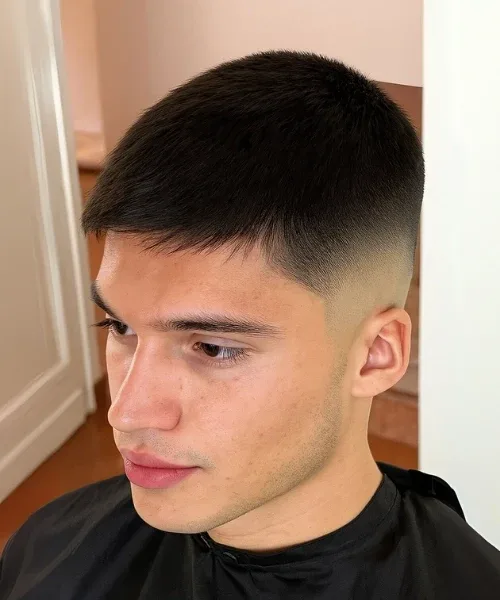
Straight hair produces the cleanest, most precise crew cut lines because the consistent flat strands make the graduation visible and sharp. The scissor-over-comb technique on straight hair creates a crisp, well-defined top section.
Tell your barber, “Crew cut for straight hair. Scissor-over-comb on the top—I want the graduation from front to crown to be visible and precise. Number 1.5 on the sides.”
For the full straight hair guide, our boys’ haircuts for straight hair page covers twenty cuts for this type.
Crew Cut with Beard
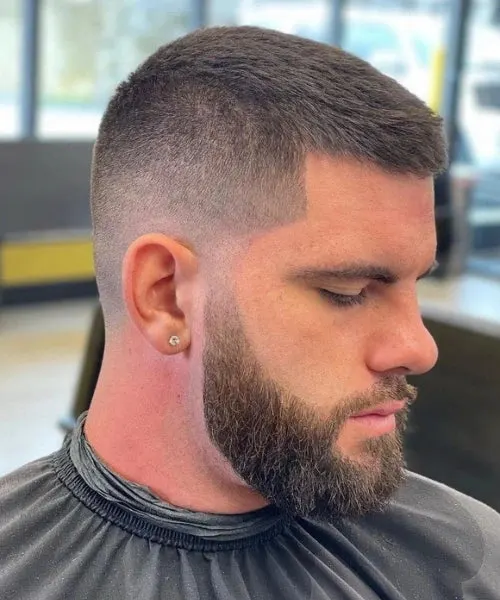
The crew cut’s short graduated top combined with a beard. The sides of the fade blend into the beard at the sideburn rather than cutting a hard line. Drake’s signature combination is the crew cut paired with a precisely edged beard—the short, clean top frames the face, and the beard adds definition at the jaw.
Tell your barber, “Crew cut blending into my beard. I want the fade at the sides to taper smoothly into the beard at the sideburn—no hard line. The crew cut the top as normal.”
Maintenance: Every 3-4 weeks.
Spiky Crew Cut
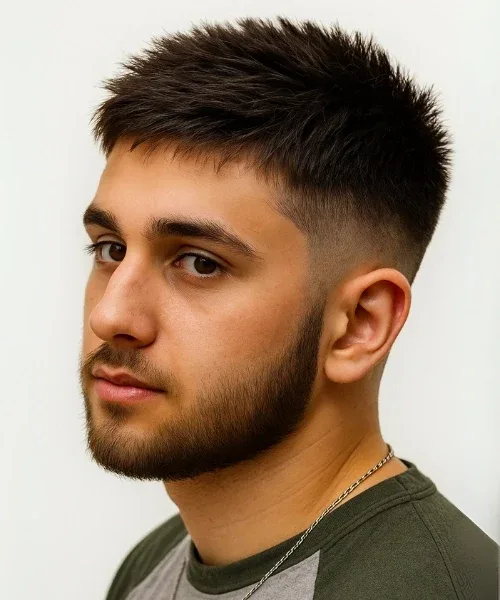
The crew-cut top is styled upward in loose spikes using gel or wax with a firm hold. The sides stay in the crew-cut structure. The result adds a playful, energetic character to the classic crew cut without changing the haircut itself—just the product and styling direction.
Tell your barber, “Standard crew cut—I style the top in spikes with product. Keep enough length to spike—half inch minimum on top.”
Style time: 3 minutes—firm hold gel or wax worked through dry top section.
Crew Cut for Receding Hairline
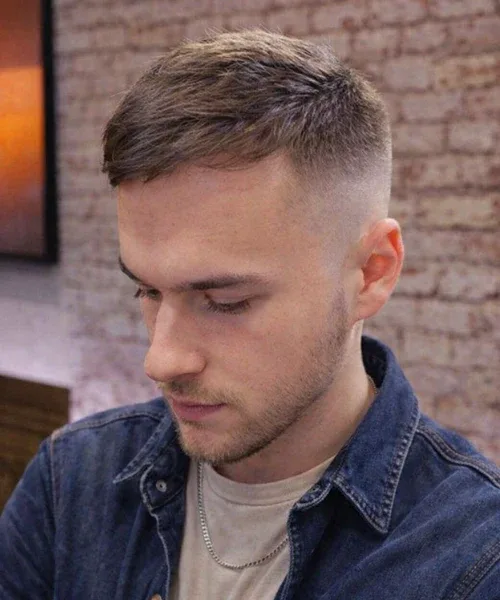
The crew cut is one of the most effective haircuts for receding hairlines. The short overall length reduces the contrast between the thinning sections and the fuller areas. When all the hair is short, the gradual hairline recession is significantly less visible than it would be on a longer style where the difference in density is obvious.
The forward-brushed crew cut is the strongest version—brushing the top section forward reduces the visual exposure of any recession at the temples.
Tell your barber, “Crew cut for a receding hairline. Keep the top section brushed forward rather than backward—this reduces the visible recession at the temples. Low taper. Conservative length.”
Crew Cut for Boys and Teens
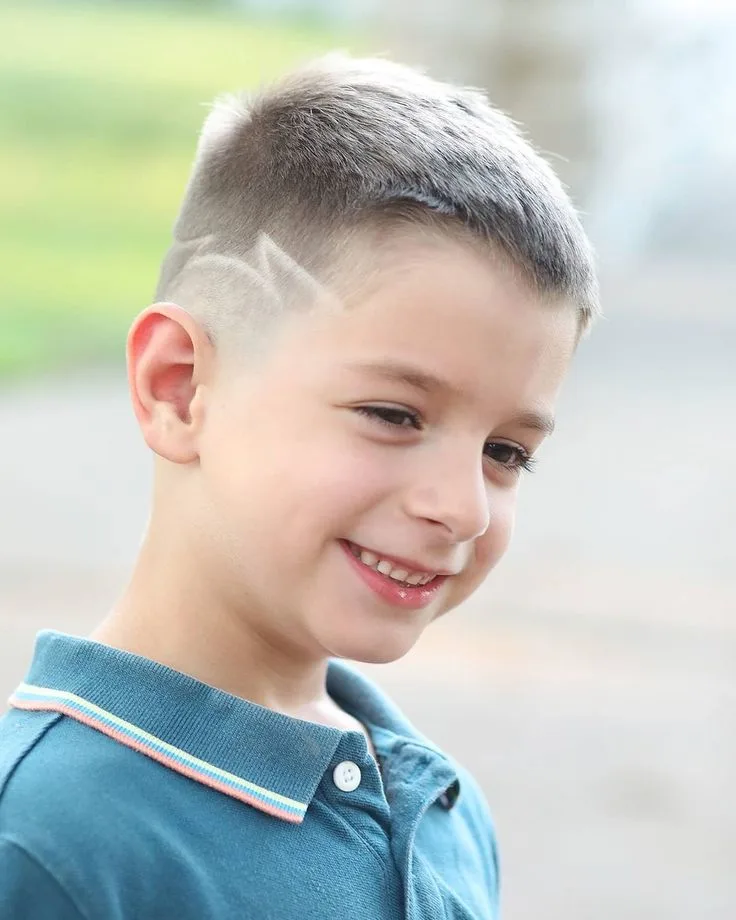
The crew cut is one of the most consistently school-appropriate haircuts for boys aged ten to eighteen. It passes every dress code in every school in every country without exception. It requires zero daily styling for active boys. It suits every hair type and face shape. It grows out gradually without an obvious neglected phase.
For boys ten to thirteen—classic crew cut with a low taper. School-safe everywhere, zero effort.
For teens fourteen to eighteen—classic, textured, or fade version. All school-appropriate.
Tell your barber (for boys): “Crew cut for an [age] year old. Classic or textured version. Low taper or mid fade. School-appropriate.”
For the full guides: our teen boy haircuts page and boys’ haircuts hub.
Crew Cut for Asian or Thick Hair

Thick, straight Asian hair holds the crew cut shape exceptionally well. The natural density produces clean, precise lines at the sides and a well-defined top section. The challenge is internal weight—thick hair on a short crew cut top can feel and look heavy without internal point-cutting to remove bulk.
Tell your barber, “Crew cut for thick Asian hair. Point-cut the top to remove internal bulk—I want movement and separation, not a flat heavy mass. Mid fade on the sides. Number 1.5 at the lowest.”
Crew Cut by Face Shape
Oval Face: The Best Match
Oval faces suit every crew cut variation without adjustment. The balanced proportions work with any top length and any taper or fade level. The classic, textured, and side-part versions all look particularly strong on oval proportions.
Square Face: A Strong Match
The crew cut enhances a strong square jawline by keeping the sides short and tight. The clean sides draw the eye to the jaw structure without fighting it. SWAGGER Magazine confirms: textured crops and crew cuts work particularly well for men with strong masculine jawlines.
Round Face Add Height
The crew cut on a round face benefits from slightly more top length and a quiff or upward-styled crown to add vertical proportion. The quiff crew cut or the textured version with crown volume elongates round proportions. Avoid very flat, close-cropped tops that emphasize the roundness.
Oblong Face: Keep It Short
The crew cut suits oblong faces best in their shorter versions, quarter inch to half inch on top. Avoiding significant crown volume prevents adding further height to an already long face. The classic flat or slightly rounded crew top is the correct approach.
Heart Face Low Taper Preferred
The heart face has a wider forehead and narrower chin. A low taper that keeps the sides slightly fuller balances the forehead width rather than emphasizing it through high-contrast fading. A forward-brushed crew top adds a downward direction that suits heart face proportions.
Diamond Face Balanced Option
Diamond faces have prominent cheekbones with narrower foreheads and jaws. A medium-length textured crew cut with a moderate taper balances the cheekbone prominence without adding width. Avoid very high fades that can emphasize the angular cheekbone structure.
Crew Cut by Hair Type
| Hair Type | Best Version | Key Technique | Daily Effort |
|---|---|---|---|
| Straight | Classic or textured | Scissor-over-comb | Zero to 2 min |
| Wavy | Textured or messy | Natural wave shows | Zero to 1 min |
| Curly | Curly crew | Cut top dry. | Scrunch and air dry |
| Thick or Asian | Mid-fade version | Point-cut for bulk | 2 min |
| Fine or thin | Classic conservative | No skin fade | Zero |
How Do I Ask a Barber for a Crew Cut?
The Universal Crew Cut Script
“Crew cut. Half inch to one inch on top graduated so the front is fractionally longer than the crown. Low to mid taper on the sides. Scissor-over-comb on the top so it rounds naturally with my head shape.”
That script covers the four essential elements: the top length, the graduation direction, the side treatment, and the top cutting technique. The scissor-over-comb instruction is the detail that separates a crew cut that looks deliberate from one that looks like a box.
Scripts Per Variation
Classic: “Classic crew cut. Half inch on top, graduated. Low taper. Scissor-over-comb on top.”
Textured: “Textured crew cut. One inch on top point-cut for texture, not blunt. Mid fade. Matte finish.”
Skin fade: “Crew cut with a skin fade. Zero guard at the lowest to skin. One inch on top, graduated.”
Conservative office: “Conservative crew cut. Number 2 on the sides, no skin. Low taper. Half inch graduated on top. Office appropriate.”
Military: “Military crew cut. Number 1 on the sides. Very short on top as close to regulation as possible.”
For boys: “Classic crew cut for a [age] year old. Low taper. Half-inch graduated. School appropriate.”
What Is a No. 1. Haircut?
A number one guard cuts hair to three millimeters, the tightest level before bare skin. On a crew cut, it is used at the lowest section of the sides in the taper or fade zone. Number two is six millimeters, and number three is nine millimeters. The Army regulation cut typically uses a number 1 or 1.5 on the sides with a scissor finish on the top.
Two Photos: Front and Side
The front photo shows the top length, graduation direction, and any styling preference. The side photo shows the taper height and the transition between the top section and the sides. Without the side photo, the barber cannot see the exact graduation angle you are referencing.
Can I Do a Crew Cut at Home?
PAA asks this directly, and the honest answer is “partially.”
The Honest Answer
The sides can be clipped at home with any quality clipper set using the chosen guard number. The scissor-over-comb graduation on the top section is the difficult part—this technique requires practice to execute consistently and symmetrically. Most men who attempt a home crew cut produce acceptable sides and a slightly uneven top graduation.
For the classic close crew cut at half an inch on top, home cutting is more achievable than for longer versions because there is less graduation visible to get wrong.
What You Need
Sharp kitchen scissors damage the hair shaft and produce uneven results. Quality clippers with at least four guard sizes. A wide-tooth comb for guide cutting. Two mirrors—front and back—to check symmetry.
What Can Go Wrong
The most common home crew cut mistake is cutting the top section too short on one side through an inconsistent comb angle. The graduation from front to crown is easy to miss without a guide, producing a flat rather than slightly domed top. The neckline cleanup—the line at the back of the neck is the hardest part to do alone and is where most home crew cuts look obviously self-cut.
Step by Step
Clip the sides first with the chosen guard, working from the neckline upward. Use a longer guard at the top of the sides to begin the blend. Switch to scissors for the top section. Use the comb as a guide; lift the comb horizontally across the top and cut against it, moving from front to crown with each pass. Leave the front section fractionally longer than the crown by reducing the comb angle as you move back. Clean the neckline with a straight-edge clipper or razor.
Crew Cut vs. Buzz Cut: The Full Comparison
The crew cut and buzz cut are used interchangeably in casual conversation. They are not the same haircut.
A buzz cut uses the same guard from front to back with no graduation. The result is an even length all over the top. A crew cut uses a shorter guard on the sides and a scissor-over-comb on the top to create a graduated top that is longer at the front and shorter at the crown.
The crew cut has a defined top section. The buzz cut has no defined top section; everything is the same length.
Which lasts longer: both need attention every three to four weeks in their taper versions. The skin-fade versions of both need trimming every two to three weeks.
Which is easier to maintain daily: the buzz cut requires absolutely zero styling because there is no length difference to manage. The crew cut requires zero to two minutes depending on whether a texture product is used on top. Both are among the lowest-maintenance haircuts available.
For the full buzz cut guide, our buzz cut page covers every guard number and variation.
Crew Cut for School and Office
School Safety Always Passes
The crew cut is the most school-safe men’s haircut in existence. No school dress code in any country specifically prohibits a crew cut. The classic version with a taper passes every conservative, religious, and state school dress code without any discussion.
The only crew-cut elements that occasionally require a school policy check are the skin fade version, where the sides go to bare skin and shaved designs or hard parts.
Office Safety: Always Professional
The crew cut is the default professional haircut. It is worn by military officers, corporate executives, professional athletes, and everyone in between. There is no professional environment that requires a conversation about whether a crew cut is appropriate; it always is.
| Version | School Safe | Office Safe |
|---|---|---|
| Classic crew taper | Yes, universally. | Yes, everywhere. |
| Textured crew fade | Yes, usually. | Yes, everywhere. |
| Skin fade version | Check policy. | Yes, most environments |
| Hard part version | Yes. | Yes. |
| Flat top | Yes. | Yes. |
For boys specifically: our boys’ haircut hub covers ages seven to eighteen with per-style school safety ratings. Our teen boy haircuts guide covers the full teen range.
How Long Does a Crew Cut Last?
Maintenance Table by Version
| Version | Looks Sharp | Trim Needed |
|---|---|---|
| Classic low taper | Weeks 1-4 | Every 4-5 weeks |
| Textured mid fade | Weeks 1-3 | Every 3-4 weeks |
| Skin fade version | Days 1-10 | Every 2-3 weeks |
Annual Cost: The Lowest of All Cuts
The classic crew cut is the most cost-effective, well-maintained haircut available. At ten to twelve visits per year for the standard version, it costs between $250 and $300 annually at a standard barbershop price of $30 per visit in the US.
| Version | Visits Per Year | Annual Cost |
|---|---|---|
| Classic low taper | 10-12 | $250 to $300 |
| Mid-fade version | 12-15 | $300 to $375 |
| Skin fade version | 17-26 | $425 to $650 |
For comparison, a high skin fade costs two to three times the annual investment of a classic crew cut taper. The crew cut produces a clean, professional result for less money and less frequent barbershop time than any other modern-styled haircut.
Browse More Haircut Guides
For the shorter alternative with no graduation, our buzz cut guide covers every guard number from zero to four.
For more texture on top: our textured crop haircut page covers the textured alternative with the point-cutting technique explained.
For the side comparisons: our low taper fade guide, mid taper fade page, and skin fade guide cover every side treatment option.
For the full fade comparison, our taper vs. fade guide explains the difference with exact terminology.
For curly hair: our curly hairstyles for men page covers types 2A through 4C.
Not sure which version suits your face shape? Our teen haircut finder quiz takes sixty seconds.
Frequently Asked Questions
What is a crew cut haircut for men?
A crew cut is a short men’s haircut with tapered or faded sides and a slightly longer top section that graduates from longer at the front to shorter at the crown. The front is fractionally longer than the crown; this graduation is the defining technical element. The standard top length is half an inch to one inch. The sides are clipped shorter than the top using a taper or fade. It originated at Yale University in the 1920s and remains one of the most universally flattering men’s haircuts available.
Who looks good with a crew cut?
Everyone. The crew cut suits all face shapes; it is the most universally flattering men’s haircut because the short sides work with every face proportion, and the top length can be adjusted to balance any face shape. Round faces benefit from slightly more crown volume. Oblong faces suit shorter versions. Square faces are enhanced by the clean side contrast. Oval faces suit any version equally.
How do I ask a barber for a crew cut?
Say: “Crew cut. Half inch to one inch on top graduated so the front is fractionally longer than the crown. Low to mid taper on the sides. Scissor-over-comb on the top so it rounds with my head shape.” Specify whether you want a taper or a fade on the sides and your preferred top length. Bring a front photo and a side photo.
What is a crew cut with taper?
A crew cut with a taper means the sides gradually shorten from longer near the top of the sides to shorter toward the neckline, with visible hair maintained throughout the gradient, never going to bare skin. The taper produces a conservative, professional side treatment. A crew cut with a fade takes the sides shorter, sometimes to bare skin, for stronger contrast.
What is the Gen Z haircut?
The Gen Z haircuts include the textured crop, wolf cut, and two-block as the defining styles. The crew cut itself is not specifically Gen Z; it spans all generations and has been worn continuously since the 1920s. The modern textured crew cut with a mid or skin fade has been adopted by younger men in 2026 as the crew cut version that fits the Gen Z preference for natural texture over structured styling.
What is a crew cut vs. fade?
The crew cut describes the haircut structure: graduated top and short sides. The fade describes the technique used on the sides: a gradual blend from shorter at the bottom to longer toward the top. A crew cut can have a taper or a fade on the sides. “Crew cut fade” typically means the sides use a fade technique rather than a traditional taper. The top section is the same either way.
What is a no. 1 haircut?
A number one guard cuts hair to three millimeters, the tightest level before bare skin. On a crew cut, it is typically used at the lowest section of the sides. Number two is six millimeters, number three is nine millimeters, and number four is twelve millimeters. Specifying the guard number when asking for a crew cut removes all ambiguity about how tight the sides should be.
Is a crew cut high maintenance?
No, the crew cut is one of the lowest-maintenance haircuts available. The classic version with a taper needs a trim every four to five weeks. Daily styling ranges from zero to two minutes with light matte clay for the textured version. No blow dryer required. Annual cost is the lowest of any styled modern haircut at approximately $250 to $300 for standard visits.
Can I do a crew cut at home?
Partially. The sides can be clipped at home with a standard clipper set using the appropriate guard. The scissor-over-comb graduation on the top section is the difficult part that requires practice to execute evenly. The neckline cleanup is the hardest element to do alone. A clean home crew cut on the sides is achievable for most men. The top graduation and neckline are better left to a barber until the technique is practiced.
Is a crew cut a military hairstyle?
The crew cut is associated with the military but did not originate there. It originated at Yale University’s rowing team in the 1920s. The US military adopted it during World War II for its practicality and hygiene advantages. In 2026 it is simultaneously the regulation haircut of military branches worldwide and a mainstream civilian choice on red carpets and in professional environments.
What is the Army number 1 haircut?
The Army number 1 haircut refers to clipping the sides with a number 1 guard three millimeters combined with a short graduated top, meeting US Army Regulation AR 670-1 requirements. The regulation requires a tapered appearance with hair that does not touch the collar, ears, or eyebrows. Most Army regulation cuts use a number 1 or 1.5 on the sides with scissor-over-comb on the top, producing a tight, clean crew cut that meets grooming standards.
Which is better, a U or a V cut?
The U cut and V cut are terms for the shape of the neckline rather than the entire haircut structure. A U cut at the neckline creates a rounded bottom edge. A V cut creates a pointed shape at the center of the neckline. For crew cuts, most barbers default to a squared or rounded neckline. Neither is objectively better; it is a personal preference that does not significantly change the overall appearance of the crew cut from the front.
Why is a crew cut called a crew cut?
The name comes from Yale University’s rowing team in the 1920s. Rowing teams are called crews, and the Yale crew kept their hair very short to prevent it from blowing across their faces during competition on the water. The style spread from the Yale crew to other university students, then to the military during World War II, then to mainstream civilian life. The association with the Yale rowing crew gave it the name that has remained for over one hundred years.
Is a crew cut school appropriate?
Yes, universally. The crew cut is the most school-appropriate men’s haircut in existence. No school dress code prohibits a crew cut. The classic version with a taper passes every conservative, religious, and state school dress code without any discussion. The only elements that occasionally need a policy check are the skin fade version and any shaved designs added to the sides.
The crew cut never needed saving. It never needed a comeback. It was being cut every day in every barbershop while people were writing headlines about its return.
What 2026 added is the modern version of the textured crew with a mid fade and a matte finish that gave the classic structure a contemporary expression. Same graduation. Same short sides. Same universal flattery across every face shape. Just matte clay instead of pomade and a point-cut texture instead of a smooth flat top.
Pick the version that matches your lifestyle. The classic if you want zero daily effort. The textured fade if you want something current. The low taper if you need the most professional option possible.
Any barber in any country can execute a crew cut correctly. It is the most fundamental short men’s haircut in barbering.
For the shorter alternative, our buzz cut guide covers every guard number. For boys and teens, our boys’ haircuts hub covers every age from seven to eighteen.