Edgar Haircut 2026: 20 Styles, the Real History, and Exactly What to Tell Your Barber
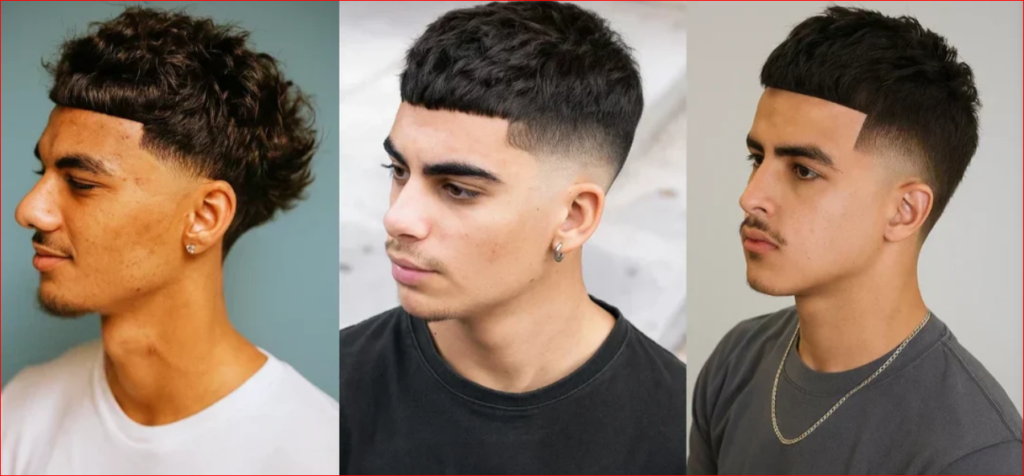
The Edgar is probably the most meme-worthy haircut of the last decade. It has its own Wikipedia page, its own subreddit, its own NBC News article, and a restaurant in San Antonio that banned it. A country banned it in schools.
None of that stopped it.
In 2026, the Edgar haircut is one of the most requested cuts in barbershops across the United States. The requests are getting more specific: fluffy Edgar, Edgar the mullet, curly Edgar, and Edgar with design. The original crossed over from Latino barbershop culture into mainstream style guides, GQ, and every major grooming publication. Athletes wear it. Musicians wear it. Gen Z men of every background wear it.
Here is what the memes miss: when an Edgar is executed correctly, the fringe line is genuinely straight, the skin fades seamlessly, and the disconnection between the top and sides is precise. It is one of the most technically demanding and visually striking cuts a barber can produce. A bad Edgar looks like a bowl-cut disaster. A good one looks incredibly clean.
This guide covers twenty Edgar haircut styles for 2026, the actual cultural history behind the cut, exactly what to tell your barber, and the fixing guide for the three most common Edgar problems nobody else addresses.
At a Glance — Quick Picks
| Need | Best Edgar Version |
|---|---|
| Classic original | Mexican Edgar high skin fade + straight fringe |
| Most popular 2026 | Fluffy Edgar volume + textured fringe |
| Curly hair | Curly Edgar cut dry, natural fringe texture |
| School appropriate | Conservative Edgar mid taper, no design |
| Special event | Edgar with design razor art in the fade |
| Less aggressive | High taper Edgar not to skin |
| Long back | Edgar Mullet trending combination |
| Short overall | Edgar Buzz Cut |
What Is an Edgar Haircut?
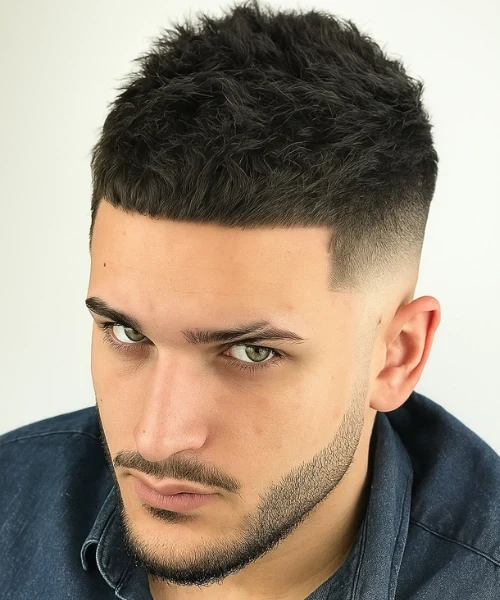
An Edgar haircut is a men’s style with three defining elements: a straight blunt fringe across the forehead, a high skin fade on the sides and back, and a clear visual disconnection between the faded sides and the longer top section. It is named for its association with Latino culture, specifically the Mexican-American community in Texas and the US Southwest, though the exact origin of the name is unconfirmed.
The fringe is the signature element. Without a straight fringe, you do not have an Edgar. Without the high fade and the disconnection from the top, you have a different cut. All three must be present.
The Three Non-Negotiables
Every Edgar has three elements. If any one of these is missing, you are looking at a different haircut, usually a Caesar cut, a bowl cut, or just a fade with bangs.
Non-negotiable one: The straight fringe line. Not curved. Not angled. Not textured to the point of losing the line. The fringe falls forward and ends in a clean, horizontal line across the forehead. This is what makes an Edgar an Edgar and not just a taper with some length on top.
Non-negotiable two: High skin fade. The sides go to the skin or very close to it, starting high on the head. The contrast between the skin fade and the full fringe above is the visual impact of the cut.
Non-negotiable three: Clear disconnection between fade and top. There is a visible separation between where the fade ends and where the top hair begins. This is not a blended taper. There is a line, and that line is intentional.
Edgar vs. Caesar: Cut the Real Difference
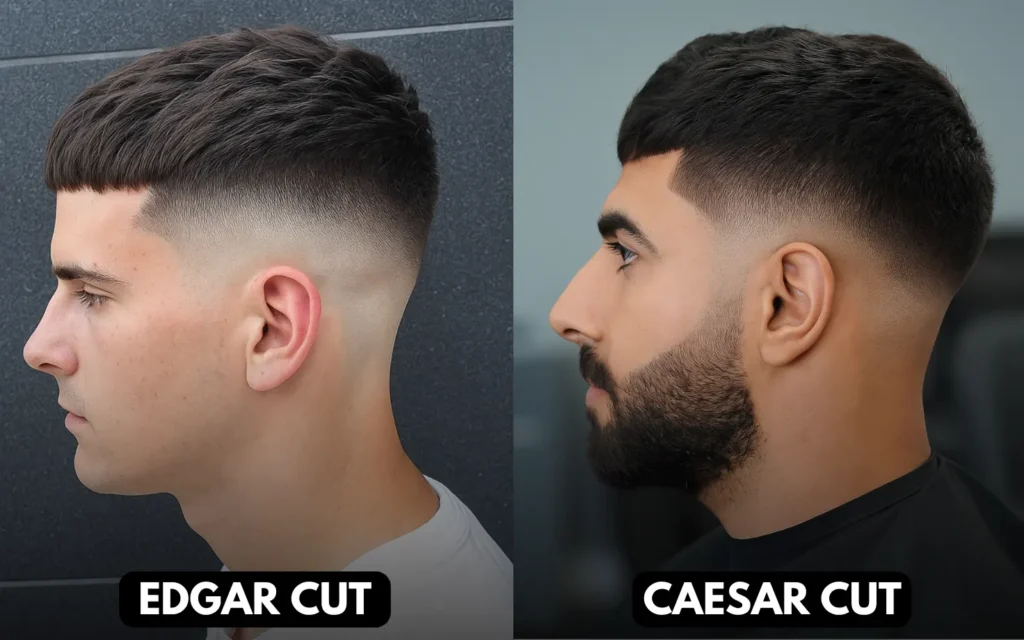
Both the Edgar and the Caesar cuts have a forward fringe. Both are short on the sides. The similarities end there.
The Caesar uses a lower, blended taper rather than a high skin fade. The contrast is moderate. The fringe is part of a gradual transition from top to sides. The overall look is polished and professional.
The Edgar uses a high skin fade with a clear disconnection between the fade zone and the top. The contrast is dramatic. The fringe sits above visually separate sides. The overall look is bold and deliberate.
The Edgar has way more attitude. That is the entire point.
Edgar vs. Bowl Cut: Why the Comparison Is Wrong
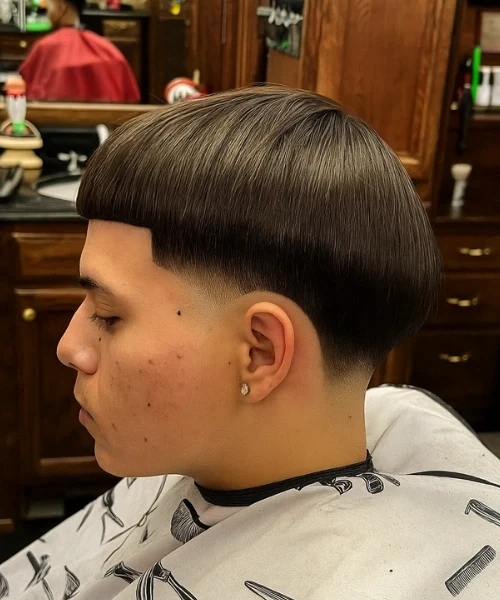
The internet compares Edgar to a bowl cut constantly. The comparison misses what makes the Edgar technical.
A bowl cut cuts even length all the way around the hair and sits uniformly from fringe to sides to back. No fade. No disconnection. No contrast. The result is what everyone makes fun of in the meme compilations.
The Edgar has a skin fade. The Edgar has a disconnection. The Edgar has a contrast between the full-length top and the nearly shaved sides. The bowl cut has none of these.
Calling an Edgar a bowl cut is like calling a suit a bathrobe. They both cover the body. That is where the comparison ends.
Who Made the Edgar Cut Popular?
The origin of the name Edgar is unconfirmed. It is often misattributed to former Seattle Mariners baseball player Edgar Martínez; Wikipedia confirms this attribution is incorrect. The name most likely came from an early wearer in the Texas or Southwest border community whose name was Edgar, but no definitive origin has been established.
What is confirmed: the cut became popular with Generation Z and Millennials during the 2010s and 2020s, first gaining traction in US border states like Texas, New Mexico, Arizona, and California. It spread from the Latino barbershop culture of the Southwest before crossing over to mainstream style culture by 2023.
The Real History of the Edgar Haircut
How come so many guys are getting this Edgar cut? Why is it so popular with the youths right now in the USA? The answer is longer than most people expect.
Indigenous Roots: Jumano Tribes

Before the Takuache subculture. Before TikTok. Before the memes. The hairstyle has been found to have similarities to the hairstyles of Indigenous tribes such as the Jumano, a Native American people of the Texas-New Mexico border region. A 2021 San Antonio Express- A news report confirmed the connection. The straight fringe with shaved sides was not invented in a Texas barbershop in 2019. It has roots that predate the internet by centuries.
Texas, Southwest, Where It Started

The modern Edgar cut first gained traction in US border states in the early to mid-2010s. Texas, New Mexico, Arizona, California. The Rio Grande Valley of Texas is specifically cited as an origin point. Barbershops in San Antonio, El Paso, and cities along the US-Mexico border were cutting it years before the wider internet noticed.
The Takuache Culture Connection

The Edgar haircut is inseparable from the Takauache cultural movement. The word “takuache” means “opossum” in Spanish and is used as slang for young Mexican-American men who embrace a specific aesthetic: truck enthusiasm, cowboy boots, corridos and rancheras music, and a connection to Mexican ranch culture. The haircut became so associated with this movement that “takuache haircut” and “cuh haircut” became their own search terms.
The “cuh” name comes specifically from the Rio Grande Valley of Texas, derived from the song “Cuh 956” by Dagobeat. In the Valley, asking your barber for “the cuh” and asking for an Edgar meant the same thing.
For members of this community, the cut represents something beyond a hairstyle. It is a form of expression, a connection to cultural heritage, and a visible marker of generational identity. It represents a combination of new trends and cultural heritage that seeks to make an impact while breaking conventional boundaries.
The Meme Era and Crossover 2019-2024
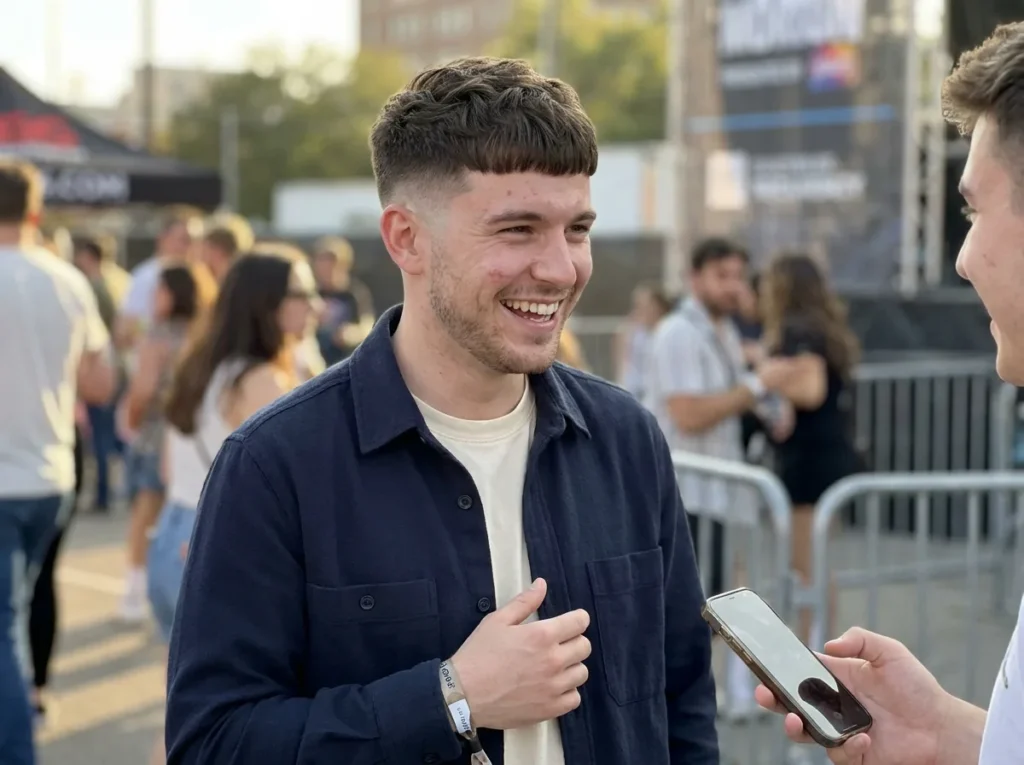
The Edgar haircut meme exploded around 2019-2020. Social media found the cut, compared it to bowl cuts and helmet shapes, and the comments sections went to war. The memes kept coming. The cut kept getting requested.
A restaurant owner in San Antonio banned the Edgar due to an association with “gangster culture.” The ban drew significant backlash. A mural was painted downtown showing the cut’s indigenous roots in response.
NBC News covered it in March 2023. CBS News covered it. The Dallas Morning News broke the story. The Chicago Sun-Times wrote about it. GQ covered it in the UK. By 2023 the Edgar had crossed over; non-Latino barbers were learning it, style publications that had never covered Latino grooming culture were writing about it, and athletes and musicians were wearing variations publicly.
A professor at the University of Texas at El Paso noted that the teen popularity of the style makes it “a really big marker of this generation.”
2026 The Edgar Is Now a Category
In 2026, the Edgar is what the undercut was in 2015, so widespread that it has stopped being a trend and has become a permanent part of the men’s haircut vocabulary. The original blunt-fringe-with-skin-fade has branched into fluffy Edgars, textured Edgars, curly Edgars, Edgar mullets, Edgar buzz cuts, and Edgar cuts with razor designs. It is not one haircut anymore. It is a family of haircuts united by the straight fringe and the high fade.
20 Edgar Haircut Styles for 2026
Classic High Skin Fade Edgar
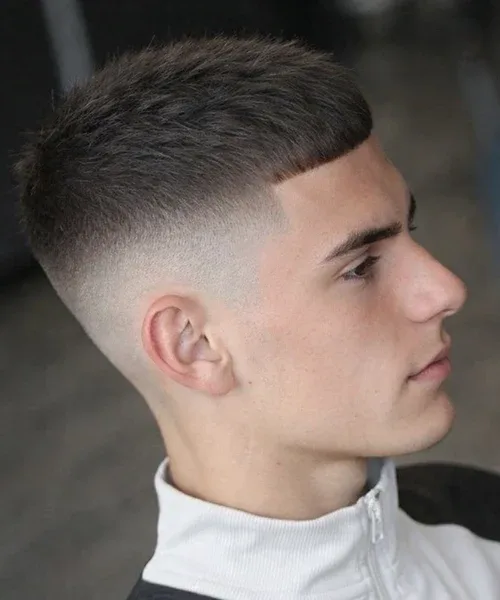
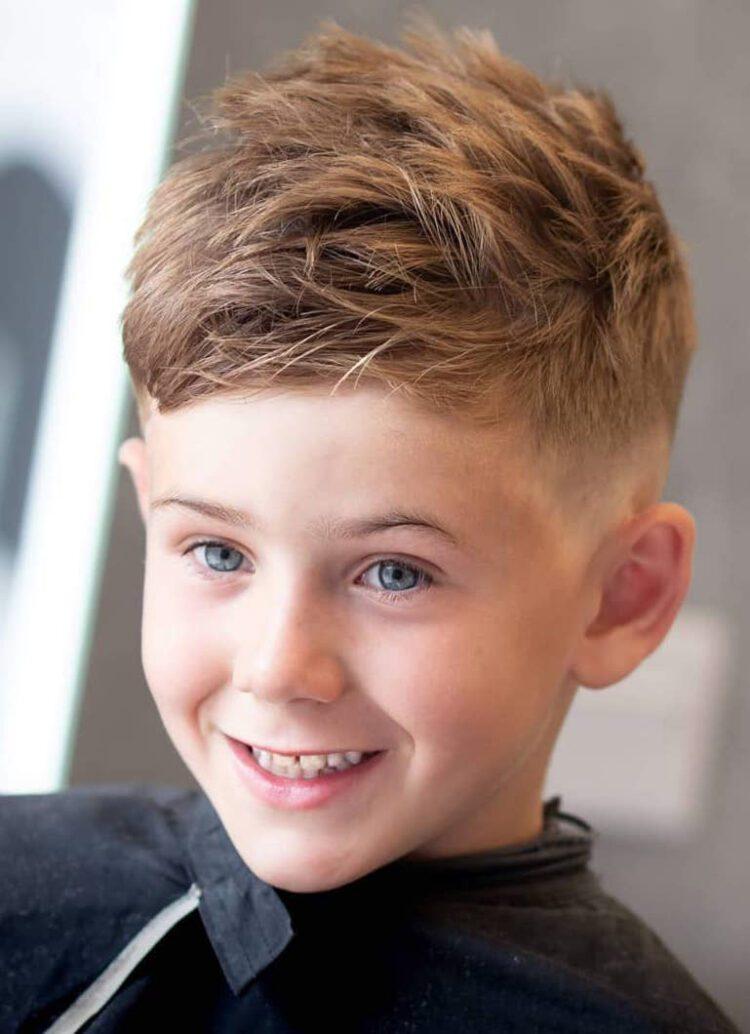
The original. Straight blunt fringe at eyebrow length, high skin fade starting well above the ear, and clear disconnection between the shaved sides and the full top. This is the Edgar that started everything. The fringe has weight and structure. The sides go to skin. The contrast is dramatic.
Tell your barber, “Edgar cut. High skin fade number 0.5 at the lowest. Straight fringe at eyebrow length cut it straight across, not angled. Clear disconnection between the fade and the top. Line-up at the forehead.”
Face shape: Oval and square; the geometry of the Edgar suits angular features.
Hair type: Thick and straight; this version needs the weight to hold the fringe.
School safe: Check high skin fade occasionally conflicts with conservative school dress codes.
Guard numbers: 0.5 at lowest, clear disconnection.
Maintenance: Every 2-3 weeks skin fades grow out fast.
High-Taper Edgar
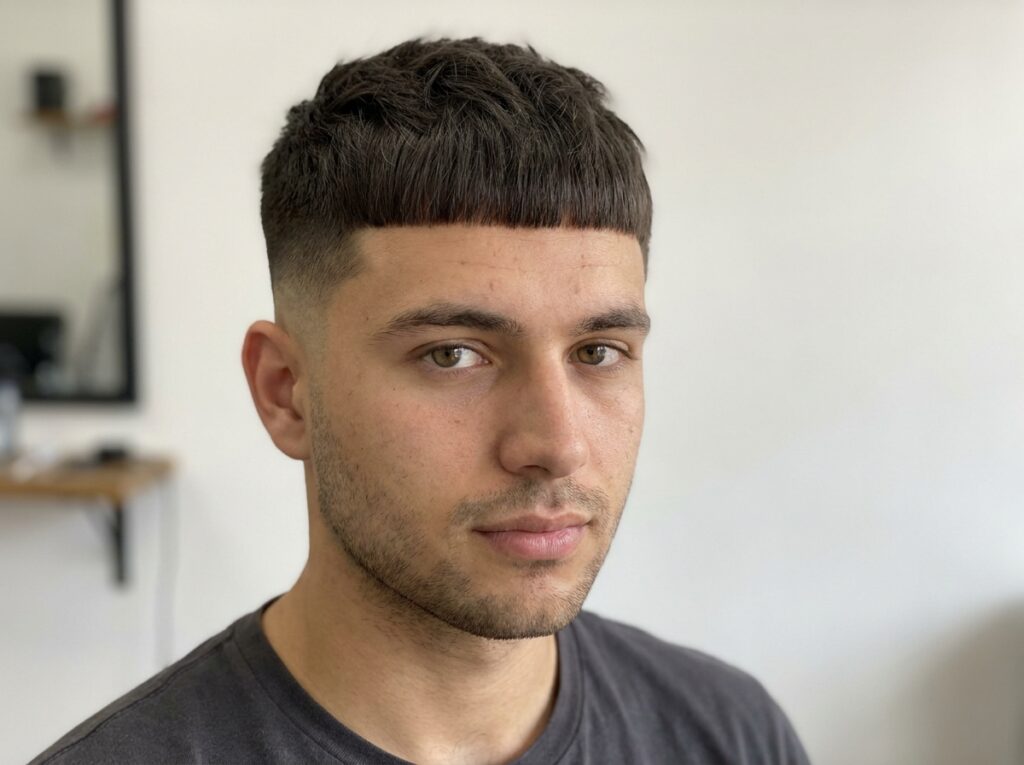
The classic Edgar structure with a high taper instead of a skin fade. The sides are cut short but keep some visible hair rather than going to bare skin. The contrast is slightly less dramatic, but the fringe and disconnection remain. More school-appropriate and more forgiving on growth-out.
Tell your barber, “Edgar with a high taper not to skin. Keep a number 1 or 1.5 at the lowest rather than skin. Straight fringe at eyebrow length. Clear disconnection at the top.”
School safe: Check better than skin fade but still needs policy verification.
Maintenance: Every 3-4 weeks.
Fluffy Edgar Cut
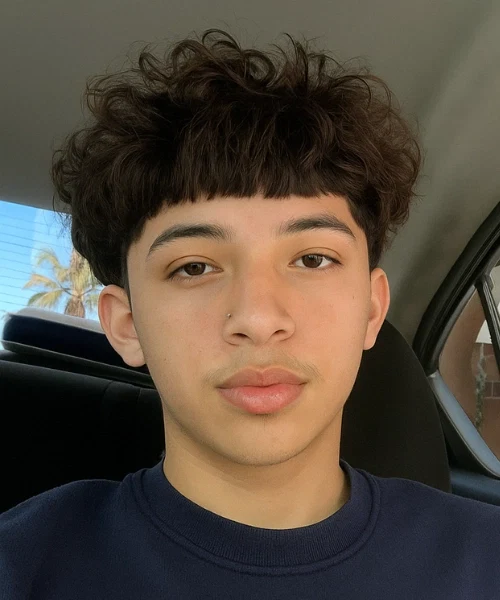
The biggest Edgar variation of 2026. The classic blunt fringe structure remains, but the top section is blown out for volume, and the fringe is point-cut for texture and separation rather than left completely blunt. The fringe falls forward with visible individual pieces rather than as a solid mass. The result is softer, lighter, and more modern than the classic.
Tell your barber, “Fluffy Edgar. High skin fade. Keep the fringe at eyebrow length; point-cut the fringe for texture and separation, not completely blunt. I want volume on top before the fringe falls forward. Keep two and a half to three inches on top.”
Face shape: Round and oval; the volume adds height.
Hair type: Wavy and curly hair produce the most natural fluffy result. Straight hair needs a blow dryer and thickening mousse.
School safe: Check depends on fade level.
Style time: 4-5 minutes blow-dry upward then forward, light clay.
Curly Edgar Haircut
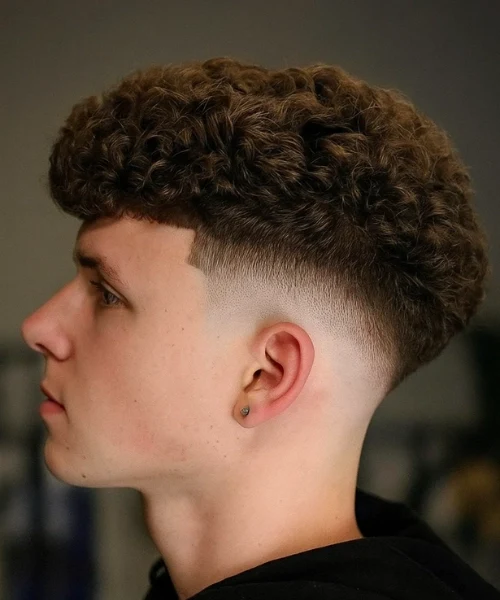
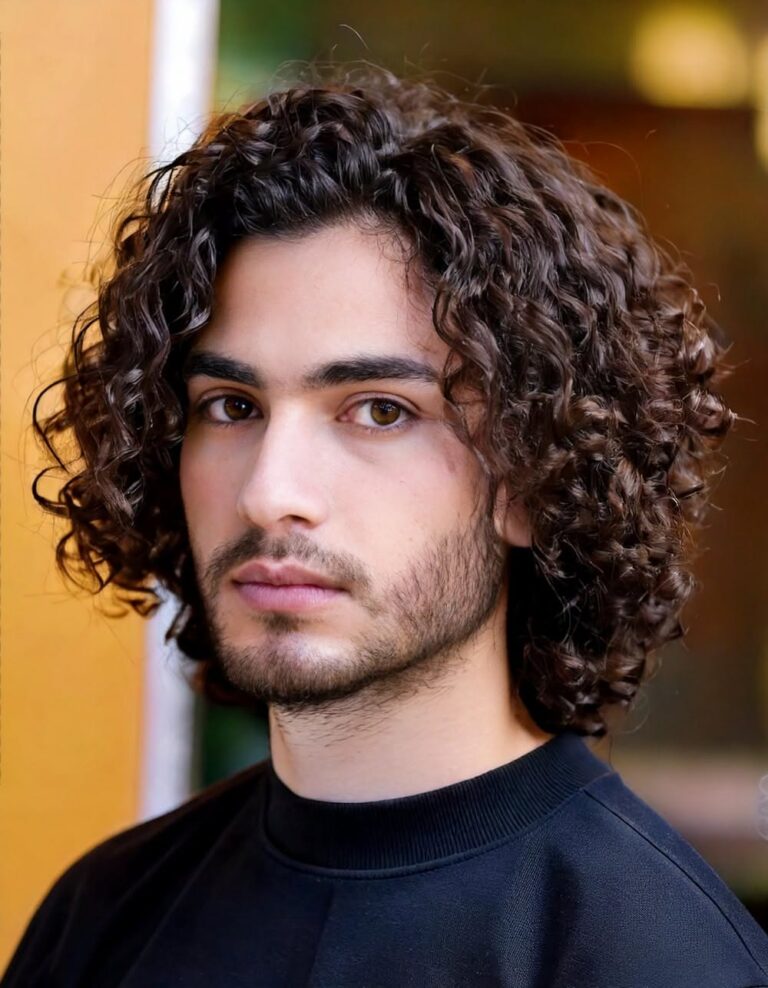
Curly hair is one of the most popular modern Edgar variations because the natural curl texture creates fringe movement and dimension that straight hair needs product to produce. The curls provide the “fluffy” quality; automatically, the fringe does not sit as a solid blunt mass but breaks naturally into separated curl pieces.
The critical instruction: ask the barber to cut the fringe section dry. Curly hair shrinks between thirty and fifty percent when dry. A barber who cuts the fringe wet will produce a significantly shorter result than intended.
Tell your barber, “Curly Edgar. High skin fade or high taper. Please cut the fringe section dry; my curls shrink significantly when wet. Keep the fringe at eyebrow length dry.” I want the natural curl to provide the texture.”
Face shape: Oval and round curls add natural width.
Style time: Curl cream through damp fringe, scrunch forward, and air dry.
Maintenance: Every 2-3 weeks.
For the complete curly guide, our curly hairstyles for men page covers types 2A through 4C.
Messy Edgar Cut
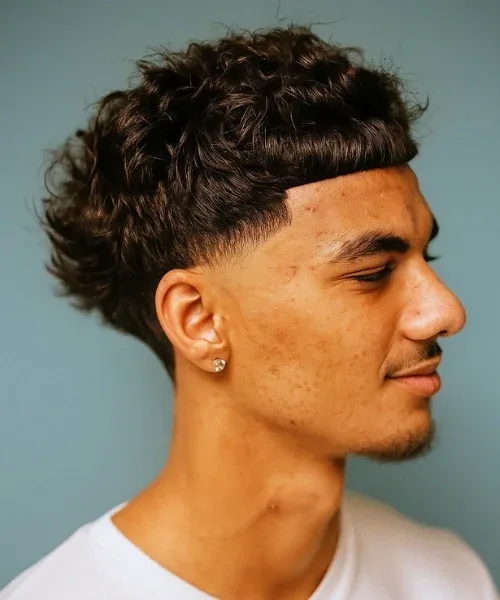
The deliberately undone version. The straight fringe line is maintained, but the top is point-cut heavily and styled with intentional disorder, with pieces going slightly different directions, some forward, some slightly to the side. The goal is effortless chaos rather than the rigid precision of the classic.
Tell your barber, “Messy Edgar. High skin fade. Keep the fringe at eyebrow length heavily point-cut for separation and texture. I want the fringe to look intentionally undone rather than perfectly straight across.”
School safe: Check.
Style time: Under 2 minutes, matte clay worked through damp fringe with fingers.
Short Edgar Cut
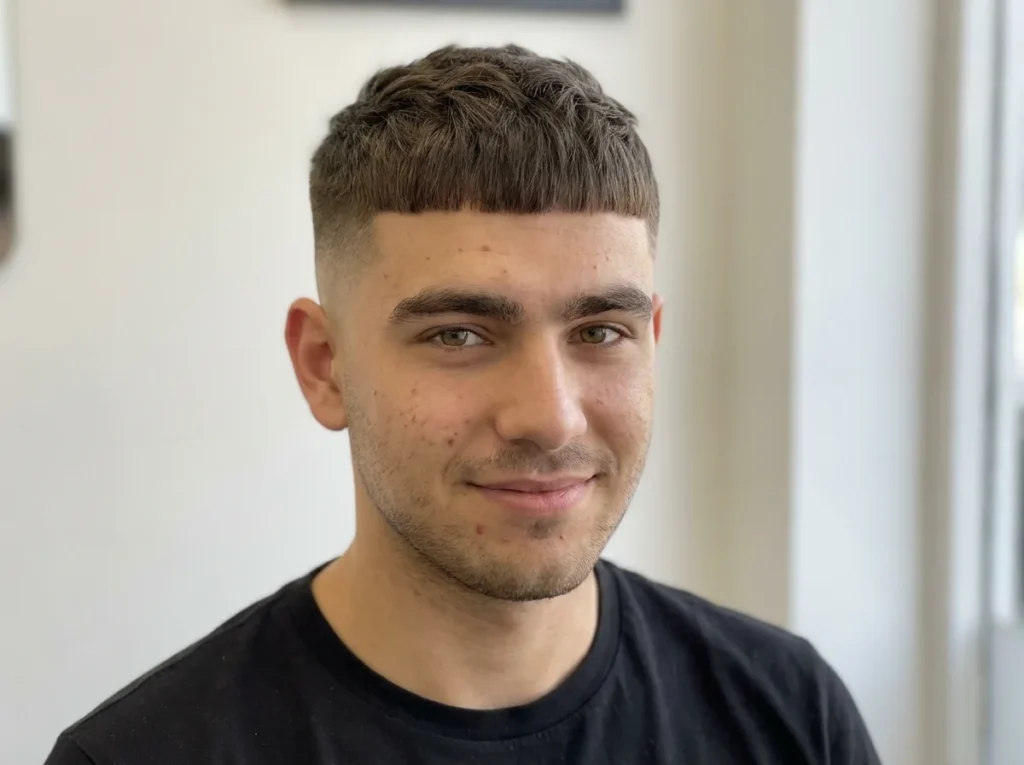
A cropped Edgar where the top section is kept to one to one and a half inches. The fringe still falls forward but with less length and less volume. The fade is typically high skin to maintain the classic Edgar proportions with the shorter top.
Tell your barber, “Short, Edgar. High skin fade. Keep the top to an inch and a half straight fringe at just above the eyebrow. Clear disconnection. Short version.”
Face shape: All the shorter top reduces the contrast with the skin sides slightly.
Maintenance: Every 2 weeks, short tops and skin fade grow out fast.
Style time: Under 60 seconds.
Edgar Mullet Haircut
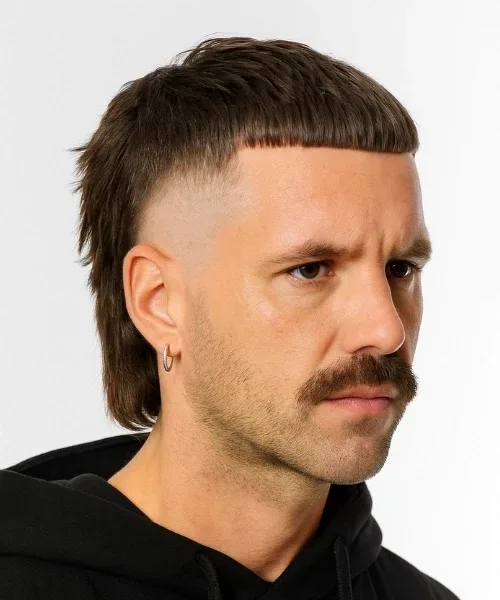
The Edgar mullet combines the Edgar fringe at the front with longer hair at the back, the modern mullet structure underneath the Edgar top. The result has the Edgar’s bold fringe and high fade on the sides, with the back section allowed to grow to collar length or below.
Tell your barber, “Edgar, mullet.” High skin fade on the sides. Straight Edgar fringe at the front. Let the back grow to collar length with clean mullet lines at the back. Clear disconnection on the sides.”
School safe: Check both the high skin fade and the mullet back occasionally; they get flagged at conservative schools.
Maintenance: Sides every 2-3 weeks. Back every 8-10 weeks.
For the full mullet guide, our modern mullet page covers every variation.
Mexican Edgar: The Classic Version
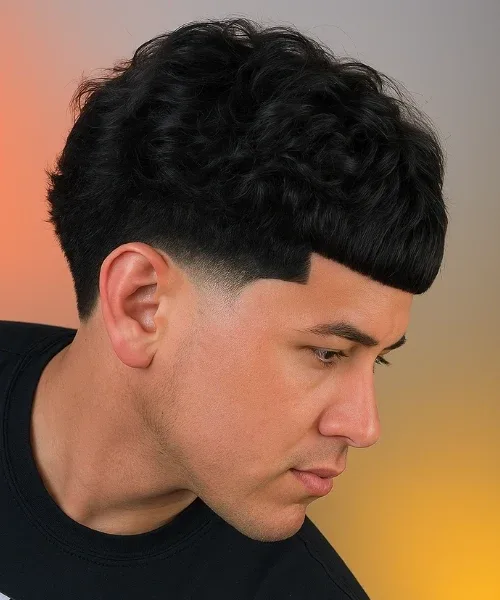
The version is most associated with the Takuache community and the original viral spread. Thick, heavy straight hair providing maximum fringe weight. High skin fade starting well above the ear. Razor-sharp fringe line. This is the version that appeared in every meme, every news article, and every barbershop in the Southwest US.
Tell your barber: “Classic Mexican Edgar. High skin fade skin at the bottom, starting above the ear. Straight fringe at eyebrow length, dead straight, no angling. Razor line-up at the forehead. Clear disconnection.”
In Spanish / En español: “Quiero un Edgar clásico. Fade a la piel bien alto. El flequillo recto bien derecho al nivel de las cejas. Línea de la frente con navaja. Que se vea la separación entre el fade y el pelo de arriba.”
Hair type: Thick straight. This is where the classic works best. The weight of thick hair holds the fringe in position all day.
Edgar Haircut with Design
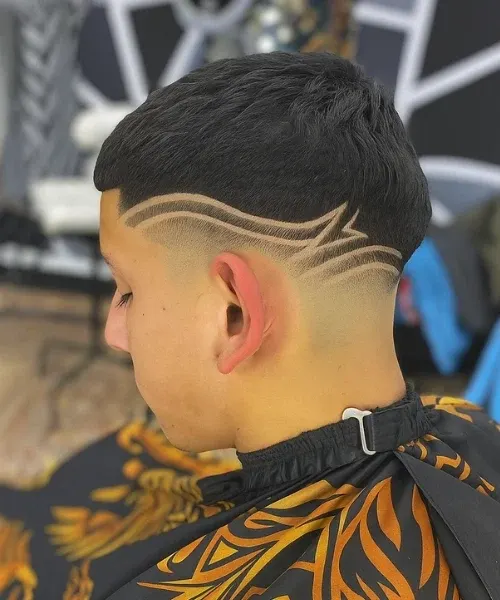
Razor art added into the fade zone lines, geometric patterns, team logos, or tribal-inspired designs shaved near the temples or behind the ears. This is the statement version. The fringe and fade provide the structure. The design provides the personalization.
Tell your barber, “Edgar with a design. High skin fade. Straight fringe. I want [describe specific design] in the fade area near the temple. Line-up at the forehead.”
School safe: Usually no shaved designs are the most commonly flagged element in school dress codes. This is the version for a quinceañera, prom, concert, or special event, not for Monday morning.
Maintenance: Every 2 weeks designs fade noticeably as the hair regrows.
Textured Edgar Cut
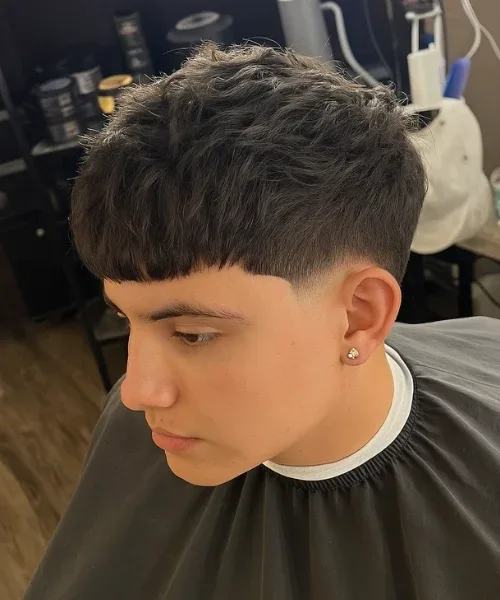
The blunt fringe is replaced with a point-cut textured fringe that maintains the forward direction but adds visible separation and natural movement. The high fade and disconnection remain. The fringe reads as intentional but not rigid.
Tell your barber, “Textured Edgar. High skin fade. Fringe at eyebrow length point-cut rather than blunt straight across. I want texture and separation in the fringe, not a hard solid line.”
For the full point-cutting technique explanation, our textured fringe guide covers the technique in dedicated depth.
Edgar on Straight Hair
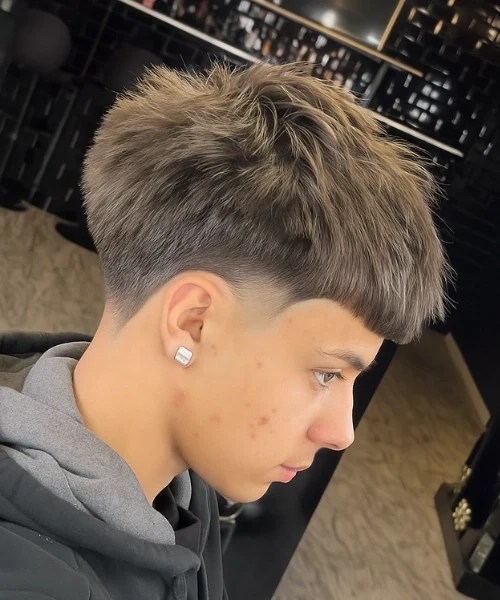
Thick, straight hair is the original Edgar canvas. The strands have natural weight that holds the fringe in position throughout the day without needing product for structure. The blunt cut line stays clean because straight strands lie flat and consistently.
Tell your barber, “Edgar, straight hair.” High skin fade. Straight blunt fringe at eyebrow length: I have thick straight hair, so the fringe should hold its line naturally.”
For the full straight hair guide, our boys’ haircuts for straight hair page covers twenty cuts for straight hair.
Edgar Buzz Cut
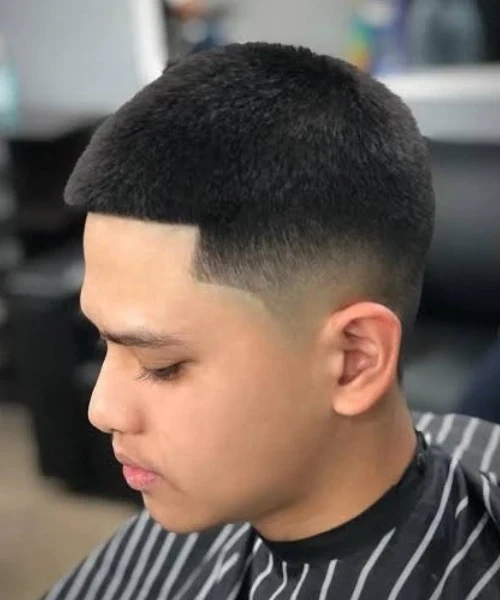
A buzz cut length all over combined with the Edgar fringe element. The overall hair length is very short, number 3 or 4 on top, with the Edgar fringe maintained at a slightly longer length falling forward. The skin fade at the sides creates the Edgar disconnection at minimal overall length.
Tell your barber, “Edgar, buzz cut.” Number 3 on top overall keeps the fringe section slightly longer so it falls forward. High skin fade on the sides. Clear Edgar line.”
For full buzz cut variations, our buzz cut guide covers every guard number option.
Edgar with Mid Taper
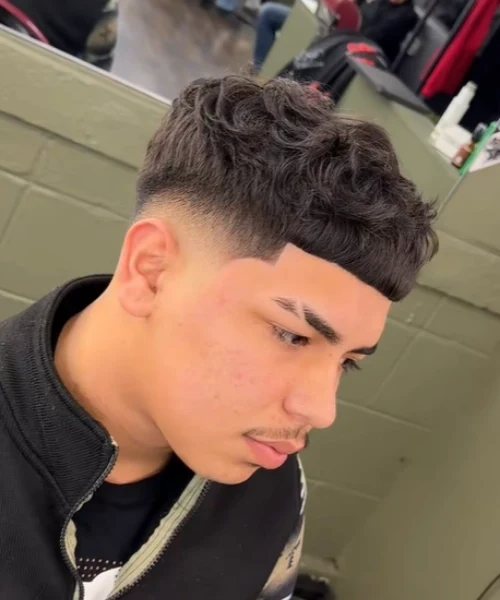
The most conservative version of the Edgar. Mid taper starting at the temple rather than a high skin fade. The fringe and disconnection remain. The contrast is significantly less aggressive. This is the Edgar for school environments, office settings, or anyone wanting the Edgar style without the high skin fade maintenance.
Tell your barber: “Edgar structure with a mid taper rather than a skin fade. Mid taper starting at the temple. Straight fringe at eyebrow length. Keep the disconnection between the top and the sides visible.”
School safe: Usually yes, the mid-taper level without skin is broadly school-appropriate.
For the full mid-taper guide, our mid-taper fade page covers every mid-taper variation.
Edgar Cut with Fade
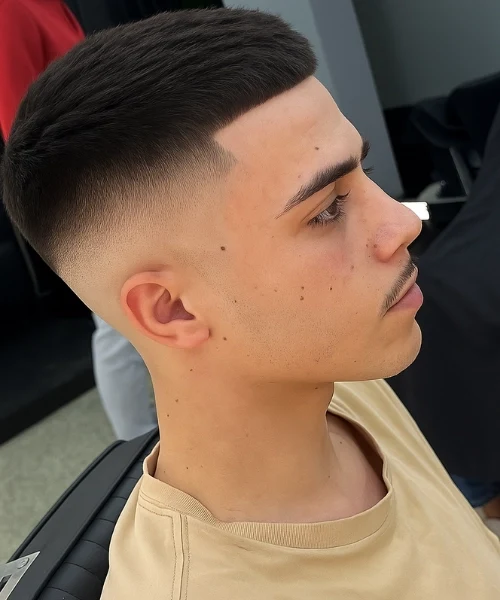
A general term covering any Edgar structure where the fade level is specified without being a skin fade. High fade, mid fade, or drop fade all combined with the Edgar fringe and disconnection.
Tell your barber, “Edgar with a [high/mid/drop] fade. Straight fringe at eyebrow length. Clear disconnection at the top. Number [X] at the lowest.”
For the full comparison between fade levels, our taper vs. fade guide explains the difference with exact terminology.
Bowl Cut Edgar
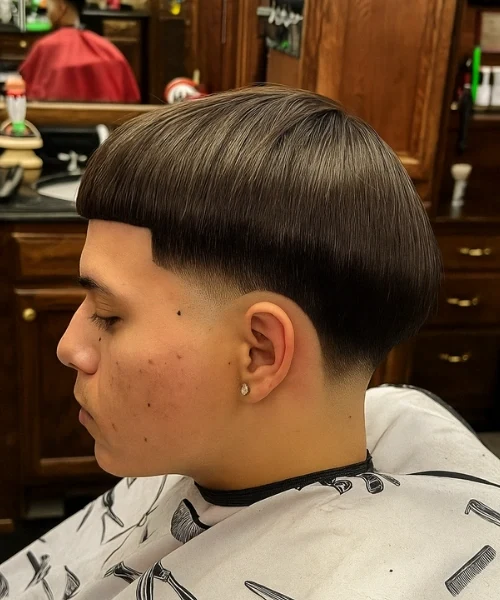
The soft modern version that acknowledges the bowl cut comparison without becoming it. Even top length across the crown with the Edgar fringe element but with a proper fade at the sides rather than the blunt bowl-cut finish. The result addresses the bowl-cut aesthetic deliberately rather than accidentally.
Tell your barber, “I want an Edgar-style bowl shape. Even length on top is about two inches all around. Edgar fringe at the front. High skin fade on the sides.”
Face shape: Round and oval.
Edgar Bangs Variations
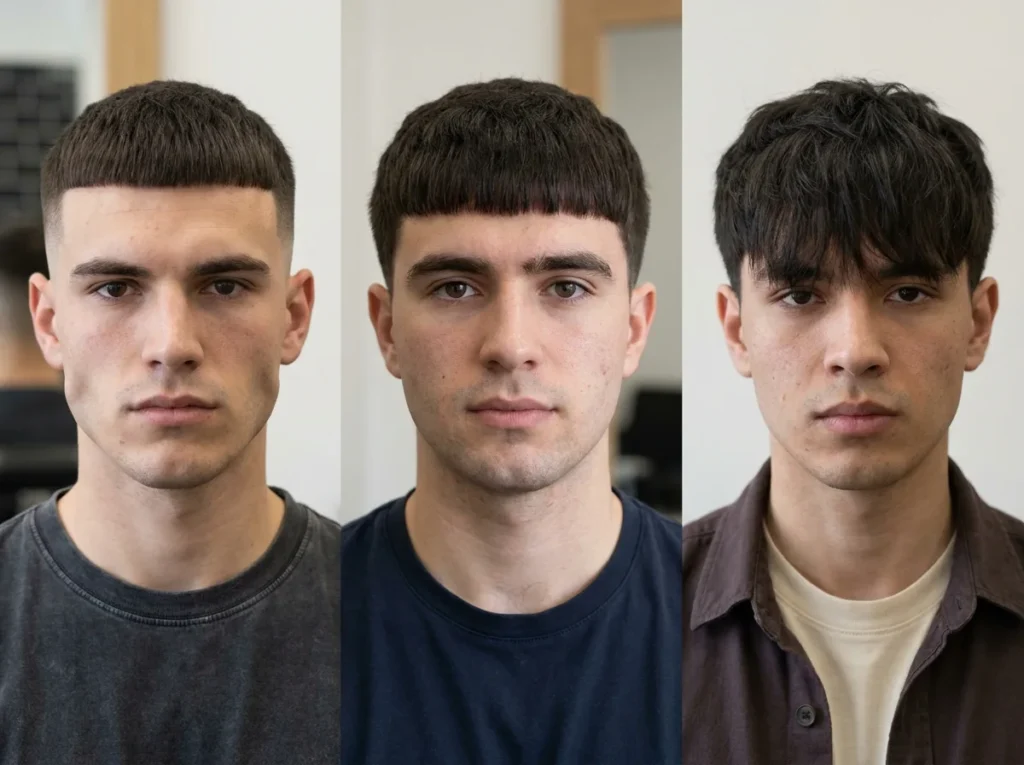
The fringe can be worn at different lengths and with different degrees of texture depending on face shape, hair density, and personal preference.
A short fringe sits above the eyebrow, showing more of the forehead. More aggressive, less coverage.
Eyebrow-length fringe is the standard Edgar position. Balanced coverage and boldness.
Below-eyebrow fringe more coverage, slightly softer appearance. Suits large foreheads particularly well.
Each length with either a blunt cut or point-cut texture creates a different result from the same haircut structure.
Edgar with Blowout
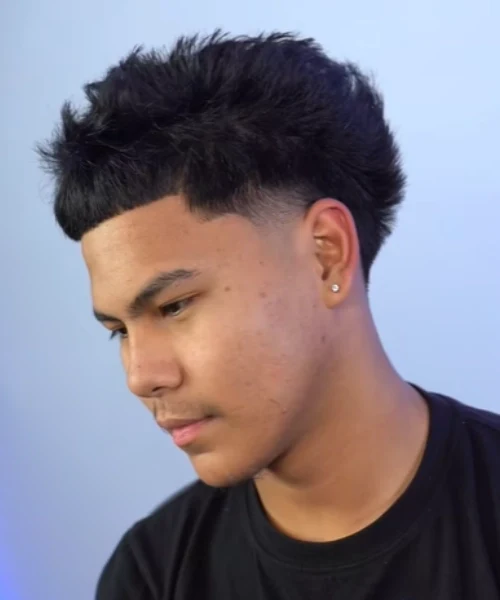
Blowout volume at the crown and back of the top section combined with the Edgar fringe at the front. The fringe falls forward while the hair behind it is blown upward and outward, creating a fuller silhouette. More volume throughout than the fluffy Edgar while maintaining the straight fringe line.
Tell your barber, “Edgar with blowout volume. High skin fade. Straight Edgar fringe at the front. Keep three inches on top; I want blowout volume at the crown behind the fringe.”
For the full blowout technique, our blowout taper guide covers every variation with honest blow-dry guidance.
Conservative Edgar
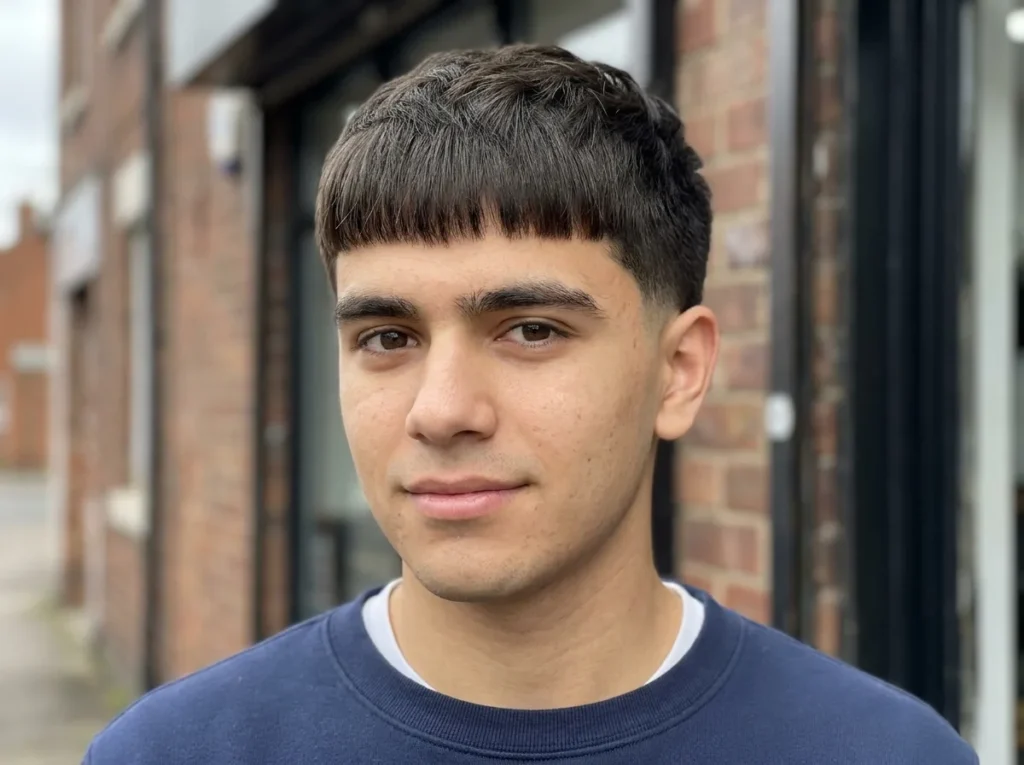
The version for environments where the classic high skin fade creates conflict. Mid taper to number 2 at the lowest, with no skin visible. Straight fringe maintained. Disconnection preserved but softer. The Edgar structure is recognizable without the aggressive contrast.
Tell your barber, “Conservative Edgar. Mid taper number 2 at the lowest, no skin. Straight fringe at eyebrow length. I want the Edgar structure but school-appropriate.”
School safe: Usually yes in most settings.
Maintenance: Every 3-4 weeks.
Edgar for Boys and Teens

The Edgar is one of the most requested cuts for boys aged twelve to eighteen. Most walk in with the reference photo already. The considerations are school safety, maintenance reality, and choosing the correct version for the specific school environment.
For boys twelve to fifteen, the conservative Edgar with a mid taper is the correct starting point. School-safe in most environments.
For teens sixteen to eighteen, the standard high taper Edgar without skin is broadly school-appropriate in most US schools.
For the classic skin fade, Edgar, check the specific school policy before committing.
Tell your barber (for teens): “Edgar for a [age]-year-old. High taper not to skin. Straight fringe. School-appropriate version.”
For full teen guides: our teen boy haircuts page covers ages thirteen to eighteen. Our boys’ haircut hub covers seven to twelve with school safety ratings.
Edgar for Special Events
The full expression version. High skin fade with design work. Razor art in the fade lines, geometric patterns, or event-specific designs. Fringe at maximum precision. This is the Edgar for a quinceañera, prom, graduation, concert, or any occasion where the haircut should make a statement.
Tell your barber, “Full event, Edgar.” High skin fade to the skin. Straight fringe maximum precision on the line. Add a design in the fade at the temple I want [describe design]. I have [event] this weekend.”
Maintenance: 2 weeks before the event for maximum freshness.
The Fluffy Edgar Cut Complete Guide
The fluffy Edgar is the fastest-rising variation of 2026. It keeps the three Edgar non-negotiables—straight fringe, high fade, disconnection but adds volume, texture, and movement to the top section that the classic rigid Edgar does not have.
What Makes an Edgar “Fluffy”
The fluffy Edgar has three additional elements beyond the classic: volume at the crown and top section blown outward rather than lying flat, point-cut texture in the fringe creating separation rather than a solid blunt mass, and a lighter overall feel where the fringe moves independently rather than sitting as one piece.
The distinction between classic and fluffy:
| Classic Edgar | Fluffy Edgar | |
|---|---|---|
| Fringe | Blunt, straight, heavy | Point-cut, separated, lighter |
| Top volume | Flat or minimal | Blown out, full |
| Movement | Rigid | Natural |
| Effort | Low | 4-5 minutes |
| Hair type | Thick, straight ideal | Wavy and curly shine |
How to Ask for a Fluffy Edgar
“Fluffy Edgar. High skin fade. Fringe at eyebrow length—point cut the fringe for texture and separation, not blunt straight across. I want volume on top before the fringe falls forward. Keep two and a half inches on top.”
Products for Fluffy Edgar
Thickening mousse or sea salt spray applied to damp roots before blow-drying creates the volume base. Blow dry upward at the crown first, then forward to direct the fringe. Light matte clay through the fringe after drying to hold separation without weight.
Never use heavy pomade on a fluffy Edgar. Pomade weighs the fringe down and eliminates the separation and lightness that defines the fluffy version.
Edgar Haircut by Hair Type
| Hair Type | Best Version | Fringe Natural Weight | Daily Effort |
|---|---|---|---|
| Thick and straight | Classic Mexican Edgar | Heavy holds itself | Low |
| Wavy | Fluffy or textured | Medium natural movement | Low |
| Curly | Curly Edgar | Natural curls separate | Very low |
| Fine | Short Edgar | Lighter shorter fringe | Medium |
| Very thin | Consider alternative fringe exposure | — | — |
Edgar on Thick Straight Hair
The original canvas. Thick, straight hair holds the blunt fringe in position all day without product for structure. The natural weight of the strands keeps the line clean and the fringe forward.
For the full straight hair guide, our boys’ haircuts for straight hair page covers twenty styles.
Edgar on Curly Hair
Curly hair requires the dry-cut rule without exception. Always ask the barber to cut the fringe section dry. Apply curl cream to damp hair, scrunch the fringe forward, and air dry. The natural curl pattern provides texture, separation, and dimension automatically.
For dedicated curly guidance, our curly hairstyles for men guide covers type 2A through 4C.
Edgar on Wavy Hair
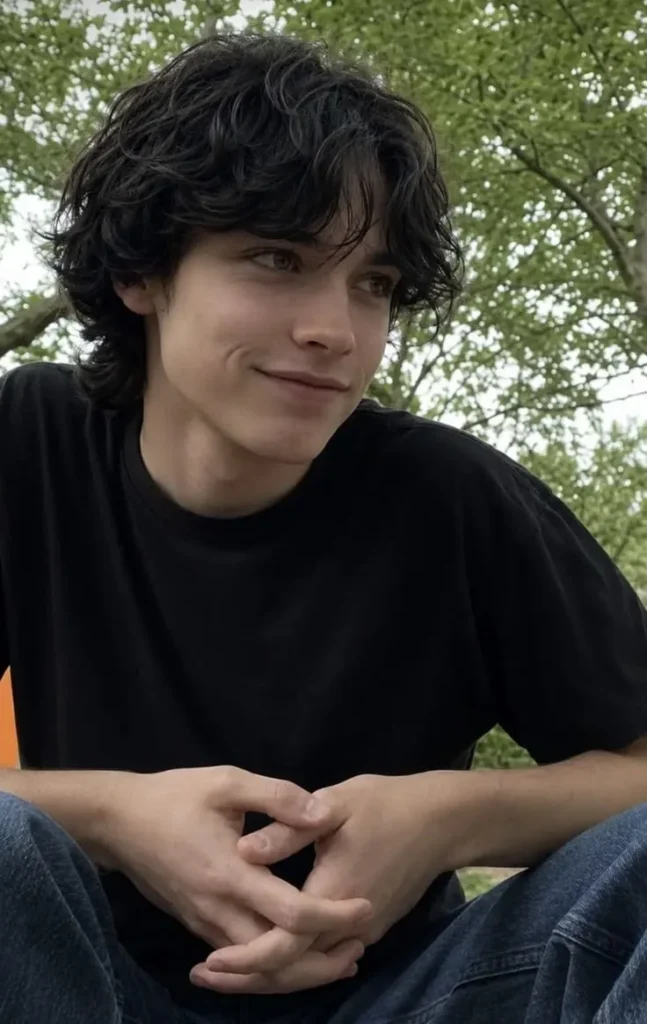
Wavy hair produces a natural, fluffy Edgar result with minimal effort. The wave adds movement and volume to the fringe without heat styling. Sea salt spray on damp hair, scrunch the fringe forward, and air dry.
Edgar on Fine or Thin Hair
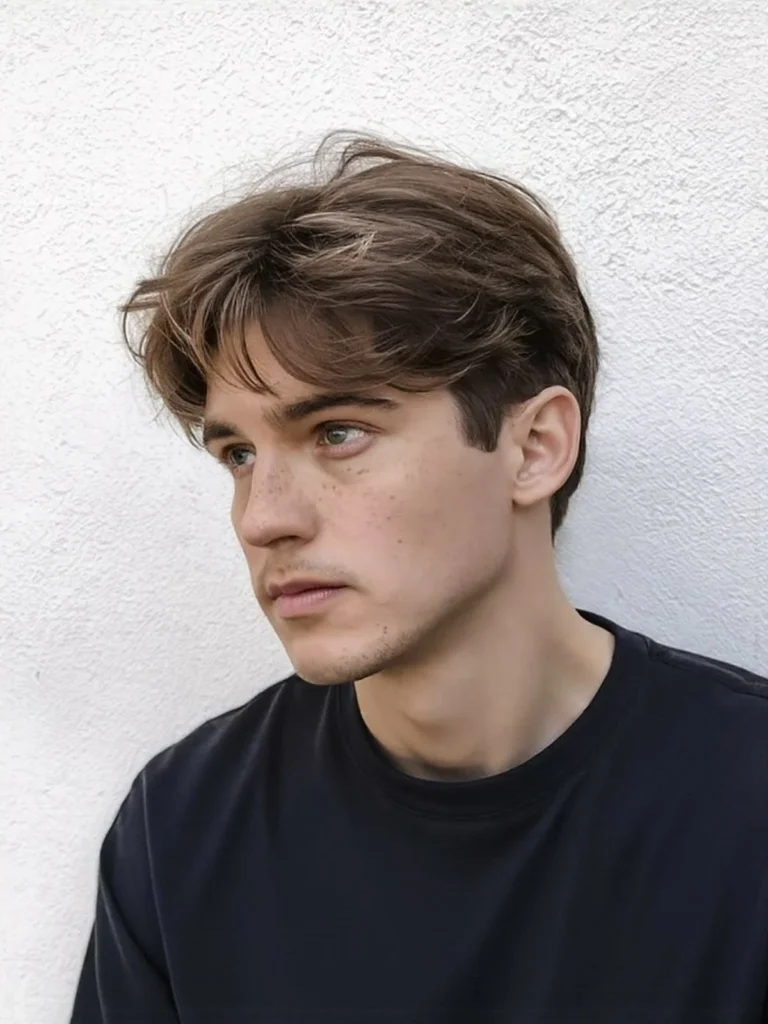
Fine hair produces a lighter, less imposing fringe than thick hair. The classic blunt Edgar with heavy fringe works best on thick hair; on fine hair, the blunt fringe can look sparse. The short Edgar or textured Edgar are better options for fine hair, keeping the fringe shorter and lighter.
Very thin hair at the front can make any forward-falling fringe look like it is exposing rather than covering. In this case, the conservative Edgar with a textured fringe or an alternative cut like the mid taper fade may produce a better result.
Edgar Haircut by Face Shape
Oval and Square Face
The two strongest face shapes for Edgar. The geometric precision of the straight fringe and the high fade complement angular features and balanced proportions. The clean horizontal fringe line adds a deliberate element that suits defined face shapes.
Diamond Face
Works well. The straight fringe reduces the visual width of the forehead while the high fade keeps the sides tight. The contrast creates balance around the prominent cheekbones.
Round Face
The fluffy Edgar or textured Edgar is the correct version for round faces. The added volume and height on top add vertical proportion. The classic blunt Edgar on a round face can add horizontal width through the fringe; the textured or fluffy version avoids this.
Oblong Face
An excellent match. The horizontal fringe adds width to what is a predominantly vertical face. Keep the top shorter rather than adding height above the fringe.
Heart Face
The fringe covers forehead width; Edgar’s signature element is exactly what heart-shaped faces benefit from. Keep the fringe at mid-forehead to maximum-eyebrow level for the best coverage.
Why Was the Edgar Haircut Banned?
This is one of the most searched questions about the Edgar and one that no haircut guide properly answers.
The El Salvador School Ban
On August 21, 2025, Reuters confirmed that El Salvador banned the Edgar haircut in public schools following a directive issued by education minister Karla Trigueros. The ban came alongside a prohibition on mohawks and other styles associated with gang culture, following a military captain taking over management of the education ministry.
The ban applied specifically to El Salvador’s public schools. It was not a US ban. It was not a global ban.
The San Antonio Restaurant Ban
Before the El Salvador ban, a restaurant owner in San Antonio, Texas, drew criticism for posting an anti-Edgar message banning the cut from their establishment. The owner cited an association with “gangster culture.” The backlash was significant; the Mexican-American community and others pointed out that the ban was targeting a hairstyle with indigenous roots and deep cultural significance. A mural was painted in downtown San Antonio depicting the cut’s tribal origins in response.
Is Edgar Banned in US Schools?
No US school district has officially banned the Edgar haircut by name. Individual schools may apply dress codes that effectively prohibit the high skin fade component, but this applies to skin fades generally, not to Edgars specifically. The conservative Edgar with a mid taper is school-appropriate in virtually every US school environment.
School Safety Per Edgar Variation
| Version | School Safe |
|---|---|
| Conservative Edgar (mid taper, no skin) | Yes, universally. |
| High taper Edgar (number 1-1.5, no skin) | Usually yes, check policy. |
| Classic Edgar (high skin fade) | Check depends on school |
| Edgar with design (razor art) | Usually no |
| Edgar Mullett | Check both fade and back length |
How to Ask for an Edgar Haircut Complete Barber Scripts
Wikipedia notes that the Edgar is “not a favorite among barbers.” That is a real phenomenon. The straight fringe line is technically demanding; getting it genuinely straight and symmetric across the forehead requires precision that not every barber has practiced extensively. A bad Edgar fringe is immediately visible.
Before sitting down, ask, “Have you cut Edgars before? Can I see some photos?” A barber who is confident in the cut will show you immediately.
The Classic Edgar Script
“Edgar cut. High skin fade number 0.5 at the lowest. Straight fringe at eyebrow length cut it straight across, not angled or curved. I want a clear disconnection between the fade and the top. Line-up at the forehead.”
The Fluffy Edgar Script
“Fluffy Edgar. High skin fade. Fringe at eyebrow length point-cut for texture and separation, not blunt. Volume on top blown out before the fringe falls forward. Two and a half inches on top.”
Scripts in Spanish for the Barberia
Classic Edgar: “Quiero un Edgar. Fade a la piel bien alto. El flequillo recto al nivel de las cejas bien derecho, no chueco. Que se vea la separación entre el fade y el pelo de arriba. Línea de la frente con navaja.”
Fluffy Edgar: “Quiero un Edgar esponjoso. Fade alto. El flequillo al nivel de las cejas puntéalo para que tenga textura, no recto. Quiero volumen en la parte de arriba antes de que caiga el flequillo.”
Can Any Barber Cut an Edgar?
Every barber is trained in fades. Not every barber has mastered the straight fringe line that makes an Edgar an Edgar. The fringe must be genuinely straight horizontal across the forehead, symmetric from left to right. This requires a steady hand and practiced technique.
Ask these three questions before sitting down: Have you cut Edgars before? Can you show me photos of Edgar’s you have done? Can you do the fringe completely straight, not angled?
A barber who hesitates on any of these questions needs more practice on the Edgar specifically. It is acceptable to find a barber who has cut this style before rather than being the test case.
Two Photos, Always Two
The front photo shows the fringe line, fringe length, and top volume. The side photo shows the fade height and how high the disconnection sits. A single front photo leaves the fade height entirely to the barber’s interpretation.
Fixing the Edgar Haircut Problems
My Bangs Keep Splitting: How to Fix
This is the most common post-Edgar problem and the most frequently asked question on haircut forums. The fringe pieces split apart throughout the day, creating gaps that break the clean forward line.
The cause is almost always product choice. Heavy pomade or oil-based products make individual strands slick; they slide apart easily, and the fringe cannot maintain cohesion. Wet-look products do the same thing.
The fix: a water-based matte clay or paste applied to dry or slightly damp hair, distributed through the fringe with fingers. Work it in, then press the fringe forward with the palm of your hand to close any splits. The matte formula provides grip rather than slip. Reapply a small amount midday; if needed, a small jar fits in any pocket.
For curly Edgars: curl cream applied to damp hair before drying, scrunched forward. The curl pattern holds naturally. A light curl-defining gel on top of the cream if more hold is needed.
The Fringe Is Curved, Not Straight
A barber cutting too quickly or using a curved motion with the scissors creates a fringe that arches rather than lies horizontally. This is the version that looks closest to the meme comparisons.
At-home temporary fix: use a fine-tooth comb to press the fringe completely flat against the forehead. Apply a light clay, then press again with the comb held horizontally. The fringe will dry in a straighter position. This is not permanent but gets through the day.
Next barbershop visit: bring a photo showing a straight horizontal fringe line and specify explicitly, “I need the fringe completely straight across horizontally, not curved. Can you use a comb as a guide when cutting the fringe line?”
The Edgar Looks Like a Bowl Cut
This happens when the fade is not high enough or the disconnection between the fade and the top is blended rather than defined. The gradual blend removes the contrast that distinguishes an Edgar from a bowl cut.
Next cut: specify a higher starting point for the fade and ask explicitly for a visible disconnection. “I want a clear line where the fade ends and the top begins, not a blended taper. The disconnection should be visible.”
The Edgar Grew Out Messy
The Edgar has one of the fastest visible grow-out schedules of any haircut because the skin fade and the fringe line both show regrowth quickly.
| Days after the cut | Appearance |
|---|---|
| Days 1-7 | Fresh, sharp lines, clean fade |
| Days 8-14 | Slight growth visible at fade |
| Days 15-21 | Fade line softening, fringe getting long |
| Day 22+ | Needs full refresh |
An edge-up between full cuts five minutes refreshing only the hairline and fringe line extends the clean period by one week. Book it on day fourteen rather than waiting for the full grow-out.
Is the Edgar Cut Still Popular?
Is the Edgar cut still popular? The evidence is clear: yes.
The Numbers
The keyword “edgar haircut” generates over 10,000 searches per month in the US alone. MensHairstyleEmpire published 60+ Edgar styles in July 2026 because the demand is high enough to fill that content. Barbershops in the US Southwest report it as consistently among their most requested styles.
Regional Popularity
In the US Southwest, Texas, New Mexico, Arizona, California the Edgar remains the dominant style among young Latino men and is widely popular across all demographics.
Nationally, the 2023 mainstream crossover established the Edgar as a mainstream option rather than a community-specific style. It is now requested in barbershops across every US region.
In the UK, the Edgar is an emerging style that gained visibility through US cultural influence.
In El Salvador, the August 2025 school ban has predictably made it more popular among young people who are aware of the prohibition.
What Gen Z Calls It Now
The edgar is one of the defining Gen Z hairstyles. Other names used for the same cut or close variations: takuache cut, cuh cut, Mexican Caesar, cuh haircut, and Edgar bangs. All refer to the same fundamental structure: straight fringe, high fade, and disconnection.
How to Dress Like an Edgar The Takuache Aesthetic
This question appears directly in Google’s People Also Ask and reflects genuine curiosity about the cultural context behind the cut.
The Takuache Aesthetic Explained
The Takachuache aesthetic that Edgar is associated with includes square-toe cowboy boots, lowered pickup trucks (trokiando culture), corridos and regional Mexican music, oversized shirts or jerseys, and an aesthetic that blends Mexican ranch culture with urban American influence. Young men often wear cowboy hats alongside the Edgar cut as part of this aesthetic.
The community identity around this aesthetic is significant; it represents Mexican-American cultural pride expressed through music, fashion, and hairstyle simultaneously.
The Edgar Without the Aesthetic
You do not have to dress like a Takuache to wear an Edgar. The cut crossed over to mainstream style precisely because it stands alone as a haircut independent of any cultural performance. Athletes wearing it at press conferences are not wearing cowboy hats. Musicians wearing it at award shows are not dressed in the full Takurache aesthetic.
The Edgar is a haircut. The takuache aesthetic is a cultural movement. They overlap in origin. They do not require each other.
Browse More Related Guides
For a less aggressive version of the Edgar structure, our mid taper fade guide covers the mid taper as a starting point for Edgar variations.
For the fringe element specifically, our textured fringe haircut page covers the point-cutting technique that creates the fluffy Edgar fringe.
For the Edgar mullet combination, our modern mullet guide covers the mullet structure in full depth.
For the blowout volume combination, our blowout taper page covers volume techniques across every hair type.
For boys and teens: our boys’ haircuts hub covers ages seven to eighteen. The teen boy haircut guide covers the full teen range with school safety ratings.
For curly Edgar variations, our curly hairstyles for men guide covers every curl type from 2A through 4C.
Not sure which version suits your face shape and hair type? Our teen haircut finder quiz takes sixty seconds.
Frequently Asked Questions
What is the Edgar haircut?
The Edgar haircut is a men’s style defined by three elements: a straight blunt fringe across the forehead, a high skin fade on the sides and back, and a clear visual disconnection between the faded sides and the longer top. Originally popular in the Mexican-American community of the US Southwest, it has crossed over into mainstream men’s style and is now one of the most requested haircuts in barbershops across the US.
Why do Mexicans like Edgar’s cuts?
The Edgar is deeply connected to Mexican-American cultural identity, specifically the Takahuache subculture of the US Southwest that blends truck enthusiasm, corridos music, and Mexican ranch culture. The cut has indigenous roots connecting to the hairstyles of the Jumano tribes of the Texas-New Mexico border region. For many in this community, the Edgar represents cultural expression, generational identity, and a connection to heritage rather than simply a hairstyle choice.
Who made the Edgar cut popular?
The origin is unconfirmed. The cut emerged in the Latino barbershop culture of Texas and the US Southwest border states in the early to mid-2010s. It is often misattributed to baseball player Edgar Martínez; Wikipedia confirms this attribution is incorrect. The cut gained mainstream visibility through social media and cultural coverage starting around 2019, crossing over fully by 2023.
What is the best Edgar cut?
The best Edgar cut depends on hair type and lifestyle. Thick, straight hair, the classic Mexican Edgar with a high skin fade. Wavy or curly hair, the fluffy or curly Edgar. School or professional environment: the conservative Edgar with mid taper. Special event: the Edgar with design. Most versatile overall is the high-taper Edgar without skin.
What is the new Edgar haircut in 2026?
The fluffy Edgar is the dominant new variation of 2026. The Edgar mullet is a fast-rising combination. The textured Edgar with point-cut fringe continues growing. The curly Edgar has expanded as more non-straight-hair men adopt the style. All four share the Edgar’s three non-negotiable elements with modern variations on the top styling and fade approach.
What is the Gen Z haircut called?
The Edgar is one of the defining Gen Z haircuts alongside the blowout taper, curtain bangs, and textured fringe. Other Gen Z names for Edgar variations include the takuache cut, cuh cut, and Mexican Caesar. All refer to the same fundamental structure: straight fringe, high fade, and disconnection.
Why ban the Edgar haircut?
El Salvador banned the Edgar in public schools in August 2025 through education minister Karla Trigueros, alongside mohawks and other styles, following military oversight of the education system. A restaurant owner in San Antonio, Texas, drew significant backlash for banning the Edgar, citing “gangster” associations; a mural was painted showing the cut’s indigenous roots in response. No US school district has officially banned the Edgar by name.
How do I ask for an Edgar haircut?
Say: “Edgar cut. High skin fade number 0.5 at the lowest. Straight fringe at eyebrow length cut straight across, not angled. Clear disconnection between the fade and the top. Line up at the forehead.” For fluffy: “Fluffy Edgar. High skin fade. Point-cut fringe for texture. Volume on top.” In Spanish: “Quiero un Edgar. Fade a la piel bien alto. El flequillo recto al nivel de las cejas. Que se vea la separación.”
Is the Edgar cut still popular?
Yes, definitively. Over 10,000 monthly searches for “edgar haircut” in the US alone. Barbershops report it as consistently one of their most requested styles, particularly in the Southwest. The mainstream crossover of 2023 established it as a permanent part of the men’s haircut vocabulary rather than a passing trend. The El Salvador school ban in 2025 increased youth interest rather than decreasing it.
How to get a fluffy Edgar cut?
Tell your barber, “Fluffy Edgar. High skin fade. Fringe at eyebrow length point-cut for texture and separation, not blunt. Volume on top before the fringe falls forward. Keep two and a half to three inches on top.” Products: thickening mousse on damp hair before blow-drying upward, matte clay through the fringe after. Never heavy pomade—it removes the separation and weight that define the fluffy version.
How to dress like an Edgar?
The Takachu aesthetic associated with Edgar includes square-toe cowboy boots, lowered pickup trucks, corridos music, and Mexican ranch culture aesthetics. However, you do not need to dress like a Takauache to wear an Edgar. The cut crossed over to mainstream style as a standalone haircut. Athletes and musicians wear it at formal events without the associated cultural aesthetic.
My Edgar bangs keep splitting. How to fix?
Switch to a water-based matte clay or paste rather than pomade or oil-based products. Apply to dry or slightly damp hair, distribute through the fringe with fingers, then press the fringe forward with your palm to close splits. The matte formula provides grip rather than the slickness that causes splitting. For curly Edgars, curl cream on damp hair before drying holds the natural curl pattern closed.
Is the Edgar school appropriate?
The conservative Edgar with a mid taper and no skin visible is school-appropriate in virtually every US school. The classic skin fade Edgar needs a policy check before committing. Edgar cuts with razor-shaved designs are almost always flagged. The high taper Edgar without skin falls between these usually acceptable but worth checking the specific school’s policy.
What is the difference between an Edgar and a Caesar haircut?
Both have a forward-falling fringe and shorter sides. The Caesar uses a lower blended taper with moderate contrast. The Edgar uses a high skin fade with a clear disconnection between the faded sides and the longer top. The Edgar has dramatically more contrast and visual impact. The Caesar reads as polished and professional. The Edgar reads as bold and deliberate. The fringe technique can overlap both can use point-cutting, but the fade level and disconnection are fundamentally different.
The Edgar haircut survived the memes. It survived the restaurant ban. It survived the school ban in El Salvador. It survived every attempt to make it a joke.
It survived because when it is executed correctly, three non-negotiables are present: the fringe line is genuinely straight, the fade is seamless, and the disconnection is precise. It does something most haircuts cannot. It combines cultural identity, technical precision, and visual impact in a single cut.
Pick the version from this guide that matches your hair type, face shape, and environment. Save the barber script or the Spanish version if that is what your barber understands. Find a barber who has actually cut Edgars before. Bring two photos.
For the technical foundation of Edgar’s fringe, our textured fringe guide covers point-cutting in full depth. For boys and teens, our boys’ haircuts hub covers every age from seven to eighteen.