Middle Part Haircut 2026: 20 Styles, the Grow-Out Guide Nobody Gives You, and Exactly What to Tell Your Barber
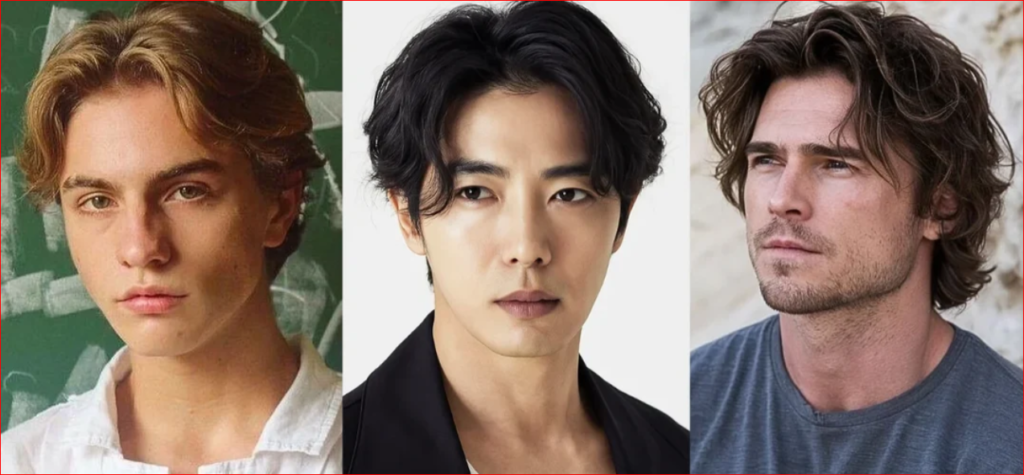
K-pop pushed it. TikTok scaled it. Gen Z owns it.
The middle part haircut for men has been the biggest men’s cut since 2020. No other men’s silhouette has stuck this hard, this long, since the buzzcut. The formula sounds simple: grow the top to four to six inches, blow it forward off a center split, and let it fall in curtains on either side of your face.
The formula is simple. The six months between a short fade and that result is what nobody tells you about.
This guide covers twenty middle part styles for 2026, the exact length you need before you start, the month-by-month grow-out guide that Reddit keeps asking for, the honest face shape truth, and every barber script you need to get the right version first time including the Korean variation that is driving the fastest search growth globally right now.
At a Glance
| Need | Best Version |
|---|---|
| Most popular 2026 | Classic curtains, 5 inches, scissor sides |
| Korean-inspired | Korean two-block middle part |
| Bold sides modern | Middle part with mid fade |
| Most professional | Conservative low-taper version |
| Wavy hair, zero effort | Messy middle part, sea salt, air dry |
| Curly hair | Curly curtains cut top dry |
| Growing out from fade | Month-by-month guide below |
| Boys and teens | Age-specific version: see section |
What Is a Middle Part Haircut?
A middle part haircut is a men’s style where the hair is grown to medium length, parted through the center of the head, and allowed to fall forward on either side of the face in a curtain-like shape. The base geometry is consistent across every variation: longer top, center split, and curtains falling forward.
What changes from one version to the next is the side treatment taper, fade, or scissors the length of the top, and the amount of texture and movement in the fringe.
Middle Part vs. Curtain Hair: Same Thing, Different Name
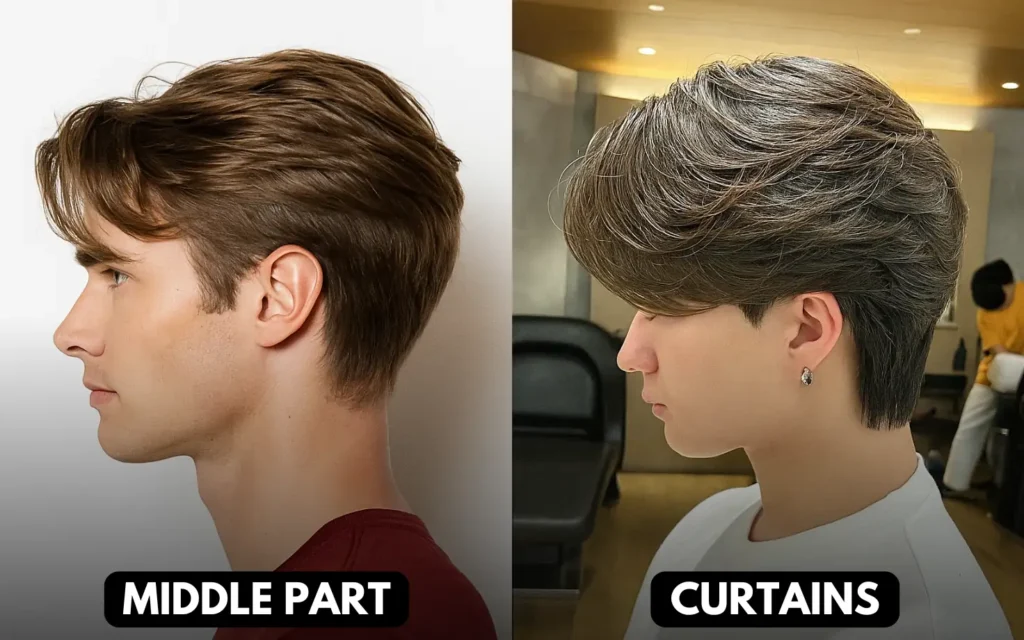
A middle part refers to where the hair is parted. Curtain hair, or the curtain cut, describes how the parted fringe falls like curtains opening on either side of the face. In practice, the terms describe the same haircut. The middle part is the dominant US and TikTok term. Curtain hair or curtains are more common in UK and European barbershops.
Some distinction worth knowing: every curtain cut has a center part, but not every center part produces full curtains. A very short middle part where the fringe barely reaches the eyebrows is a center part. A four-to-six-inch fringe that falls symmetrically to both sides of the face and frames the cheekbones is curtain hair. This guide covers both ends of that spectrum.
Why Does Gen Z Like Middle Parts?
Three forces brought it back.
K-pop groups made the two-block-and-curtain silhouette their signature after 2016. BTS, Stray Kids, and ENHYPEN—the Korean middle part—became a visual identity for the genre globally, and every fan who absorbed the aesthetic brought it to their local barbershop.
Timothée Chalamet gave it Hollywood cover. His middle-part appearances at major premieres from 2019 onward established the cut as critically acceptable, not just a teenage trend but a fashion statement.
The e-boy aesthetic gave it an edge. The slicked, defined curtain fringe of the TikTok e-boy aesthetic brought the middle part to an audience that had no connection to K-pop.
The generational element is real too. The side part was the dominant Millennial men’s style for over a decade. The middle part is a deliberate departure from that. Gen Z’s adoption of the center split is partly aesthetic and partly identity a conscious differentiation from the generation before.
Is the Middle Part Still in Style in 2026?
Yes. It is not a trend that peaked and is declining; it is the most requested scissors cut in barbershops in 2026. Search interest has grown consistently from 2020 to the present. The Korean variation and the messy flow version are both growing in search volume in September 2026. The middle part is not going anywhere.
Is Middle Part Hair Attractive?
Yes, when the length is right and the face shape suits it. The center split creates symmetry, which research consistently associates with attractiveness. The curtain fringe frames the cheekbones and softens the forehead. The movement of the hair adds dimension.
The honest caveat: the middle part looks significantly better at the right length than at the wrong length. Too short, and it reads as a haircut growing out awkwardly. At the nose-to-chin length range, it reads as deliberate and intentional.
What Length Do You Need for a Middle Part?
The Nose Test Exact Measurement
Quora asks this precisely: by gently pulling down your hair straight toward your nose, how long should it reach for a solid middle part?
The nose tip is the minimum. Hair that reaches the nose tip when pulled straight down has enough weight to fall forward naturally and enough length to split into curtains. At this length the middle part is functional, but the curtains are short, a minimal version that works but does not flow dramatically.
The chin is the ideal. Hair that reaches the chin when pulled straight down produces the full curtain shape; the fringe sits at the cheekbone level, the curtains frame the face properly, and the weight distributes evenly on both sides.
Below the chin is the long-flow version. This is the shaggy, wolf-cut-adjacent middle part where the length creates natural movement and the curtains fall past the cheekbone.
If your hair does not reach the nose tip when pulled down, there is not yet enough length to produce a proper middle part. Growing out is the only path forward.
How to Train Your Hair to the Middle Part
Hair has directional memory. If you have worn a side part for months or years, the hair shaft has been trained to fall sideways. Retraining it to fall forward and split from the center takes consistent effort over several weeks.
Part damp hair through the center immediately after every shower before any drying. The hair is most shapeable when wet and will take the direction you set during drying.
Blow dry the fringe forward and slightly away from the face on both sides simultaneously. Not straight down forward, off the forehead. Do this for sixty seconds with medium heat, then a cool shot to lock the direction.
Repeat this consistently. Within four to six weeks the hair will start to fall toward the center part naturally without active direction. The memory resets.
20 Middle Part Haircut Styles for 2026
Classic Middle Part Curtains
The baseline. A clean five-inch top scissor-blended into sides that sit just above the ear, with no fade and no undercut, just a clean side treatment that allows the curtain fringe to be the main event. Works on almost any face shape. Best on straight-to-wavy hair with medium density. This is the version most men picture when they search for a middle part.
Tell your barber: “Middle part curtain haircut. Keep five inches on top; I want the fringe to fall to cheekbone level. Scissor the sides to just above the ear. Point-cut the fringe for natural movement, not blunt. No fade.”
Length needed: Five inches minimum.
Face shape: Oval, heart, or round strong match.
School safe: Yes.
Maintenance: Every 5-6 weeks, it grows out gracefully.
Style time: 3-4 minutes blow-dry forward, light sea salt spray.
Middle Part with Mid Fade
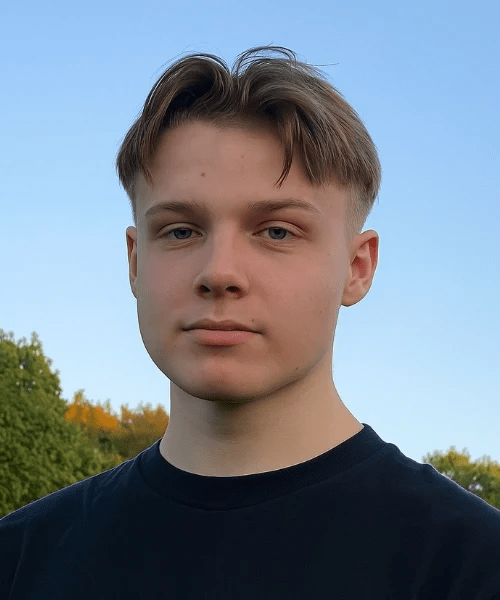
The most popular barbershop combination in 2026. A mid-fade on the sides starting at the temple with a full curtain top above. The fade adds sharp modern contrast, while the curtain fringe keeps the length and movement that define the style.
Tell your barber, “Middle part with a mid fade. Temple start. Number 1.5 at the lowest. Five inches on top point-cut for movement. Natural center part.”
Length needed: Five inches on top.
Maintenance: Every 3-4 weeks for the fade, 5-6 weeks for the top.
For the full mid-fade guide, our mid-fade haircut page covers every variation.
Korean Middle Part

The K-pop-inspired version. Softer, lighter, and slightly airy at the fringe rather than heavy or blunt. Clean outline. Volume at the crown rather than flat weight. The two-block side structure closely cropped sides with a clear distinction from the long top frames of the Korean middle part specifically.
Tell your barber, “Korean middle part. Two block sides with a short but soft transition, not an undercut line. Six to seven inches on top. Air fringe light point-cutting, not heavy. Volume at the crown. Blow-dry upward at roots.”
Length needed: Six to seven inches.
Hair type: Straight to slightly wavy holds the Korean volume shape most naturally.
Style time: 5-7 minutes blow-dry upward at roots, lightweight mousse.
For the full two-block guide, our two-block haircut page covers the Korean side structure in dedicated depth.
Middle Part with Low Taper
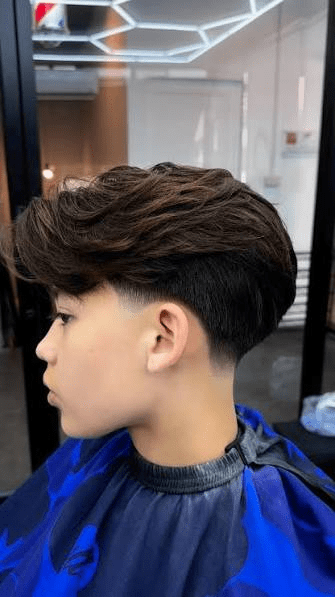
The most professional and office-appropriate version. The sides are tapered with no skin exposure anywhere. The overall look is clean and intentional without being bold or unconventional. The version for men who want a middle part that passes every professional environment.
Tell your barber, “Curtain cut with a low taper. Low taper on the sides of number 2, no skin. Four to five inches on top of point-cut fringe for natural movement. Office appropriate.”
Office safe: Yes, in every environment.
School safe: Yes, universally.
Maintenance: Every 5-6 weeks the most forgiving grow-out of any version.
For the full low taper guide, our low taper fade page covers the conservative side treatment.
Middle Part Undercut
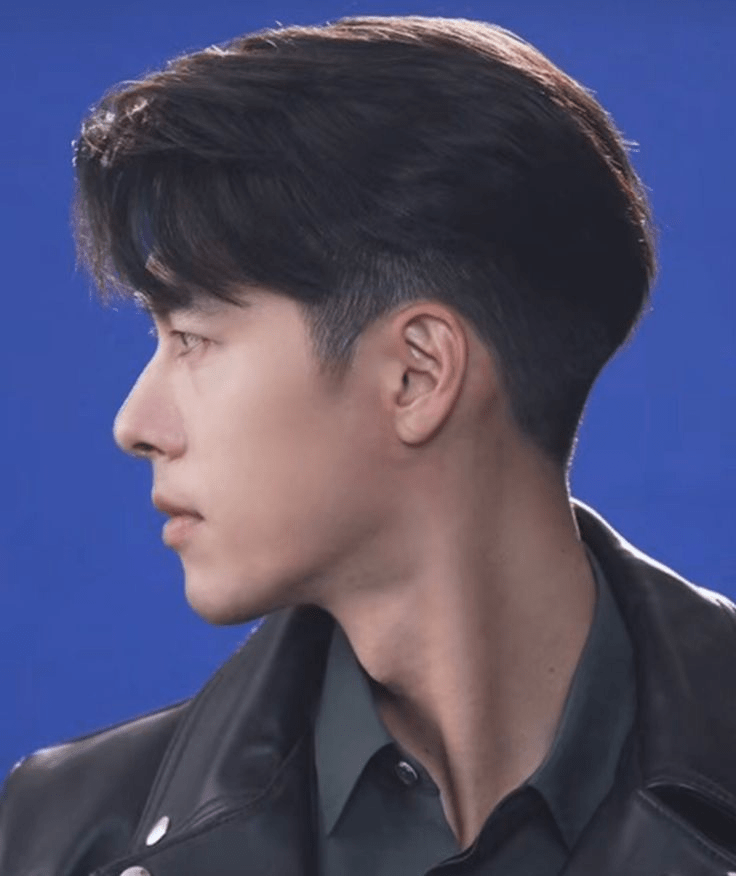
A high-contrast version where the sides are closely cut in an undercut structure, a deliberate disconnection between the long curtain top and the closely cut sides. The curtain fringe is the main visual event because the sides provide no visual competition.
Tell your barber, “Middle part with a disconnected undercut. Sides short with a visible disconnection from the top. Six inches on top for the curtain flow. Soft disconnection, not razor sharp.”
Length needed: Six inches for the full curtain effect.
Hair type: Straight and thick holds the disconnect structure best.
Short Middle Part Curtains
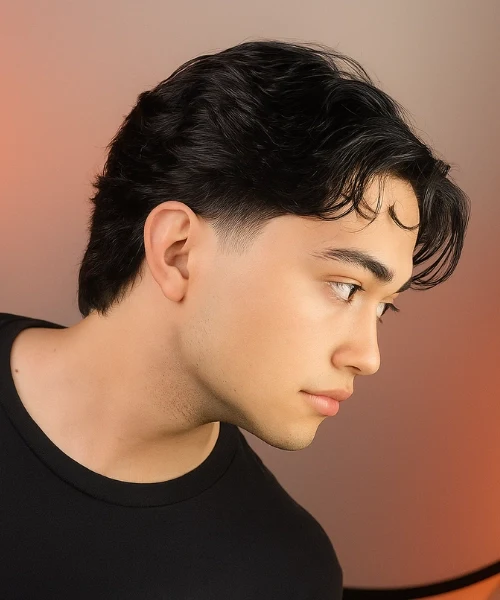
The entry-level version for men with two to three inches on top. The fringe sits at the eyebrow or just below. The curtains are short and close to the face rather than flowing past the cheekbone. The most low-maintenance and wearable starting point works while growing out to a longer version.
Tell your barber, “Short curtain cut. Keep two and a half to three inches on top enough for a center part and curtains at eyebrow level. Scissor-cut sides. Point-cut fringe.”
Length needed: Two and a half to three inches.
Maintenance: Every 4-5 weeks.
Style time: 2 minutes.
Textured Middle Part
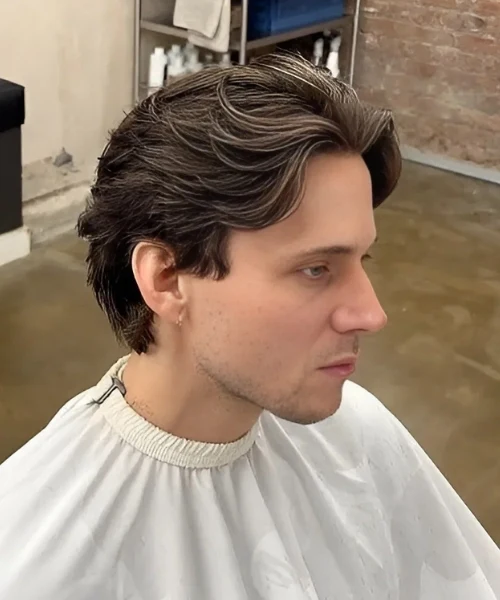
Heavy point-cutting throughout the top section creates visible separation and movement in the curtains. Rather than smooth, flowing curtains, the textured version has choppy, separated pieces that move independently. A more dynamic and current version of the classic.
Tell your barber, “Textured middle part. Heavy point-cutting throughout the top—I want visible separation in the curtains, not smooth and flat. Five inches on top. Scissor sides or low taper.”
Style time: 3-4 minutes. Matte clay, work through damp hair.
For the point-cutting technique, our textured crop guide covers the method in full depth.
Middle Part Wavy Hair
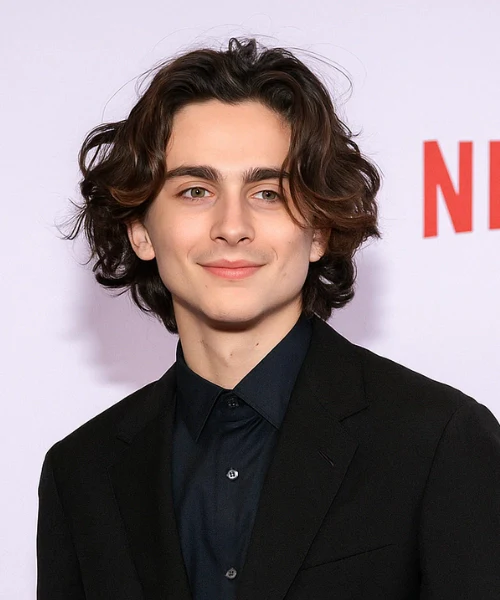
The most effortless version of the middle part. Natural wave creates texture, volume, and movement without any product or technique effort. Sea salt spray on damp hair, scrunch forward, air dry. The middle part falls into place as the hair dries because the wave naturally distributes weight evenly from the center.
Tell your barber, “Middle part for wavy hair. Five to six inches on top leave the natural wave to work. Soft layering to remove weight without shortening the curtains. Scissor sides or low taper.”
Style time: Sea salt spray, scrunch forward, air dry. Zero effort.
Middle Part Curly Hair
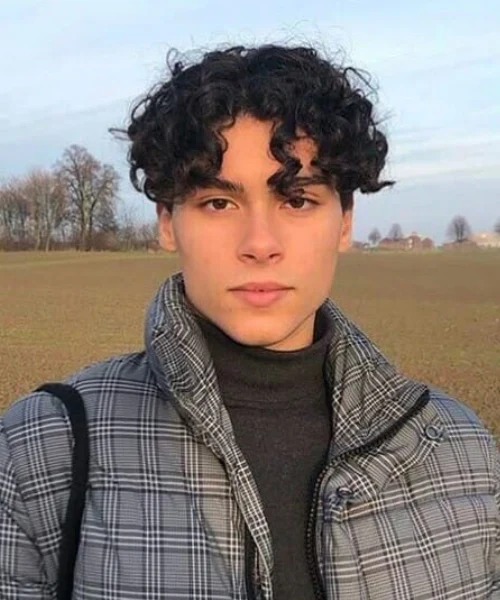
Curly hair produces one of the most distinctive middle-part results; the natural curl volume creates dimension and movement that straight hair requires product to achieve. The dry-cut rule applies without exception. Curly hair shrinks significantly when wet, and a wet cut produces a shorter result than intended.
Tell your barber, “Middle part for curly hair. Please cut the top section dry; my curls shrink when wet. Keep four to five inches on top dry. Part while damp and let the curls dry naturally.”
Style time: Curl cream on damp hair, part with fingers from the center, and diffuse or air dry.
For the complete curly guide, our curly hairstyles page covers types 2A through 4C.
Middle Part Straight Hair
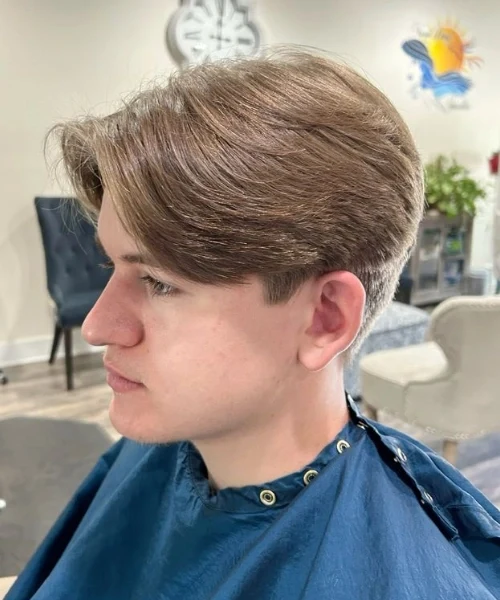
The most common type and the most tutorial-heavy version on TikTok. Straight hair gives the cleanest, most precise curtain lines because the consistent strands lie flat and the blow-dry direction holds throughout the day. The blow-dry technique is essential for straight hair; without root lift, it produces flat, heavy curtains rather than the airy, forward-falling shape.
Tell your barber, “Classic middle part for straight hair. Five to six inches on top. Scissors only on the top section point-cut for some texture. Low taper or scissor sides.”
Style time: 4-5 minutes. Blow dry upward at the roots, then forward, cool shot, and matte paste.
E-boy Middle Part
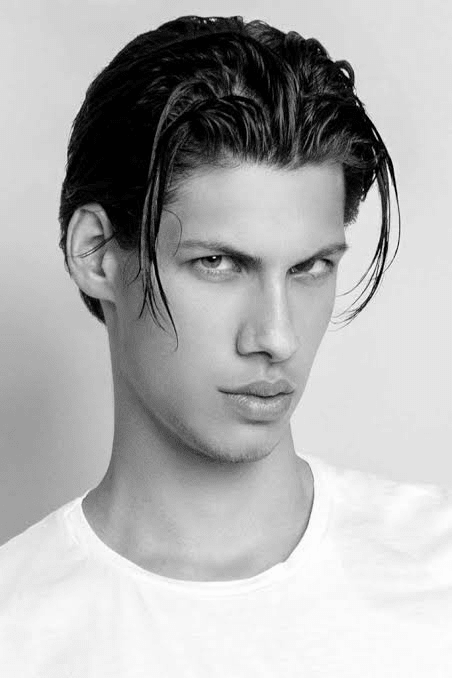
The TikTok-popularized version. A defined, deliberate center part with a clean curtain fringe, slightly textured or with a relaxed finish that reads as intentionally styled rather than naturally falling. The e-boy middle part is more defined and precise than the messy version; the part is clear, and the curtains sit symmetrically.
Tell your barber, “E-boy middle part. Clean curtain fringe five to six inches on top. Clear center part definition. Scissor sides or low taper. Slightly textured finish.”
Style time: 3 minutes—light pomade or texture paste on damp fringe.
Messy Middle Part
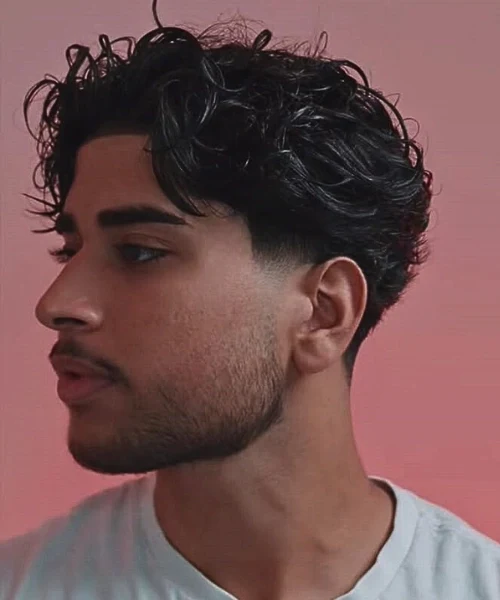
The lived-in version. Heavy layers throughout the top section create a deliberately undone result. The curtains are loose and fall unevenly rather than symmetrically. Sea salt spray and air-drying do everything. The version for men who want the middle part aesthetic without any morning effort.
Tell your barber, “Messy middle part. Heavy layers throughout the top—I want a lived-in, undone look. Natural movement and unevenness are intentional. Six inches on top. Scissor sides.”
Style time: Sea salt spray, scrunch forward, air dry. Done.
Long Middle Part Flow
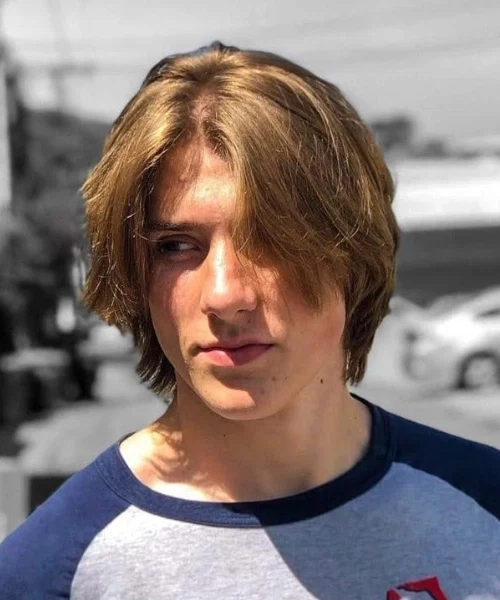
Shoulder length or longer on top, with the middle part falling naturally because the length itself provides the weight and direction. The least-effort version of long hair simply falls into a middle part without any training or technique because the weight does the work.
Tell your barber, “Keep the length. Trim the ends by an inch for health. Clean the neckline. I am growing for a long middle part; do not shorten the top.”
Maintenance: Every 8-10 weeks, the longest between-visit cycle of any version.
For the full long-hair strategy, our boys’ haircuts are long on the top page, covering the grow-out maintenance method.
Middle Part with Curtain Bangs
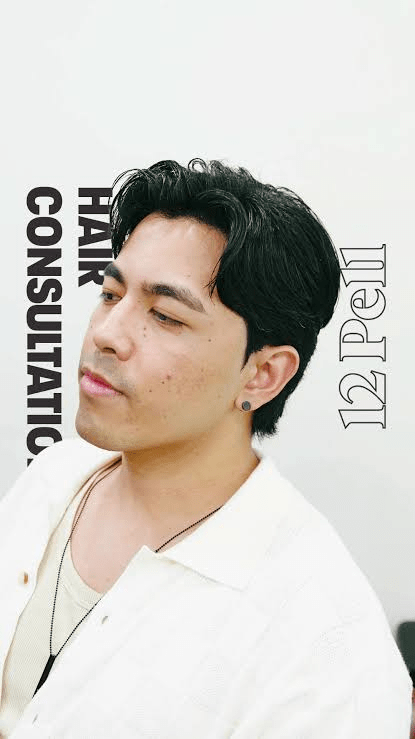
The curtain bang version places specific emphasis on the fringe as a styled element; the bangs are defined, weighted, and fall symmetrically as deliberate curtains rather than loosely. The crown section behind the bangs has more texture and movement.
Tell your barber, “Middle part with curtain bangs. I want the fringe specifically shaped and weighted symmetrical curtains at cheekbone level. Heavy weight in the fringe, texture behind it in the crown. Low taper or scissor sides.”
Style time: 3 minutes. Blow-dry bangs forward symmetrically, light hold.
For the fringe technique, our textured fringe guide covers the fringe shaping method.
Slicked Back Middle Part
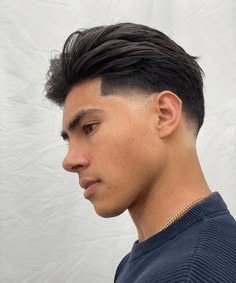
The formal version. The top is slicked slightly backward after the part is set, creating a polished, intentional finish. Most professional reading of all middle part versions. The part is present, but the hair is directed backward rather than hanging forward in curtains.
Tell your barber, “Middle part slicked back. Five to six inches on top—enough length to slick back from the part. Clean mid fade or scissor sides. I want a polished, formal finish.”
Style time: 3 minutes. Pomade on damp hair, comb backward from the center part.
Middle Part with Wolf Cut
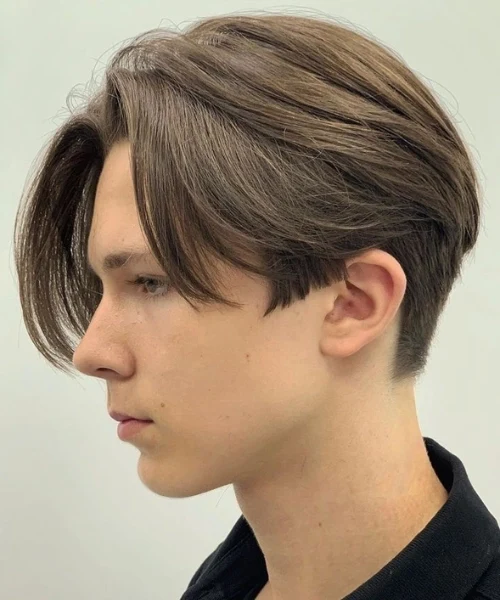
The wolf cut’s short crown layers and longer sides and back create natural volume and movement that complements the middle part structure. The two styles share an aesthetic of natural texture, movement, and length and combine into one of the most requested TikTok combinations in 2026.
Tell your barber, “Middle part with wolf cut layering. Short crown layers for lifting two to three inches. Longer sides and back at four to five inches. Natural center part. Point-cut throughout for movement.”
For the full wolf cut technique, our wolf cut men guide covers the layering method.
Blunt Cut Middle Part
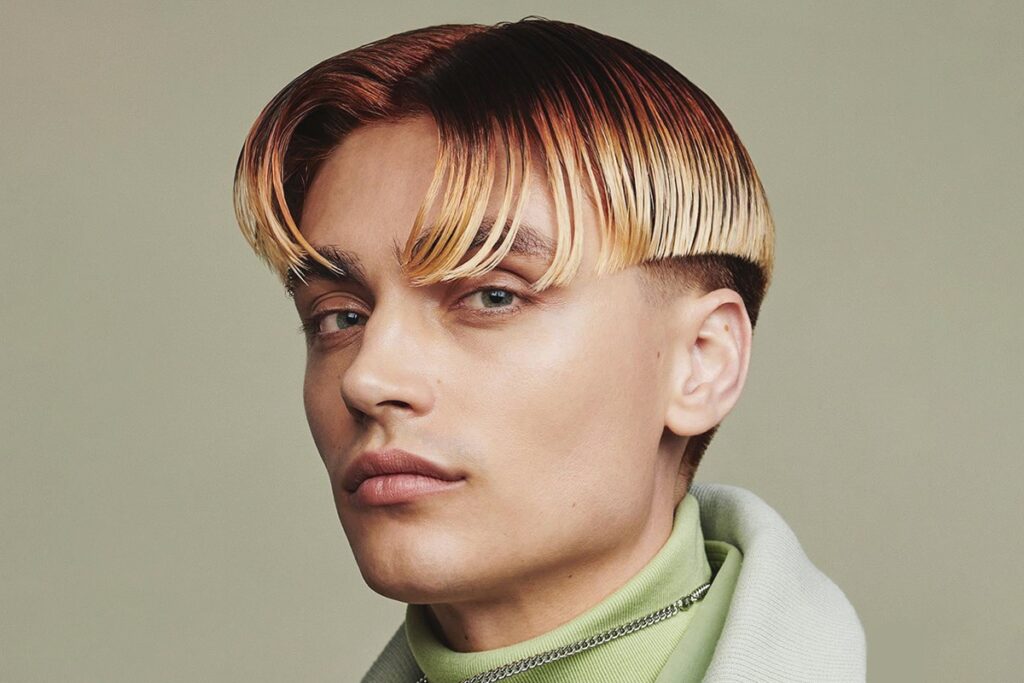
A precise, one-length fringe cut straight across at a uniform length. The ends are blunt rather than point-cut, with a sharp horizontal line at the bottom of the curtains. Best on straight hair where the blunt line reads as crisp and intentional.
Tell your barber, “Blunt cut middle part. One-length fringe cut straight across, with no point-cutting at the ends. I want a sharp horizontal line. Scissor sides only. Straight hair: the blunt line needs to be precise.”
Hair type: Straight only. A blunt line on wavy or curly hair produces a heavy mass rather than a crisp edge.
Middle Part Skin Fade
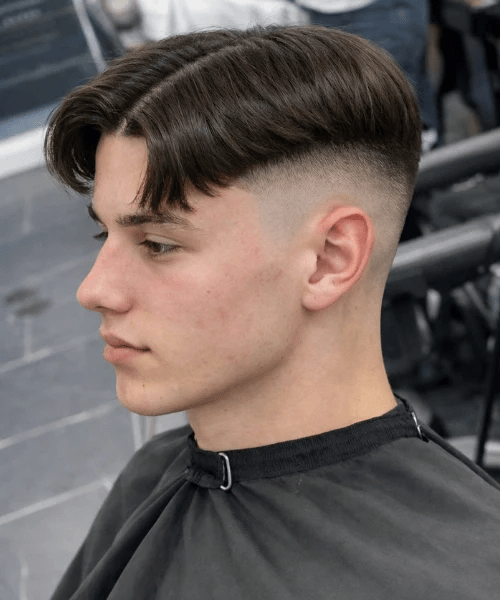
Maximum contrast. A skin fade on the sides with a long curtain top. The bare skin at the lowest section and the full-length curtain above create the most dramatic version of the middle part. StyleX Magazine August 2026 describes this as a sharp contrast that adds structure, while the middle part keeps the look current.
Tell your barber, “Middle part with skin fade. Low to mid skin fade temple start, zero at the lowest. Five to six inches on top for the curtain shape. Natural center part.”
Maintenance: Every 2-3 weeks for the fade, the most frequent of all versions.
For the skin fade guide, our skin fade haircut page covers the grow-out reality.
Middle Part for Boys and Teens
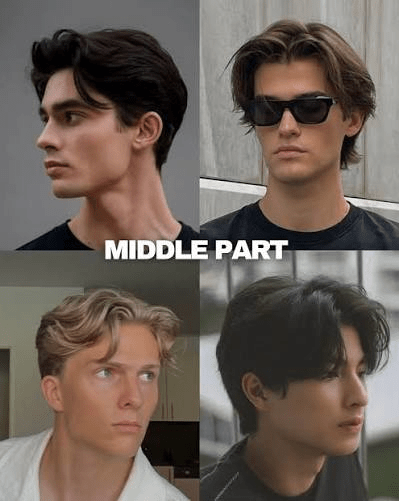
The middle part is the defining primary school-to-teen boys’ style of 2026. Popees Baby Care confirmed it as the leading style for ages seven to fourteen. For boys aged seven to ten, short curtains at two to three inches, low taper sides, and sea salt spray rather than gel. For teens aged eleven to eighteen—a full four- to five-inch version with low to mid fade.
Tell your barber (for boys): “Middle part for an [age] year old. Low taper on the sides. Keep [X] inches on top for the curtains. Sea salt spray styling, no gel. School appropriate.”
For the full age guides: our teen boy haircuts page and boys’ haircuts hub.
Conservative Office Middle Part
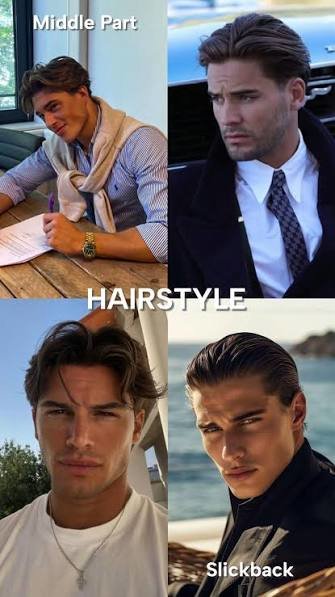
Short curtains three to four inches with a low taper and no skin. The fringe sits just above or at the eyebrow rather than flowing to the cheekbone. Polished and current without being trendy. Passes every professional environment.
Tell your barber, “Curtain cut, conservative version.” Three to four inches on top, fringe at eyebrow level. Low taper number 2, no skin. Point-cut fringe for natural movement. Office appropriate.”
Office safe: Yes, in every environment.
Maintenance: Every 5-6 weeks.
The Grow-Out Guide From Fade to Middle Part
This is the question Reddit keeps asking. “M23, any guide for a proper middle part hairstyle?” “How to style the middle part.” “Advice with flow in the middle part.” The grow-out phase is the real challenge, and nobody gives the specific month-by-month guide.
The Awkward Phase Is Real Here Is What to Expect
The awkward phase lasts two to four months depending on starting length. If you are starting from a mid fade with one inch on top, the path to a five-inch curtain is approximately four to five months. There is no shortcut. There is a way to manage it that makes it look intentional rather than neglected.
Month-by-Month Guide
Month one: One to two inches on top. Too short to part or style as a middle part. Keep the sides short with a low taper. Use a light clay to push the fringe forward in the direction the middle part will eventually fall. Nothing to do but grow. Do not cut the top.
Month two: Two to three inches. The first center part is possible, but the curtains are very short. This is the short curtain version, not the finished result, but a real style in its own right. Ask the barber to trim only the neckline and nothing else. Tell them explicitly: do not touch the top.
Month three: Three to four inches. The middle part is functional and looks intentional. The curtains reach the cheekbone or just below. This is when most men book the first proper curtain-specific appointment and ask the barber to shape the fringe for the first time.
Months four to five: Four to five inches. The full classic middle part is achievable. The fringe falls past the cheekbone. The Korean version is possible at this length. Book the full curtain appointment here.
Months six and beyond: Five inches and above. Every variation on this page is achievable. The long flow version needs six to eight months from a short starting cut.
What to Tell the Barber at Each Stage
Months one to two: “Don’t cut the top at all. Trim only the neckline. I am growing for a middle part.”
Month three: “Leave the top completely alone. Low taper on the sides only. Still growing.”
Months four to five: “I have enough length for a curtain cut now. Shape the fringe for the first time point-cut for movement. Low taper or scissor sides.”
Months six and beyond: “Middle part curtain haircut. Standard shaping.”
Does a Middle Part Need to Be Cut Into Place by a Barber?
Reddit asks this directly, and the answer is yes, eventually, a skilled scissor barber makes a significant difference.
During the first three months of growth, the barber can only trim the sides while the top grows. There is not enough length to do curtain-specific shaping.
From month three onward, a barber who understands scissor cutting and internal weight removal produces a dramatically better result than clippers alone. The key technique is internal layering, removing weight from inside the top section rather than the surface, so the fringe falls forward naturally rather than sitting as a heavy flat mass. This requires a barber comfortable with scissors-only work on the top section.
What to ask: “I need internal weight removal through the top section scissor only, no clippers on the top. I want the fringe to fall forward naturally from the center part rather than lying flat.”
Products During the Grow-Out Phase
Sea salt spray adds texture and direction to growing hair that is too short to style properly. Apply to damp hair and use your hands to push the fringe forward in the center-part direction. This sets the habit and the direction simultaneously.
Light clay holds the fringe forward during the awkward phase when it is still short enough to want to fall sideways. A small amount through damp hair, pushed forward, is sufficient.
A hair band during exercise sets the forward direction and removes the temptation to sweep sideways during the sweaty phase. Consistent forward direction training accelerates the memory reset.
Can Everyone Pull Off a Middle Part?
The Honest Face Shape Guide
Oval face: The strongest match. The center split hits balanced against the oval bone structure with nothing to adjust. Every middle part version works.
Heart face: Excellent match. The center split balances a wider forehead. The curtain fringe covers the temple area, reducing the visual width at the top and creating proportion with the narrower chin.
Round face: Works well with one adjustment. Add height at the crown rather than letting the curtains fall completely flat. A slight blow-dry lift at the roots before the fringe falls forward adds vertical proportion that round faces benefit from.
Oblong face: Works best with shorter curtains at the eyebrow rather than the cheekbone. Very long flowing curtains add further length to an already long face. Keep the fringe shorter and add width with a softer, slightly more voluminous side treatment.
Square face: Works with the textured version. The point-cut, soft-edged textured middle part suits square faces better than the blunt cut; the soft irregular edges of the textured version complement angular jaw structure rather than emphasize it.
Diamond face: A good match. The curtain fringe balances prominent cheekbones by providing visual coverage at the forehead and drawing the eye inward toward the face rather than outward to the cheekbones.
Is the Middle Part Working for Me?
Reddit asks this regularly, and the honest answer depends on four questions.
Does the fringe fall to the same length on both sides naturally, without you actively holding it in place? If not, the hair is not long enough yet or needs training.
Does it reach at least nose level when you pull it toward your face? If not, grow more before attempting the style seriously.
Do the curtains frame your cheekbones when they fall naturally? If yes, the face shape suits the style.
Does it require a mirror check every hour to look right? If yes, either the length is wrong, the product is wrong, or it needs a scissor appointment for internal weight removal.
If the answer to the fourth question is yes, the most likely fix is a barber who removes internal weight from the top section so the curtains fall forward naturally rather than needing active redirection throughout the day.
Middle Part vs Side Part Which Is More Attractive?
Neither is universally more attractive. The answer depends on face shape more than personal preference.
The middle part suits oval, round, oblong, and heart faces and the symmetry of the center split, working with faces where the proportions benefit from balance and symmetry.
Side parts suit square, diamond, and heart faces; the asymmetry of a side part adds angular interest to faces with strong structure.
If the face shape argument is neutral, the current cultural moment gives the middle part the edge; it is significantly more requested in 2026 than the side part across every age group from thirteen to forty.
How to Ask Your Barber for a Middle Part Haircut
The Four Things to Specify
Length on top in inches, state it numerically. “Five inches on top” is clear. “Medium length” is not.
Side treatment: taper, fade, or scissors. Each produces a different silhouette. Specify which.
Fringe weight blunt or point-cut. Blunt creates a sharp line. Point-cut creates natural movement. Most modern middle parts use point-cut.
Movement is textured or smooth. Heavy point-cutting produces textured separation. Minimal cutting produces smooth-flowing curtains.
The Universal Script
“Middle part curtain haircut. Keep five inches on top; I want the fringe to fall to cheekbone level. Low taper on the sides. Point-cut the fringe for natural movement, not blunt. Scissor only on the top section.”
Scripts Per Variation
Classic: “Middle part five inches on top, scissor sides, point-cut fringe, natural center part.”
Korean: “Korean middle part two block sides, six to seven inches on top, airy light fringe, volume at crown.”
With fade: “Middle part with mid fade temple start, number 1.5, five inches on top, natural center part.”
Professional: “Curtain cut low taper, no skin, four inches on top, eyebrow-level fringe, office appropriate.”
Messy: “Messy middle part heavy layers throughout, natural movement, six inches on top, nothing precise.”
Short entry: “Short curtain cut three inches on top, eyebrow-level fringe, scissor sides.”
The Right Barber for a Middle Part
Not every barber produces the same result on a middle part. The crucial technique of internal weight removal through the top section using scissors requires a barber comfortable with scissors-only work on the top. Barbers trained primarily in clipper fades sometimes approach the top section with the same clipper-heavy technique, and the result is a flat, heavy curtain that requires constant product to stay forward.
What to look for in a barber’s portfolio: middle part clients, curtain cuts, and scissor work on top sections. Korean-style barbers and scissor-specialist stylists consistently produce the best middle part results because their training centers on this type of work.
How to Style a Middle Part
Start with damp hair. Part with fingers from the center, not a comb at this stage.
Blow dry the fringe forward and away from the face on both sides simultaneously. Not straight down forward off the forehead, creating the natural fall direction. Use medium heat for sixty seconds, then a cool shot to lock the direction in place.
Apply sea salt spray or matte paste with fingertips rather than palms. Fingertip application deposits product only where touched, avoiding the overloaded fringe that makes curtains lie flat.
The most common mistake is using too much product. The best middle part should still move.
Middle Part by Hair Type
| Hair Type | Best Version | Key Instruction | Daily Effort |
|---|---|---|---|
| Straight | Classic or Korean | Blow-dry forward roots first. | Low |
| Wavy | Messy or textured | Sea salt spray, air dry | Zero |
| Curly | Curly curtains | Cut the top section dry always. | Low |
| Thick | Textured or wolf cut | Internal weight removal is essential. | Medium |
| Fine | Short curtains | Light product only, no pomade | Low |
Middle Part on Straight Hair
The most precise result—the clean lines read as intentional from every angle. The blow-dry technique is the difference between flat heavy curtains and the airy, forward-falling version. Blow upward at the roots for thirty seconds, then forward for the fringe. Cool shot. Minimal matte paste to finish.
Middle Part on Wavy Hair
The easiest version to achieve. The natural wave creates texture and volume automatically. Sea salt spray on damp hair, scrunch gently forward toward the center part, and air dry. The wave does the rest.
Middle Part on Curly Hair
The dry-cut rule without exception. Curly hair can absolutely carry a middle part, and the result is distinctive; the curl adds volume and dimension that straight hair requires product to achieve. State the dry-cut instruction before anything else at the appointment.
For the complete curly guide, our curly hairstyles page covers types 2A through 4C.
Middle Part on Thick Hair
Thick hair without internal weight removal produces the helmet-shaped, heavy, flat-lying curtains that need constant product to stay forward. The fix is an appointment with a scissor barber who removes internal weight through the top section. Ask specifically: “Internal weight removal through the top scissor only; remove bulk from inside the section without shortening the surface length.”
Products for Middle Part Honest Guide
Product by Hair Type
Straight hair: matte paste or texture spray for hold without shine. Shine products on straight curtains look greasy within an hour.
Wavy hair: sea salt spray for texture and direction. Nothing heavier than the wave does the rest.
Curly hair: curl cream on damp hair before air drying or diffusing. No brushing after drying.
Thick hair: matte clay for control. Apply to damp hair, not dry. Start with a small amount and add gradually.
Fine hair: sea salt spray or texture powder at the roots. Light enough to add grip without weighing the hair down and collapsing the fringe.
Budget, Mid, and Premium Options
Budget under $12: Not Your Mother’s Sea Mist Sea Salt Spray ($8) for wavy and fine hair. Got2B Phenomenal Paste ($10) for straight hair control.
Mid-range $12 to $20: American Crew Fiber ($14) for medium hold on straight to wavy. R+Co Rockaway Salt Spray ($16) for wavy and textured versions.
Premium above $20: Oribe Dry Texturizing Spray ($44) for fine hair volume and texture. Moroccanoil Texture Clay ($24) for thick hair control with a natural finish.
What Not to Use
Heavy pomade makes the curtains lie flat and heavy within two hours of styling. Oil-based products add visible weight to the fringe. Heavy gel produces the stiff, 1990s version of the curtain that reads as dated rather than current.
The best middle part should still move when you turn your head. A product that prevents movement is the wrong product.
Middle Part for Boys and Teens
The middle part is the defining primary school and early teen style of 2026. The trend moved down from teenagers to boys aged seven to fourteen in 2026; a Popees Baby Care analysis from July 2026 confirmed this specifically.
Ages seven to ten: Short curtains at two to three inches. Low taper sides, no skin. Sea salt spray-only gel makes fine child hair look greasy and flat. School safe everywhere.
Ages eleven to fourteen: Standard four-to-five-inch curtains. Low- to mid-fade options. School-safe in all versions at this age.
Ages fifteen to eighteen: Full versions including Korean two-block and skin fade variants. School policy check for skin fade level. All other versions are school-appropriate.
For the full age guides: our teen boy haircuts page and boys’ haircuts hub.
Browse More Related Guides
For the Korean-influenced side structure, our two-block haircut guide covers the side treatment that drives Korean middle part searches.
For the layered version, our wolf cut men’s page covers the crown-layer structure that pairs with the middle part flow.
For the fringe technique, our textured fringe guide covers the point-cutting method in dedicated depth.
For the side treatments: our low taper fade page, mid fade guide, and skin fade page.
For curly hair: our curly hairstyles guide covers types 2A through 4C.
Not sure which version suits your face shape? Our teen haircut finder quiz takes sixty seconds.
Frequently Asked Questions
What haircut is good for a middle part?
Any haircut that leaves four to six inches of length on top works for a middle part. The scissor-blended side treatment with no fade, low taper, or mid fade determines the overall boldness. The textured crop, the wolf cut, the two-block, and the standard curtain cut all produce middle-part-compatible results. The key requirement is top length without four inches minimum; the curtains cannot form properly.
Why does Gen Z like middle parts?
Three forces brought it back, and Gen Z specifically owns it. K-pop groups made the curtain silhouette their signature after 2016. Timothée Chalamet gave it Hollywood legitimacy. The e-boy TikTok aesthetic gave it an edge. Beyond trends, the middle part functions as a generational identity marker, a deliberate departure from the side part that Millennials wore dominantly for over a decade.
Is the middle part of hair attractive?
Yes, when the length is right and the face shape suits it. The center split creates facial symmetry, which research consistently associates with attractiveness. The curtain fringe frames the cheekbones. At the nose-to-chin length range, the middle part looks deliberately intentional. At under-nose-tip length, it can read as growing out awkwardly rather than as a deliberate style choice.
What is that Gen Z haircut?
The Gen Z-defining men’s haircut in 2026 is the middle part, also called curtain hair. Alongside the wolf cut, textured crop, and blowout taper, the middle part has become the signature silhouette of Gen Z men’s style globally. The Korean variation with two-block sides is the most searched version among the sixteen-to-twenty-five age group.
How do I ask my barber for a middle part?
Specify four things: length on top in inches, side treatment, fringe weight, and movement level. The universal script: “Middle part curtain haircut. Keep five inches on top of the fringe to the cheekbone level. Low taper on the sides. Point-cut the fringe for natural movement. Scissor only on the top section.” Bring a front photo and a side photo.
What face shape suits a middle part?
Oval, heart, and round faces are the strongest matches. Oval is the most flexible; every version works. Heart face benefits from the center split balancing a wider forehead. Round face benefits from crown height added during blow-drying. Square and diamond faces suit the textured version with soft edges rather than a blunt precision cut. Oblong faces suit shorter curtains at eyebrow rather than cheekbone level.
Can everyone pull off a middle part?
Almost everyone can; what matters more than face shape is length and patience. The style needs enough length to fall naturally. Below nose-tip length, the middle part is not yet achievable. With the right length and face-shape-appropriate styling adjustments, the vast majority of men can wear a version of the middle part effectively. Round and square faces need the adjustment of crown height or textured softness, respectively.
Is the middle part still in style in 2026?
Yes. It is the most requested scissors cut in barbershops in 2026, and search interest has grown consistently from 2020 to the present. The Korean variation and the messy flow version are both growing in search volume in September 2026. The middle part is not trending and declining; it has become a staple.
How to style a messy middle part?
Sea salt spray on damp hair, scrunch gently forward toward the center part, and air dry. No blow dryer needed. No comb. The messiness is the result; any attempt to control it beyond the initial scrunch removes the intentional disorder that defines the style. If more hold is needed for the center split, a small amount of light paste on dry fingers pressed through the parting zone only.
What is the best length for a middle part?
Hair that reaches the nose tip when pulled straight down is the minimum for a functional middle part. Hair that reaches the chin when pulled straight down is ideal at this length; the curtains fall to cheekbone level and frame the face properly. Below the chin is the long-flow version. These are the three reference points: The nose tip is minimum, the chin is a full curtain, and below the chin is long flow.
Does the middle part of the hair need to be cut into place by a barber?
Yes, eventually. During the first two to three months of growing out, the barber can only trim the sides while the top grows. From month three onward, a scissor-specialist barber who understands internal weight removal produces significantly better curtains than clipper-only work. The key technique is removing weight from inside the top section so the fringe falls forward naturally rather than lying flat. Ask specifically for scissor-only work on the top section with internal weight removal.
Is the middle part working for me, or should I change it?
Four questions tell you: Does the fringe fall to both sides without you holding it? Does it reach nose level or beyond? Do the curtains frame your cheekbones? Does it look right without a mirror check every hour? If the answer to the fourth question is yes, constant redirection is needed—the likely fix is internal weight removal at a scissor barber appointment rather than abandoning the style.
Middle part vs side part which is better?
Neither is universally better. The middle part suits oval, round, heart, and oblong faces; the symmetry of the center split works with faces that benefit from balance. Side parts suit square and diamond faces; the asymmetry adds angular interest to faces with strong structure. In 2026 the middle part is significantly more requested than the side part across all age groups, but the right choice is the one that suits your specific face shape.
How long does it take to grow hair for a middle part?
From a short fade at one inch on top, reaching the five-inch curtain length takes approximately four to five months. The timeline: month one to two is too short; just grow. Month three—first short curtain version possible at two to three inches. Months four to five full classic curtain at four to five inches. Month six and beyond long flow version at five or more inches.
The middle part haircut formula is simple. Four to six inches on top. Center split. Curtains forward. The six months between a short fade and that result is the challenge nobody talks about honestly.
The month-by-month guide on this page covers that challenge specifically. The nose test tells you when you have enough length. The barber script gets you the right version first time. The product guide tells you what not to use as much as what to use.
K-pop pushed it. TikTok scaled it. Gen Z owns it. The men who wear it well in 2026 are the ones who understood the grow-out first.
For the Korean-influenced side structure, our two-block haircut guide covers the full method. For boys and teens, our boys’ haircuts hub covers every age from seven to eighteen.